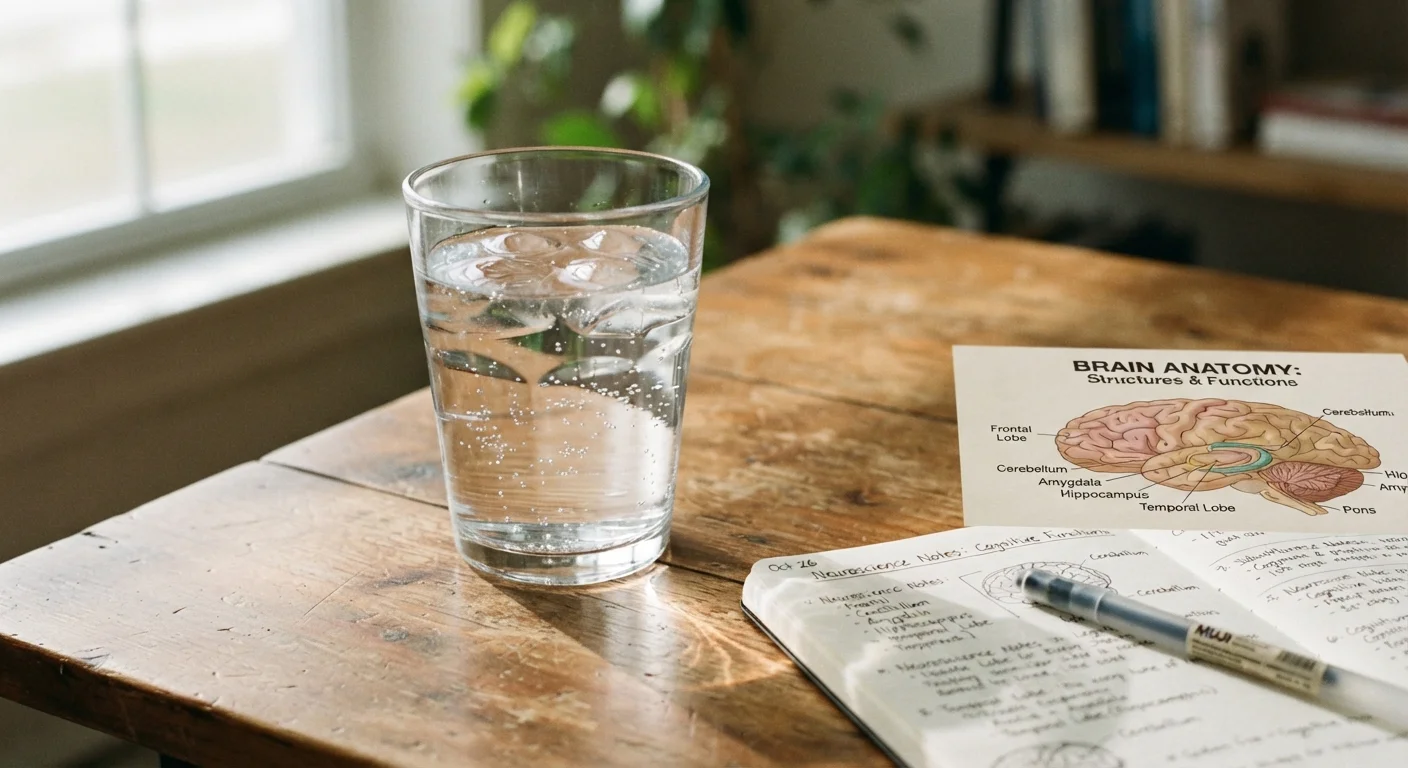

Why Hydration and Cognition Belong in the Same Conversation
Water accounts for roughly 75% of brain tissue by weight, and the brain is extraordinarily sensitive to changes in that proportion. Despite this, most discussions of diet and mental performance focus on nutrients - omega-3 fatty acids, B vitamins, antioxidants - while overlooking the most fundamental substrate of all. Fluid intake rarely receives the same attention, yet the evidence connecting it to everyday thinking and mood has grown substantially over the past two decades.
This overview is designed as a grounded starting point. It explains what current research supports, where the evidence has real limits, and what that means for building practical habits. For a deeper look at the underlying neuroscience, see the cognitive science of hydration. And if you're interested in how nutrition more broadly intersects with emotional health, diet and mood: the whole picture provides useful context.
~1-2%
Fluid loss linked to cognitive impairment
Research published in nutrition and cognitive science journals indicates this level of body-fluid deficit - easily reached in daily life - is associated with measurable attention and memory decrements.
75%
Brain tissue composition by weight
The brain's high water content makes it particularly sensitive to even modest fluctuations in overall body fluid balance.
~20%
Of daily fluid intake from food
Dietary sources such as fruits, vegetables, and soups contribute a meaningful share of total fluid intake alongside beverages.
What Mild Dehydration Actually Does to the Brain
Researchers define mild dehydration as a body-fluid loss of approximately 1-2% of body weight - a level easily reached through ordinary daily activity, warm environments, or simply forgetting to drink during a busy morning. At this threshold, the brain does not face a crisis, but performance on attention-demanding and memory tasks begins to slip in ways that are measurable under laboratory conditions.
Studies published in peer-reviewed nutrition and cognitive science journals have consistently found that mild dehydration is associated with slower reaction times, reduced working memory capacity, and a greater sense of mental effort required for tasks. These effects appear to be more pronounced in older adults and in children, whose thirst mechanisms and fluid regulation differ from those of healthy younger adults.
It is worth noting that thirst itself is a lagging signal - by the time you feel thirsty, some fluid deficit has already accumulated. This is the central practical argument for proactive rather than reactive drinking.
Don't wait until you're thirsty to drink - by that point, a mild cognitive deficit may already have begun. Building small, habitual drinking cues into your day is more effective than relying on thirst alone.
Thirst is a lagging indicator of fluid status; proactive intake patterns have been shown in hydration research to maintain steadier cognitive performance across the day.
Check your urine colour mid-morning as a quick, cost-free hydration check. If it's darker than pale straw, prioritise fluids before your next demanding cognitive task.
Urine osmolality correlates reliably with hydration status, and colour is a validated practical proxy accessible without any monitoring equipment.
Mood, Irritability, and Fluid Balance
Cognitive performance and mood are closely linked, and dehydration affects both through overlapping pathways. Even before concentration visibly declines, people commonly report increased feelings of tension, irritability, and fatigue when mildly fluid-depleted. These subjective changes are harder to quantify than task performance but appear reliably across multiple well-designed studies.
One plausible mechanism involves the relationship between dehydration and cortisol, the body's primary stress hormone. Some research suggests that fluid deficits may amplify the physiological stress response, lowering the threshold at which everyday pressures feel overwhelming. This connection is still an active area of investigation rather than settled science, and it is important not to overstate it.
Hydration also sits comfortably alongside other foundational mental wellness habits. Self-help foundations such as consistent sleep, movement, and social connection each contribute to emotional resilience - and adequate fluid intake supports rather than replaces those pillars. Similarly, the relationship between sleep hygiene and mental energy underscores how multiple basic physiological factors interact.
Mood Changes Have Many Causes
Persistent irritability, low mood, or fatigue should not be attributed to dehydration alone without ruling out other factors. While fluid status is worth addressing as a basic check, ongoing or severe mood disturbances warrant evaluation by a qualified healthcare professional. Hydration is a supportive measure, not a treatment for mood disorders.
What the Evidence Can and Cannot Tell Us
The science linking hydration to cognitive function is real and replicable, but it has meaningful limits worth understanding. Most experimental studies are short-duration, conducted in controlled laboratory settings, and use measures of fluid restriction that may not mirror real-world conditions. Effect sizes - the magnitude of the cognitive changes observed - are generally modest. Dehydration is unlikely to explain severe or persistent cognitive difficulties; those warrant professional evaluation.
Additionally, the research does not support the idea that drinking more water than your body requires will sharpen cognition beyond a normal baseline. Restoring adequate hydration corrects a deficit; it does not supercharge performance in a well-hydrated person. This distinction is important for keeping expectations realistic.
Hydration Does Not Boost Beyond Baseline
Drinking more water than your body requires does not enhance cognitive performance above normal levels in a person who is already adequately hydrated. The benefit of consistent fluid intake is the prevention of the performance deficit caused by dehydration - not the creation of a cognitive advantage. Misunderstanding this distinction can lead to unnecessary focus on water quantity at the expense of other, equally important health habits.
Individual variation also matters. Age, fitness level, climate, caffeine intake, certain medications, and underlying health conditions all influence both fluid needs and cognitive baselines. Blanket recommendations - including widely cited figures like "eight glasses a day" - are not grounded in strong evidence for universal application.
Practical Starting Points for Everyday Hydration
Given the evidence, the most useful goal is consistent, unremarkable hydration rather than precise measurement. Urine colour remains one of the most accessible proxies for hydration status: pale straw yellow generally indicates adequate fluid intake; dark amber suggests a deficit worth addressing.
A few habits with a reasonable evidence base include: drinking a glass of water on waking (overnight fluid loss is real, even without noticeable thirst); pairing fluid intake with existing routines such as meals and breaks; and keeping water accessible in work or study environments where it is easy to forget.
For how fluid needs shift across a busy day - with activity, heat, or stress - hydration and concentration across the day maps those changes in practical terms. And if you want structured strategies for building a consistent routine without obsessing over quantities, building a hydration routine that actually supports focus is the logical next step.
A Simple Daily Starting Point
Place a glass of water on your desk or workspace before you begin the day's first task. Visible, accessible water consistently increases fluid intake without requiring active tracking. Pair this with drinking a glass at each main meal and you will cover a meaningful portion of daily fluid needs through habit alone.
When to Look Beyond Water
For most people in ordinary daily conditions, plain water is sufficient to maintain cognitive hydration. The question of electrolytes - sodium, potassium, magnesium, and others - becomes relevant in specific circumstances: prolonged or intense physical activity, significant heat exposure, illness involving fluid losses, or situations where food intake is very low.
Electrolytes are minerals that carry electrical charges and play roles in nerve signalling and fluid balance at the cellular level. Their relevance to everyday cognitive performance is often overstated in popular media but genuinely meaningful in the contexts described. Electrolytes, plain water, and cognitive performance examines this distinction carefully.
Caffeine, a common daily fluid source for many people, deserves a brief note. In moderate amounts it supports alertness, but it has a mild diuretic effect and can contribute to fluid imbalance if consumption is high and water intake is low. This does not mean coffee or tea should be avoided - only that they are not equivalent to water for hydration purposes.
For those interested in the broader nutritional picture of brain health, the omega-3 and brain hub offers a complementary perspective on nutrient-level influences on cognition and mood.
This article is for general informational and educational purposes only and does not constitute medical advice. Individual health circumstances vary. Please consult a qualified healthcare professional before making significant changes to your diet or if you have concerns about your cognitive health or fluid balance.