
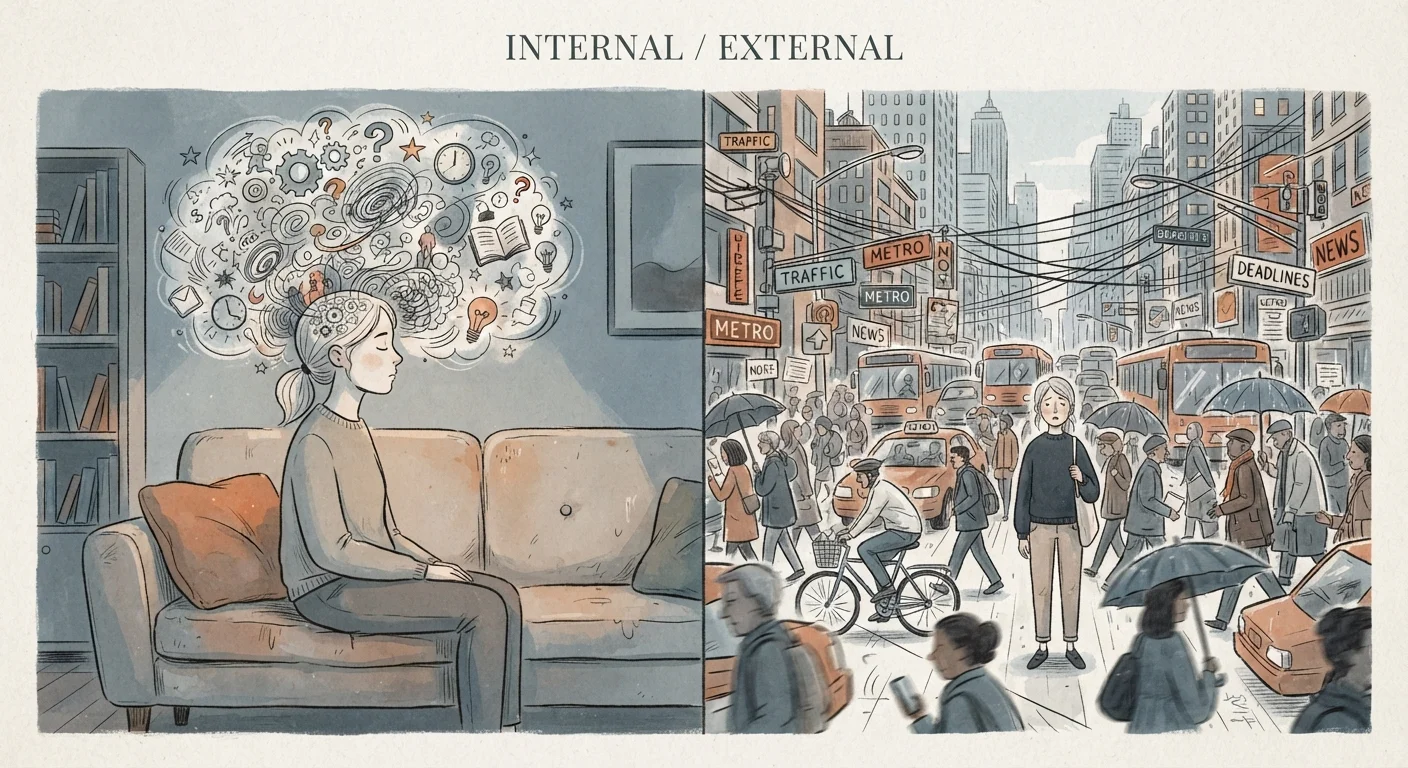
What Makes a Stress Trigger Internal or External?
When we talk about stress, it's easy to think purely in terms of what's happening around us — a demanding boss, a mounting pile of bills, a difficult relationship. These are external triggers: stressors that originate in your environment or circumstances. But a significant amount of stress is generated from within, through the way we think, interpret events, and talk to ourselves. These are internal triggers.
To understand what stress triggers really are at a foundational level, it helps to picture them as two streams feeding the same river. Whether the water comes from external rainfall or an internal spring, the river still rises. Your nervous system doesn't distinguish between a threat from the outside world and a threat perceived in your own mind — both activate the same fight-or-flight response.
Internal Triggers: Stress From the Inside Out
Internal stress triggers are rooted in your inner world: your beliefs, expectations, and habitual thinking patterns. Common examples include:
- Self-criticism and perfectionism — holding yourself to standards that feel impossible to meet
- Catastrophising — assuming the worst outcome is almost certain
- Uncertainty intolerance — feeling deeply unsettled by not knowing what comes next
- Negative self-talk — a running internal commentary that undermines confidence
- Unresolved guilt or shame — replaying past events and judging yourself harshly
What makes internal triggers particularly tricky is that they are portable. You can leave a stressful job, but if perfectionism or catastrophising travels with you, the stress follows. Research in cognitive psychology suggests that it is often our interpretation of events, rather than events themselves, that determines stress intensity.
Pause and Name the Trigger
When you notice stress building, try labeling what you're experiencing: 'This is a thought I'm having' versus 'This is something happening to me.' That small distinction can create enough mental space to choose how to respond rather than react automatically. Over time, this awareness becomes a genuine resilience skill.
External Triggers: Stress From the Outside In
External triggers are the circumstances, events, and people in your environment that place demands on you. They include:
- Work pressure — deadlines, conflict with colleagues, job insecurity
- Financial strain — debt, unexpected expenses, income uncertainty
- Relationship dynamics — conflict, poor communication, or feeling unsupported (see how hidden relationship stressors can quietly erode wellbeing)
- Major life events — moving home, bereavement, illness
- Environmental factors — noise, overcrowding, lack of safety
External triggers are often more visible and easier to name, which can make them feel more legitimate. However, not everyone responds to the same external pressures in the same way — a factor explored in depth in our look at why stress feels different from person to person.
| Internal Triggers | External Triggers | |
|---|---|---|
| Origin | Thoughts, beliefs, self-perception | Environment, events, other people |
| Examples | Perfectionism, self-criticism, catastrophising | Work deadlines, financial pressure, conflict |
| Visibility | Often hidden or subconscious | Usually obvious and identifiable |
| Portability | Travel with you regardless of setting | Tied to specific situations or places |
| Control | Can be shaped through mindset work | May be partially or fully outside your control |
| Common approach | Cognitive reframing, self-compassion | Problem-solving, boundary-setting |
How to Identify Which Type Is Affecting You
A useful starting point is to ask yourself: Would this feel stressful to most people in my situation, or mainly to me? If others in similar circumstances generally feel fine, your internal triggers may be amplifying the pressure. If the situation itself is objectively demanding, external triggers are likely dominant — though internal ones may still be intensifying your response.
Journaling can be a powerful tool here. When you notice stress rising, write down what triggered it and whether the stressor was something that happened to you or something that happened within you. Over time, patterns tend to emerge. It's worth noting that the source of stress also affects whether it becomes chronic — internal triggers left unexamined can quietly fuel long-term strain.
~70%
Stress linked to perception, not events alone
Research in cognitive behavioral psychology consistently indicates that a large proportion of stress responses are mediated by how individuals interpret events, not the events themselves.
1 in 3
Adults report work as a top external stressor
According to the American Psychological Association's recurring Stress in America surveys, work consistently ranks among the most commonly cited external stress sources for U.S. adults.
This article is for general informational purposes only and is not a substitute for professional medical or mental health advice. If stress is significantly affecting your daily life, please speak with a qualified healthcare professional.