
Anxiety Is Not One Thing
When people say they have anxiety, they could mean many different things. One person dreads social gatherings; another wakes at 3 a.m. cycling through worst-case scenarios; a third experiences sudden waves of intense physical terror that seem to come from nowhere. All of these are real forms of anxiety - and clinicians distinguish between them for good reason.
Understanding which type fits your experience matters because each has its own pattern, its own triggers, and its own most-supported treatment approaches. This overview introduces the main anxiety disorder categories recognised in contemporary clinical frameworks, translated into plain language for anyone just beginning to make sense of what they're going through.
This article is general health information, not medical advice. If you think you may have an anxiety disorder, please speak with a qualified healthcare professional.
| Anxiety disorders covered here | 4 main types: GAD, Social Anxiety, Panic Disorder, Specific Phobias (DSM-5 classification framework) |
| Prevalence of anxiety disorders in U.S. adults | Approximately 19% in any given year (National Institute of Mental Health (NIMH)) |
| Most common anxiety disorder | Specific phobias affect an estimated 12% of U.S. adults at some point (NIMH lifetime prevalence data) |
| Co-occurrence | Anxiety disorders frequently occur alongside other anxiety or mood disorders (APA clinical literature) |
| Core feature shared by all types | Excessive or persistent fear/worry that causes significant distress or impairment (DSM-5) |
| Age of onset | Many anxiety disorders first appear in childhood, adolescence, or early adulthood (NIMH) |
The Main Types at a Glance
The following are the most commonly recognised anxiety disorder categories. They share the feature of excessive or persistent fear and avoidance, but they differ significantly in focus and presentation.
Generalised Anxiety Disorder (GAD)
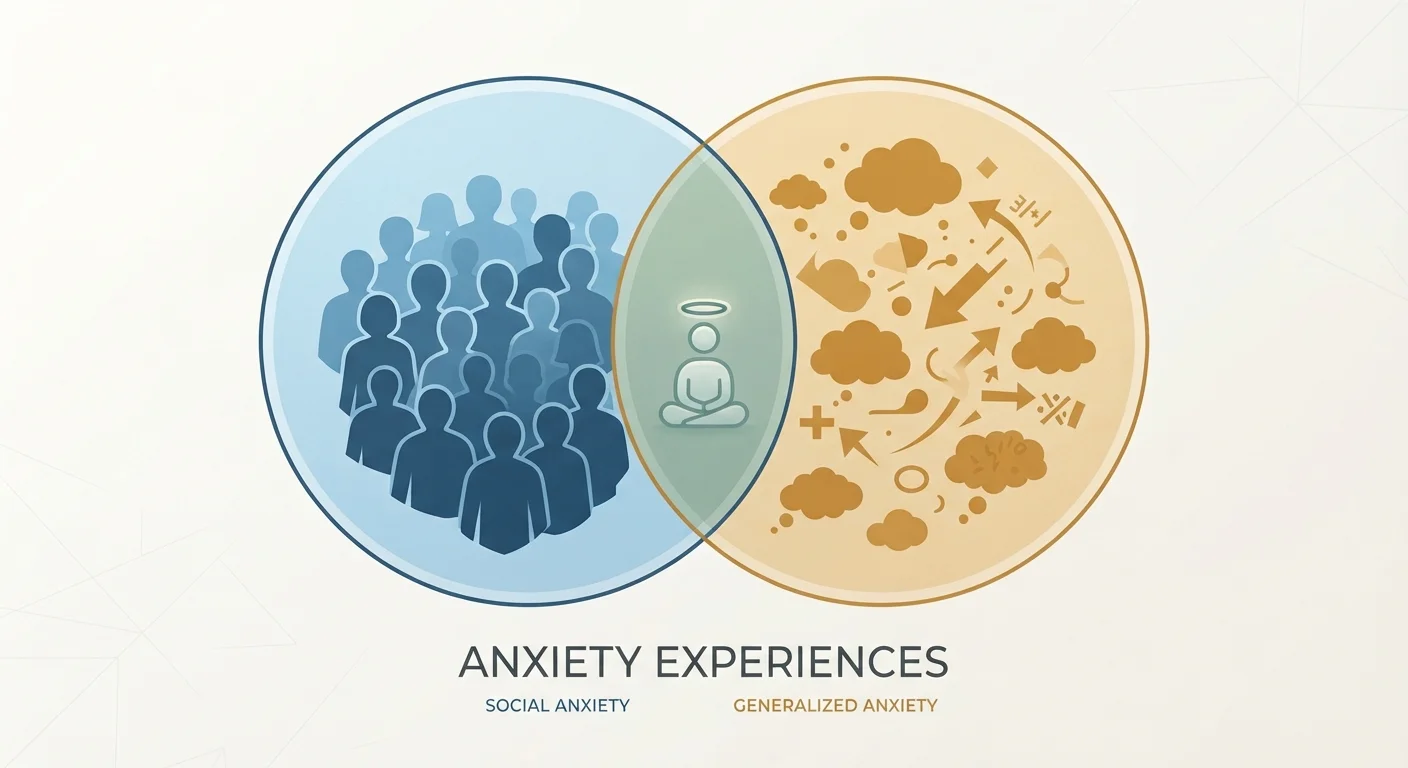
GAD is characterised by chronic, wide-ranging worry that is difficult to control and not tied to any single situation. A person with GAD might worry about health, finances, work, family, and the future - all at once, most days. Physical symptoms like muscle tension, fatigue, and disrupted sleep often accompany the mental restlessness. To learn more, see when worry becomes a disorder.
Social Anxiety Disorder
Social anxiety centres on an intense fear of being judged, embarrassed, or negatively evaluated in social or performance situations. Unlike shyness, social anxiety causes significant distress and can lead people to avoid work, school, or relationships. It differs from GAD in that the worry has a clear social focus - explore the distinction in depth at social anxiety vs. generalised anxiety disorder.
Panic Disorder
Panic disorder involves recurrent, unexpected panic attacks - sudden surges of intense fear accompanied by physical sensations such as racing heart, shortness of breath, dizziness, or a feeling of unreality. A key feature is persistent worry about future attacks and changes in behaviour to avoid them. The Panic & Phobias hub covers this condition in greater detail.
Specific Phobias
A specific phobia is a marked, disproportionate fear of a particular object or situation - animals, heights, flying, needles, blood, and many others. Exposure to the feared stimulus almost always triggers immediate, intense anxiety or avoidance. The fear is recognised by the person as excessive, yet feels uncontrollable. For a closer look at how phobias form and persist, visit the anatomy of a specific phobia. A breakdown of common phobia categories is also available at common types of specific phobias.
Generalised Anxiety Disorder (GAD)
A condition marked by persistent, wide-ranging worry about multiple everyday topics that is difficult to control and lasts for at least six months. It is typically accompanied by physical symptoms such as tension and fatigue.
Social Anxiety Disorder
An intense, lasting fear of social or performance situations where one might be judged or embarrassed. It goes well beyond ordinary shyness and often leads to significant avoidance of social settings.
Panic Disorder
A condition defined by recurrent unexpected panic attacks - sudden episodes of intense fear with prominent physical symptoms - along with ongoing worry about future attacks or their consequences.
Specific Phobia
A marked and disproportionate fear of a specific object or situation (e.g., spiders, heights, needles). Exposure to the feared stimulus almost always triggers immediate anxiety, and the person typically goes to lengths to avoid it.
Panic Attack
A sudden episode of intense fear that triggers severe physical reactions - such as rapid heartbeat, chest tightness, and dizziness - in the absence of actual danger. Panic attacks can occur in several anxiety disorders, not only panic disorder.
Avoidance
A behavioural pattern in which a person stays away from feared situations, objects, or feelings to reduce short-term anxiety. Over time, avoidance maintains and often worsens anxiety disorders.
Why the Differences Matter
These distinctions are more than diagnostic labels - they reflect genuinely different internal processes. GAD involves a generalised threat-monitoring system that rarely switches off. Social anxiety is driven by self-focused evaluation in relation to others. Panic disorder often involves a cycle of physical sensations being misread as catastrophic danger. Specific phobias are typically maintained by avoidance that prevents the fear from being updated with new, non-threatening information.
Because the mechanisms differ, the most evidence-supported approaches differ too. Understanding where your experience fits can help you have more productive conversations with a mental health professional and make the next step feel less overwhelming.
It is also worth knowing that anxiety disorders frequently co-occur - someone can have both GAD and social anxiety, for instance. And two people with the same diagnosis can have very different day-to-day experiences. Why anxiety can feel so different from person to person explores the biological, psychological, and environmental factors behind that variability.
Finally, the language around these experiences can itself be confusing - terms like fear, anxiety, and phobia are often used interchangeably in everyday speech but carry distinct clinical meanings. Sorting out the terminology offers a clear reference for anyone who wants to get the words right.
If you recognise yourself in any of these descriptions, reaching out to a licensed mental health professional is the most important next step. This content is for educational purposes only.
~19%
U.S. adults affected by an anxiety disorder each year
According to the National Institute of Mental Health (NIMH), anxiety disorders are among the most common mental health conditions in the United States.
~12%
Lifetime prevalence of specific phobias in U.S. adults
NIMH lifetime prevalence estimates indicate specific phobias are the most frequently occurring of the major anxiety disorder categories.
Only ~37%
Of those with anxiety disorders who receive treatment
The Anxiety and Depression Association of America (ADAA) notes that a significant majority of people with anxiety disorders do not receive professional care.