Why These Words Get Confused
In everyday conversation, fear, anxiety, and phobia are often used as synonyms. Someone says they have a "phobia" of public speaking when they mean they feel nervous. Another person describes intense worry as "fear." The casual overlap is understandable - all three involve distress - but clinically and experientially, they describe distinct things.
Getting the terminology straight matters because each concept points to a different mechanism, a different timeline, and a different level of impairment. Understanding which word fits your experience is the first step toward making sense of it. Anxiety takes many forms, and the vocabulary you use shapes the kind of help you look for.
| Fear vs. anxiety | Fear responds to a present, identifiable threat; anxiety responds to a future or uncertain one |
| Phobia classification | Phobias are anxiety disorders, categorized in the DSM-5 (American Psychiatric Association, DSM-5) |
| Prevalence of specific phobias | Roughly 12% of U.S. adults experience a specific phobia at some point (National Institute of Mental Health (NIMH)) |
| Panic attack duration | Symptoms typically peak within 10 minutes and subside within 20-30 minutes (NIMH) |
| Minimum phobia duration (DSM-5) | Symptoms must persist for at least 6 months to meet diagnostic criteria (DSM-5) |
Definitions Side by Side
The clearest way to distinguish these terms is to look at what triggers them and how long they last.
Fear
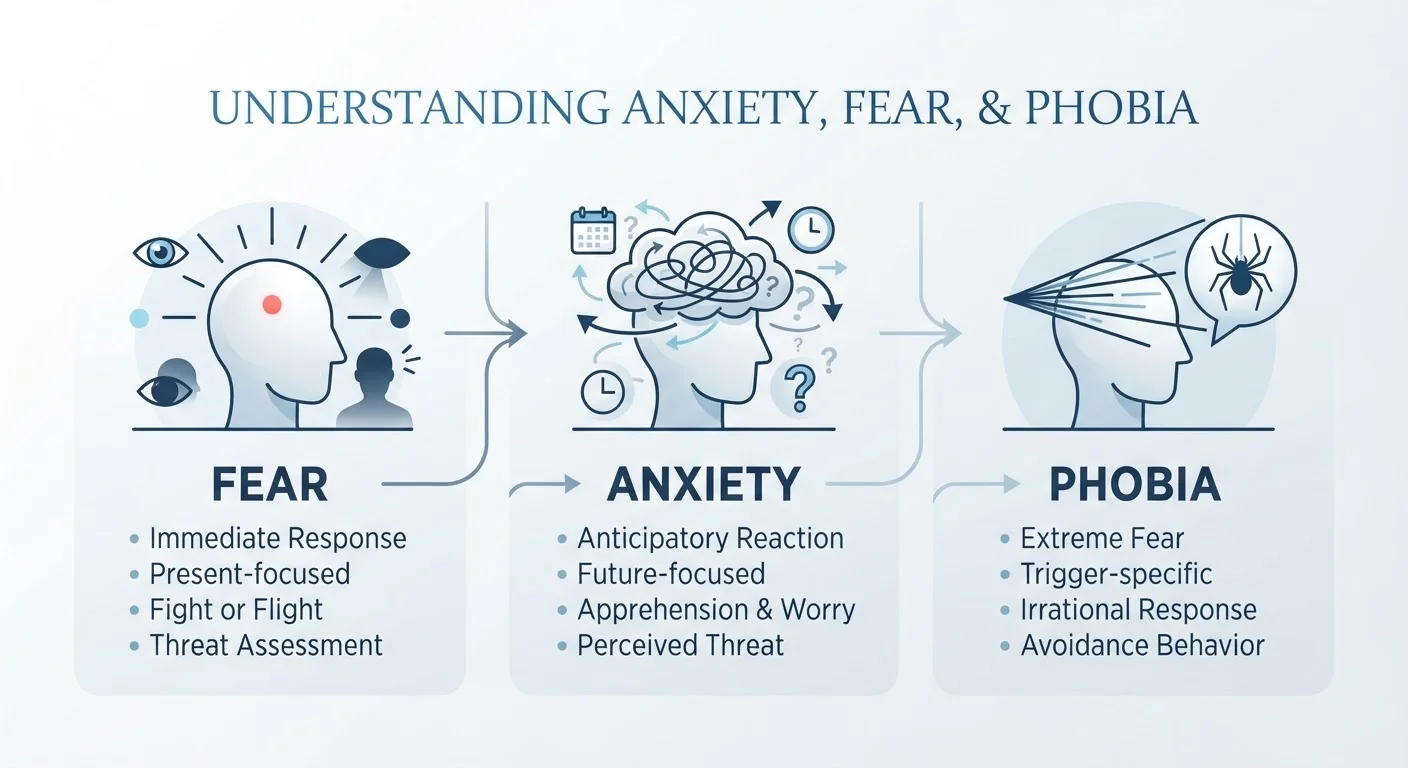
Fear is an immediate, present-tense response to something real and identifiable - a dog running toward you, a car swerving in your lane. The body's fight-or-flight response activates quickly and efficiently. Once the threat is gone, fear typically resolves. It is a normal, protective function of the nervous system, not a disorder.
Anxiety
Anxiety is oriented toward the future. It involves apprehension about what might happen rather than what is happening. The threat may be real but distant, exaggerated, or entirely uncertain. Because there's no single moment when the danger clearly passes, anxiety can persist long after - or even without - any concrete trigger. Generalized anxiety disorder is characterized by this kind of chronic, wide-ranging worry.
Phobia
A phobia is a diagnosable anxiety disorder in which fear of a specific object or situation is intense, persistent, and disproportionate to the actual risk involved. The person often recognizes the fear is excessive, but this awareness does little to reduce it. Avoidance is common, and it tends to make the phobia stronger over time. The DSM-5 requires symptoms to be present for at least six months and to cause meaningful distress or interference with daily life. See common types of specific phobias for a breakdown of major categories.
Fear
A normal emotional and physiological response to a real, immediate threat. It activates the body's fight-or-flight system and typically resolves once the danger passes.
Anxiety
A state of apprehension or unease about a perceived future threat. Unlike fear, anxiety is often anticipatory - the danger may be uncertain, exaggerated, or entirely imagined.
Phobia
An intense, persistent, and irrational fear of a specific object or situation that is disproportionate to the actual danger it poses. Phobias are clinically recognized anxiety disorders.
Panic Attack
A sudden surge of intense fear or discomfort that peaks within minutes, accompanied by physical symptoms such as a racing heart, shortness of breath, dizziness, or chest tightness.
Avoidance Behavior
Actions taken to prevent exposure to a feared stimulus. While avoidance reduces short-term distress, it typically reinforces and strengthens phobias over time.
Specific Phobia
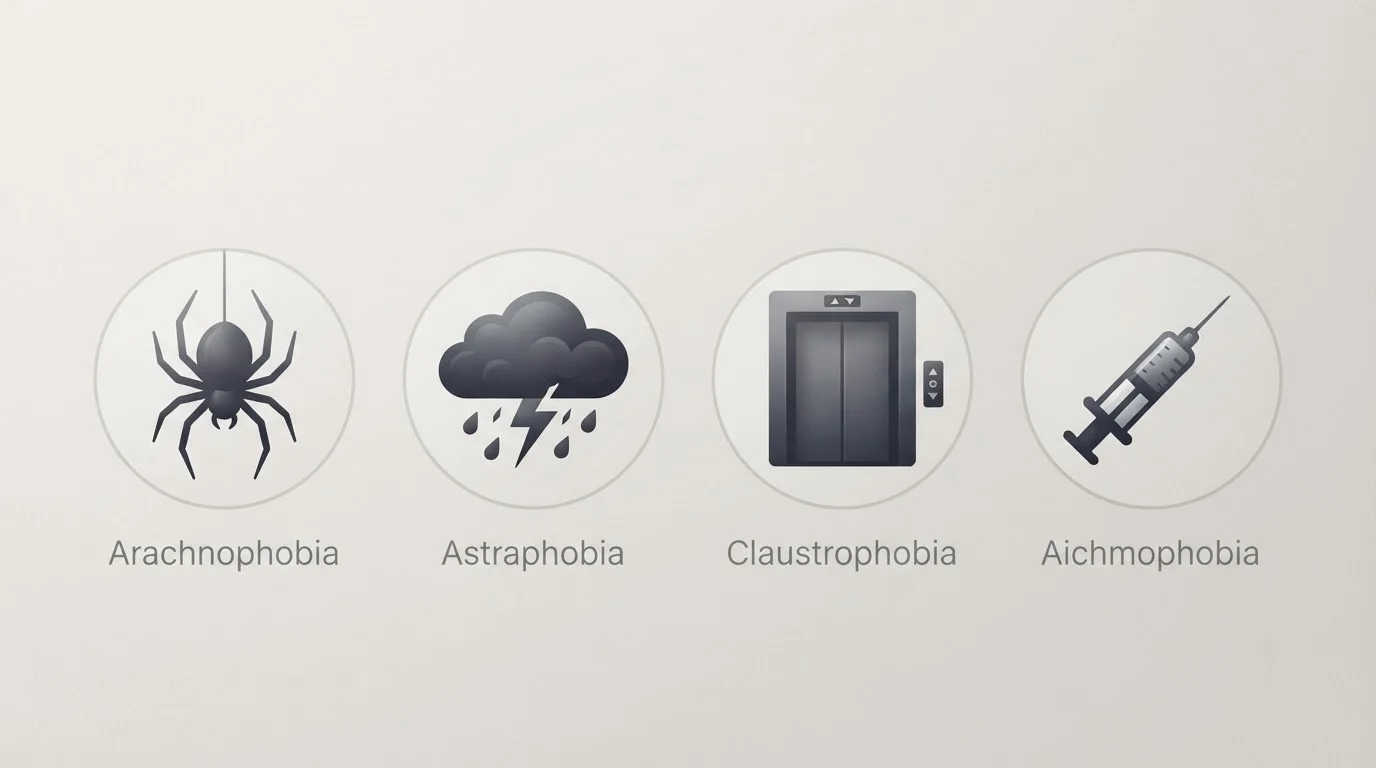
A diagnosable anxiety disorder involving marked fear or anxiety about a particular object or situation - such as heights, animals, or medical procedures - that causes significant distress or impairment.
Fight-or-Flight Response
The body's automatic physiological reaction to perceived danger, involving the release of stress hormones like adrenaline. It prepares the body to either confront or escape a threat.
Anticipatory Anxiety
Worry or dread experienced before encountering a feared situation or object, often extending the emotional impact of a phobia well beyond the moment of exposure itself.
Where Panic Attacks Fit In
A panic attack is a separate but related concept. It is a sudden, intense surge of fear that peaks rapidly - often within minutes - and comes with physical symptoms: a racing heart, chest tightness, shortness of breath, trembling, or dizziness. Panic attacks can occur in the context of a phobia (triggered by the feared object), but they can also occur unexpectedly, with no obvious trigger at all.
When unexpected panic attacks recur and a person begins to worry persistently about having more of them, a clinician may consider a diagnosis of panic disorder. That condition can also involve changes in behavior aimed at preventing future attacks - which sometimes leads to agoraphobia. Agoraphobia and panic disorder are more closely connected than most people realize.
This Is General Information, Not a Diagnosis
The definitions and descriptions in this article are intended for educational purposes. Only a licensed mental health professional can evaluate, diagnose, or recommend treatment for an anxiety-related condition. If you're concerned about your own experiences, speaking with a qualified clinician is the right next step.
For a fuller picture of how these conditions overlap and differ, the complete overview of intense fear responses covers the full spectrum in one place. And if social situations are the specific concern, social anxiety has its own distinct profile worth understanding separately.
This article is for informational purposes only and is not a substitute for professional medical or mental health advice. If you are experiencing significant distress related to fear or anxiety, please consult a qualified healthcare provider.