
What Makes a Fear a Phobia?
Most people feel uneasy around certain things - heights, spiders, needles. That discomfort is normal. A specific phobia is different: it's a persistent, excessive fear of a particular object or situation that is out of proportion to any real risk and interferes with daily life. According to DSM-5 criteria (the Diagnostic and Statistical Manual of Mental Disorders, Fifth Edition), the fear must be present for at least six months and cause significant distress or functional impairment.
Specific phobias are among the most common anxiety disorders in the United States, affecting an estimated 7-9% of adults in any given year. Unlike the broad, free-floating worry of generalized anxiety disorder, a specific phobia is tightly focused on one trigger. And unlike social anxiety disorder, it isn't rooted in fear of judgment - it's a direct fear of the thing itself.
The DSM-5 organizes specific phobias into five broad categories. Understanding which category a fear falls into can help readers recognize their own experience and have more productive conversations with a clinician. For a broader look at how phobias and panic interact, see our complete overview of intense fear responses.
Animal Phobias
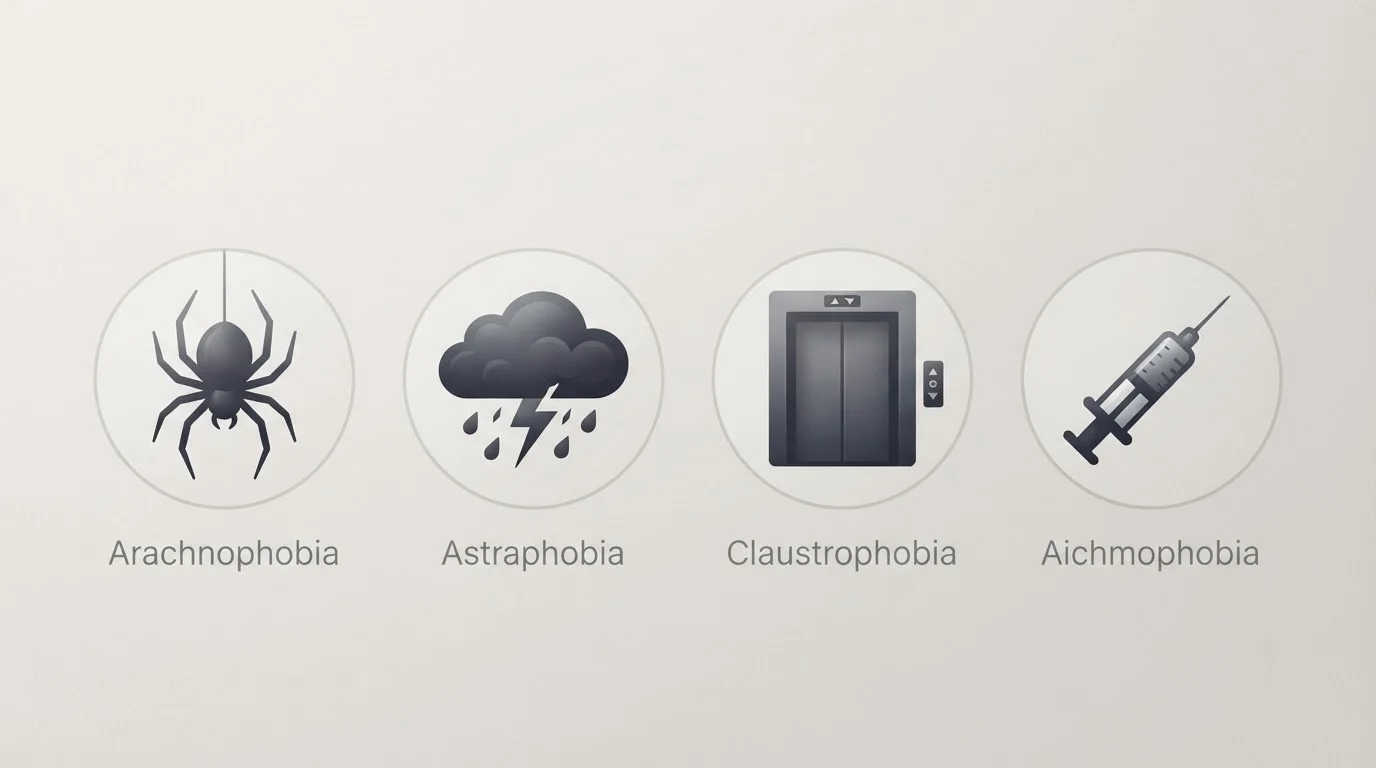
Animal phobias are the most commonly reported subtype and include fears of spiders (arachnophobia), snakes (ophidiophobia), dogs, insects, rodents, and birds, among others. These phobias tend to emerge in early childhood - often before age 10 - and research suggests a possible evolutionary basis: humans may be primed to learn fear responses to creatures that posed ancestral threats.
The intensity of the reaction matters more than whether the animal is objectively dangerous. Someone with a spider phobia may feel the same level of terror from a small house spider as from a venomous species. Avoidance can become elaborate - avoiding basements, garages, or even outdoor spaces - and meaningfully restrict daily activity.
Animal phobias often begin in early childhood and may reflect deeply ingrained threat-detection patterns.
Natural Environment Phobias
This category covers fears tied to natural phenomena: heights (acrophobia), storms (astraphobia), water (aquaphobia), and darkness. Like animal phobias, many natural environment phobias appear early in life.
Fear of heights deserves special mention because it sits on a spectrum. A degree of height caution is adaptive - it keeps people safe. A phobia, by contrast, causes distress even in low-risk situations, such as standing on a second-floor balcony with a sturdy railing, and leads to avoidance of bridges, hiking trails, or tall buildings. The key diagnostic question is whether the fear is excessive relative to the actual context.
Natural environment phobias are often adaptive fears taken to a disabling extreme.
Blood-Injection-Injury (BII) Phobias
BII phobias are distinctive in one important way: they are the only subtype commonly associated with a vasovagal response - a sudden drop in heart rate and blood pressure that can cause fainting. Most anxiety responses involve a spike in arousal (faster heart rate, shallow breathing); BII phobia often involves a two-phase reaction where initial arousal is followed by a sharp drop, leading to lightheadedness or loss of consciousness.
Fears in this category include blood, needles and injections, invasive medical procedures, and injury. Because avoidance can lead people to skip necessary medical care - vaccinations, blood draws, surgical consultations - BII phobias carry real health consequences beyond the psychological distress itself.
BII phobias are uniquely linked to fainting responses, making medical avoidance a serious downstream risk.
Situational Phobias
Situational phobias involve specific contexts rather than objects or natural phenomena. Common examples include fear of flying (aviophobia), fear of enclosed spaces (claustrophobia), fear of driving, and fear of tunnels or bridges. This subtype tends to have a later onset than animal or natural environment phobias, with many cases emerging in the mid-20s.
Situational phobias can significantly curtail life choices - declining job opportunities that require air travel, avoiding public transit, or choosing routes based on what can be avoided rather than what is convenient. The fear is typically of what could happen in the situation (a crash, being trapped, losing control) rather than the situation itself as an intrinsic threat.
Situational phobias often center on feared consequences within a setting rather than the setting itself.
Other Specific Phobias
The DSM-5 includes an "other" category to account for phobias that don't fit neatly into the first four. Common examples include fear of choking or vomiting (emetophobia), fear of loud sounds, fear of clowns, and fear of contracting an illness. Emetophobia, in particular, is worth highlighting because it's frequently underrecognized: individuals may restrict what they eat, avoid restaurants, or withdraw from social situations in ways that can resemble other conditions before the underlying phobia is identified.
The "other" designation doesn't mean these phobias are less real or less impairing - it simply reflects the breadth of specific triggers that the human fear system can attach to.
Emetophobia and illness fears are often underrecognized but can be just as functionally impairing as better-known phobias.
Recognizing Patterns and Next Steps
Across all five categories, the underlying mechanics are similar: exposure to the trigger - or even anticipating it - produces rapid, intense anxiety. Many people develop avoidance behaviors, reorganizing their routines around the feared object or situation. Over time, avoidance tends to reinforce the phobia rather than reduce it.
Talking to a Provider About a Phobia
When describing your fear to a clinician, specificity helps. Try to note the exact trigger, how long you've had the fear, and how it affects your daily routine. Mentioning which category it might fall into - animal, situational, BII, and so on - can help a provider ask the right follow-up questions. You don't need a self-diagnosis; you just need enough detail to start the conversation.
If you recognize your experience in any of the categories above, that recognition is a useful first step. Specific phobias are among the most treatable anxiety conditions; structured approaches such as exposure-based therapy have a strong evidence base. A licensed mental health professional can assess whether what you're experiencing meets the clinical threshold for a specific phobia and discuss options that make sense for your situation. This article is general educational information and is not a substitute for professional evaluation or care.
This article is for informational purposes only and does not constitute medical or psychological advice. Always consult a qualified healthcare professional for concerns about your mental health.