
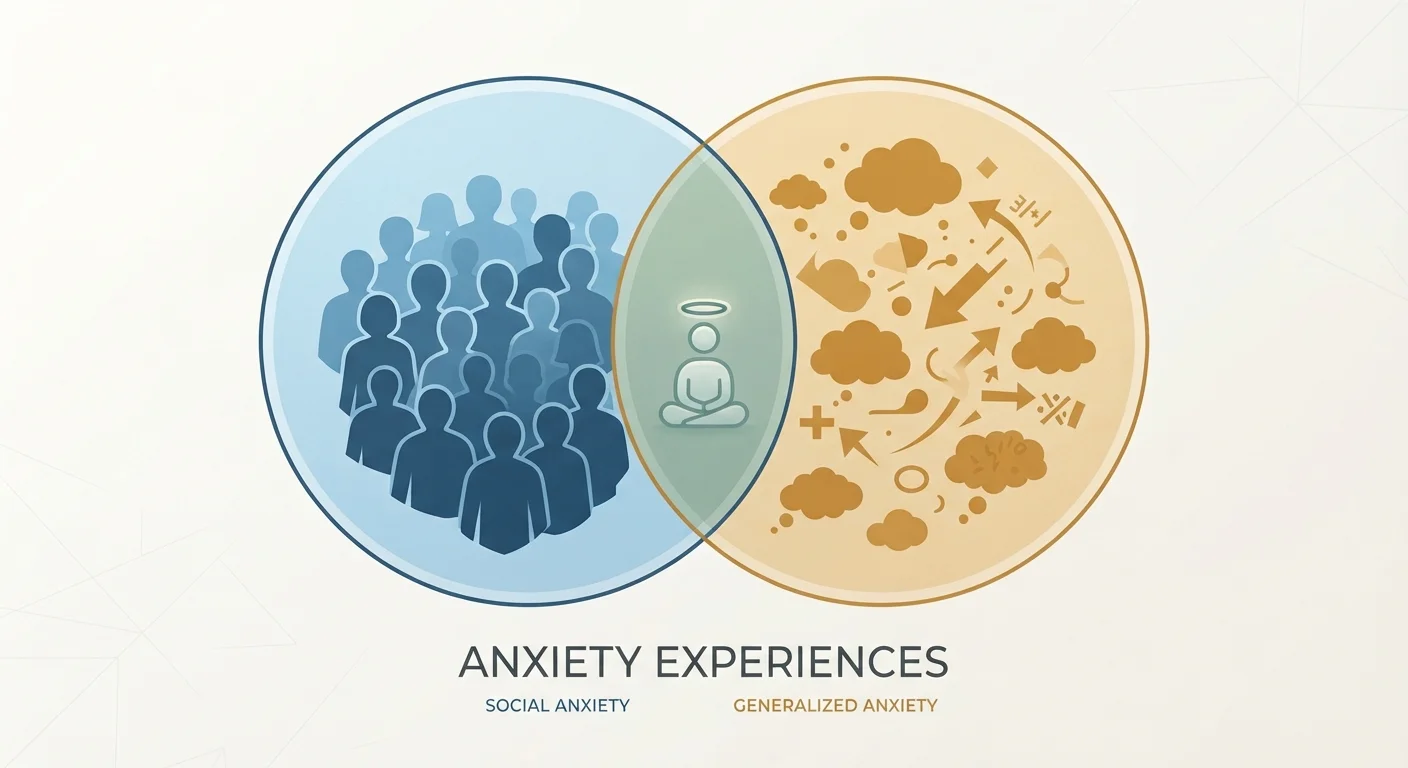
What Each Condition Actually Involves
At a glance, Social Anxiety Disorder (SAD) and Generalised Anxiety Disorder (GAD) can look alike - both involve significant worry, physical tension, and disruption to daily life. But their core features differ in important ways.
Social Anxiety Disorder is defined by intense fear of one or more social situations in which a person might be observed, evaluated, or embarrassed. According to DSM-5 criteria, the fear must be out of proportion to the actual threat, and the person typically either avoids the situation or endures it with considerable distress. It goes well beyond everyday nervousness - to learn more, see what social anxiety disorder actually is.
Generalised Anxiety Disorder involves excessive, difficult-to-control worry about a wide range of topics - not just social situations. People with GAD often describe feeling like their mind won't stop, with worries shifting from work deadlines to health concerns to relationship problems throughout a single day. For a deeper look, understanding generalized anxiety disorder explains the key distinguishing patterns.
| Criterion | Social Anxiety Disorder | Generalised Anxiety Disorder |
|---|---|---|
| Core fear | Social judgment and embarrassment | Broad, uncontrollable worry across life areas |
| Primary triggers | Social situations (public speaking, social gatherings) | Multiple domains: work, health, finances, relationships |
| Worry pattern | Concentrated on social evaluation | Wide-ranging; shifts between many concerns |
| Physical symptoms | Blushing, trembling, racing heart in social settings | Muscle tension, fatigue, restlessness, sleep problems |
| Avoidance behaviour | Avoids social situations | Avoids overwhelming tasks; seeks reassurance |
| DSM-5 duration requirement | 6+ months | 6+ months |
| First-line therapy | CBT with social exposure focus | CBT targeting uncertainty intolerance |
| Common medication class | SSRIs (prescribed by a clinician) | SSRIs (prescribed by a clinician) |
Where the Symptoms Overlap - and Where They Don't
Both conditions share a cluster of physical and psychological symptoms, which is one reason they're sometimes confused - or missed entirely when clinicians focus on only one possibility.
Shared symptoms include:
- Muscle tension and physical restlessness
- Difficulty concentrating
- Sleep disturbances
- Avoidance behaviour (steering clear of triggering situations)
Where they diverge is in the scope and trigger of the worry. In SAD, anxiety is reliably provoked by social exposure - speaking in meetings, attending parties, eating in public. Outside of social contexts, a person with SAD may feel entirely at ease. In GAD, there's no single trigger; worry is pervasive and often described as free-floating. For context on how anxiety conditions are broadly defined, see our overview at Anxiety Explained.
~15 million
US adults affected by social anxiety disorder
The National Institute of Mental Health estimates approximately 7% of US adults experience SAD in any given year.
~6.8 million
US adults living with GAD
The Anxiety and Depression Association of America estimates GAD affects around 3.1% of the US adult population annually.
~50%
of people with anxiety disorders have a co-occurring condition
Comorbidity is common in anxiety disorders; many individuals meet criteria for more than one diagnosis at the same time.
It's also worth noting that avoidance plays a role in both disorders, but its pattern differs. In SAD, avoidance is social - skipping events, declining calls, staying quiet in groups. In GAD, avoidance might look like procrastinating on tasks that feel overwhelming or seeking constant reassurance. Our article on social anxiety and avoidance explains why this coping strategy often backfires.
How Clinicians Tell Them Apart
Diagnosis isn't based on a single test - it involves a structured clinical interview, symptom history, and ruling out other causes. A key question clinicians explore is: Is the worry confined to social situations, or does it extend broadly across life?
Someone with SAD might score highly on measures of social fear but report relatively low worry about health or finances. Someone with GAD typically shows elevated worry across domains - and importantly, social situations may be one of many concerns rather than the central one.
Co-occurrence is common: research suggests a meaningful proportion of people with SAD also meet criteria for GAD. When both are present, clinicians assess which drives more impairment and prioritise treatment accordingly. The article GAD and social anxiety: two distinct experiences walks through the clinical distinctions in more detail.
When Both Diagnoses Apply
It is clinically possible - and relatively common - to receive diagnoses of both SAD and GAD. Having one doesn't exclude the other. When both are present, treatment is typically sequenced or integrated based on which condition causes the most impairment. A mental health professional is best placed to assess this.
It's also important to distinguish both conditions from ordinary shyness or stress. Shyness is a personality trait - uncomfortable but not impairing. Both SAD and GAD are clinical diagnoses that cause meaningful disruption to work, relationships, or daily functioning. See where shyness ends and social anxiety begins for a closer look at that boundary.
Treatment: Similar Tools, Different Focus
The good news is that both conditions respond to evidence-based treatment. The approaches overlap considerably, though the application differs.
Cognitive Behavioural Therapy (CBT) is a first-line treatment for both SAD and GAD. In SAD, CBT typically involves identifying distorted beliefs about social evaluation and gradually exposing the person to feared social situations in a structured way. In GAD, CBT focuses more on challenging the belief that worrying is useful or necessary, and developing tolerance for uncertainty.
Medication is commonly used for both. Selective serotonin reuptake inhibitors (SSRIs) - a class of antidepressants - are approved for both conditions in the US. The specific medication and dosage are always determined by a qualified prescriber based on individual circumstances.
For a full breakdown of treatment options for social anxiety, including therapy formats and medication classes, see recognised treatment paths for social anxiety disorder.
This article is for informational purposes only and does not constitute medical advice. If you believe you may be experiencing symptoms of either condition, please speak with a qualified healthcare professional who can provide an accurate assessment and appropriate care.