
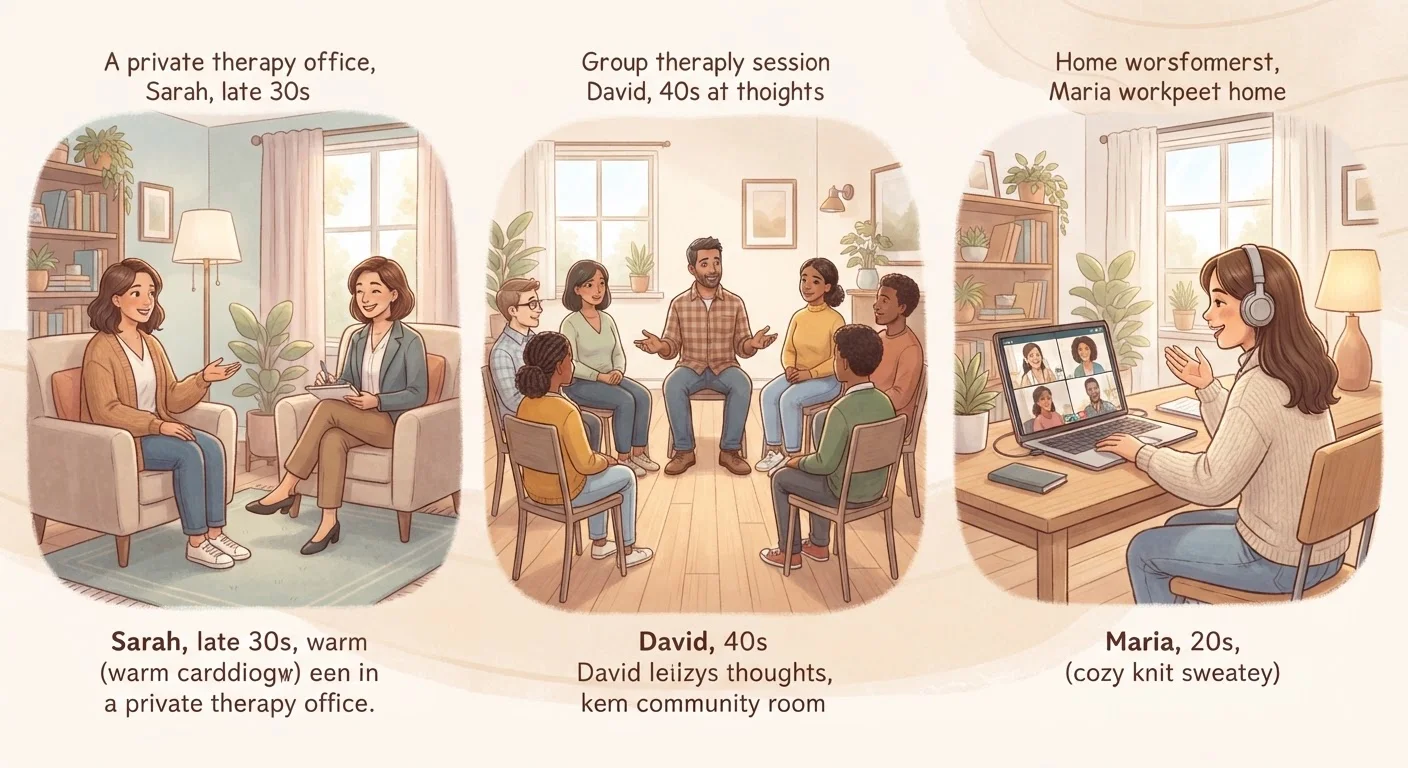
Why Therapy Format Matters
When people decide to seek therapy for the first time, the first question is often who to see — but the format of therapy matters just as much as the provider. Individual sessions, group settings, and online platforms each create a different kind of therapeutic experience. Understanding those differences can help you make a more confident choice, or at least know what to expect when you walk through the door — or open a laptop.
This is general information to help orient you. It is not a substitute for guidance from a licensed mental health professional who can assess your individual situation. For a broader look at how talk therapy works, that context is worth exploring alongside this comparison.
Individual Therapy: Private and Personalized
In individual therapy, you work one-on-one with a licensed therapist in sessions typically lasting 45–55 minutes. The entire session is focused on you — your history, goals, and current challenges. This format allows the therapist to tailor their approach closely to your needs, adjusting pace and technique over time.
Privacy is a significant draw. Many people feel more comfortable exploring sensitive topics when they are not observed by peers. Individual therapy is also well-suited to conditions that require careful clinical attention, such as trauma, severe depression, or complex anxiety disorders.
The trade-off is cost. Individual sessions are generally the most expensive format, though fees vary based on location, provider credentials, and insurance coverage. For more on what shapes pricing, see why therapy costs vary. Session frequency and duration also differ — short-term and long-term models have meaningfully different structures.
Ask About Format in Your First Call
When contacting a therapist for the first time, it is entirely appropriate to ask whether they offer individual sessions, group programs, or online options. Many clinicians work across more than one format. A brief intake conversation can help you both determine which setting makes the most sense for where you are right now.
Group Therapy: Connection Through Shared Experience
Group therapy typically involves 5–15 participants meeting with one or two licensed therapists. Sessions are structured around a shared theme or diagnosis — such as grief, addiction recovery, or social anxiety — and the group dynamic itself becomes part of the healing process.
Hearing others articulate experiences similar to your own can reduce shame and isolation in ways that individual sessions sometimes cannot replicate. Participants also practice interpersonal skills in real time, which can be especially valuable for people working through relationship patterns or social difficulties.
Group therapy sessions generally cost less per session than individual therapy. However, the format requires a willingness to share in front of others and to tolerate a less individualized focus. For a side-by-side look at how these two formats compare, this breakdown of group and individual therapy goes into more depth.
| Individual Therapy | Group Therapy | Online Therapy | |
|---|---|---|---|
| Session focus | Entirely on one person | Shared among participants | One-on-one, remotely |
| Typical cost per session | Higher (varies widely) | Lower per person | Varies; often competitive |
| Privacy level | High | Moderate (peers present) | High, if environment is private |
| Peer connection | Not a feature | Central element | Not a standard feature |
| Access and flexibility | Location-dependent | Location-dependent | High; no commute needed |
| Personalization | High | Limited | Moderate to high |
| Best suited for | Complex or private concerns | Shared experiences, social skills | Access barriers, mild-moderate concerns |
Online Therapy: Expanded Access, New Considerations
Online therapy encompasses video sessions, phone sessions, and in some cases asynchronous messaging with a therapist. It uses the same therapeutic approaches as in-person care — cognitive behavioral therapy, for example, translates well to a video format — but removes geographic and logistical barriers that prevent many people from seeking help.
For those with limited local options, mobility challenges, or unpredictable schedules, online therapy can be a practical path to consistent care. Research to date suggests it is effective for a range of concerns, though some clinical situations — such as active crisis states or certain complex diagnoses — may be better served by in-person care.
Within online therapy, there are further distinctions worth understanding. Video and messaging therapy differ in structure and depth of engagement. And online therapy is not the same as a self-guided mental health app — that distinction matters when choosing the right level of support.
Online Therapy Has Real Limitations
Online therapy is not appropriate for everyone or every situation. If you are experiencing a mental health crisis, active suicidal thoughts, or severe symptoms, in-person care or emergency services are more appropriate. If you are in crisis, please contact the 988 Suicide and Crisis Lifeline by calling or texting 988. Always be honest with a potential provider about your current situation so they can recommend the right level of care.
Choosing a Format That Fits Your Life
There is rarely one objectively correct choice among these formats. Practical factors — schedule, budget, comfort with technology, and the nature of what you are working through — all play a role. So does personal preference: some people find the intimacy of individual sessions essential; others thrive with group accountability.
Many people move between formats over time, or combine them. Someone might attend weekly individual therapy while also participating in a support group. Peer support groups and individual therapy each serve distinct functions and can complement one another well.
If you are unsure where to start, speaking with a primary care provider or a mental health professional for an initial consultation can help clarify which format best matches your presenting concerns. Therapy, in any format, works best when it is a genuine fit — not just the most convenient or least costly option available.
This article is for informational purposes only and does not constitute medical or mental health advice. Please consult a qualified mental health professional for guidance specific to your situation.