
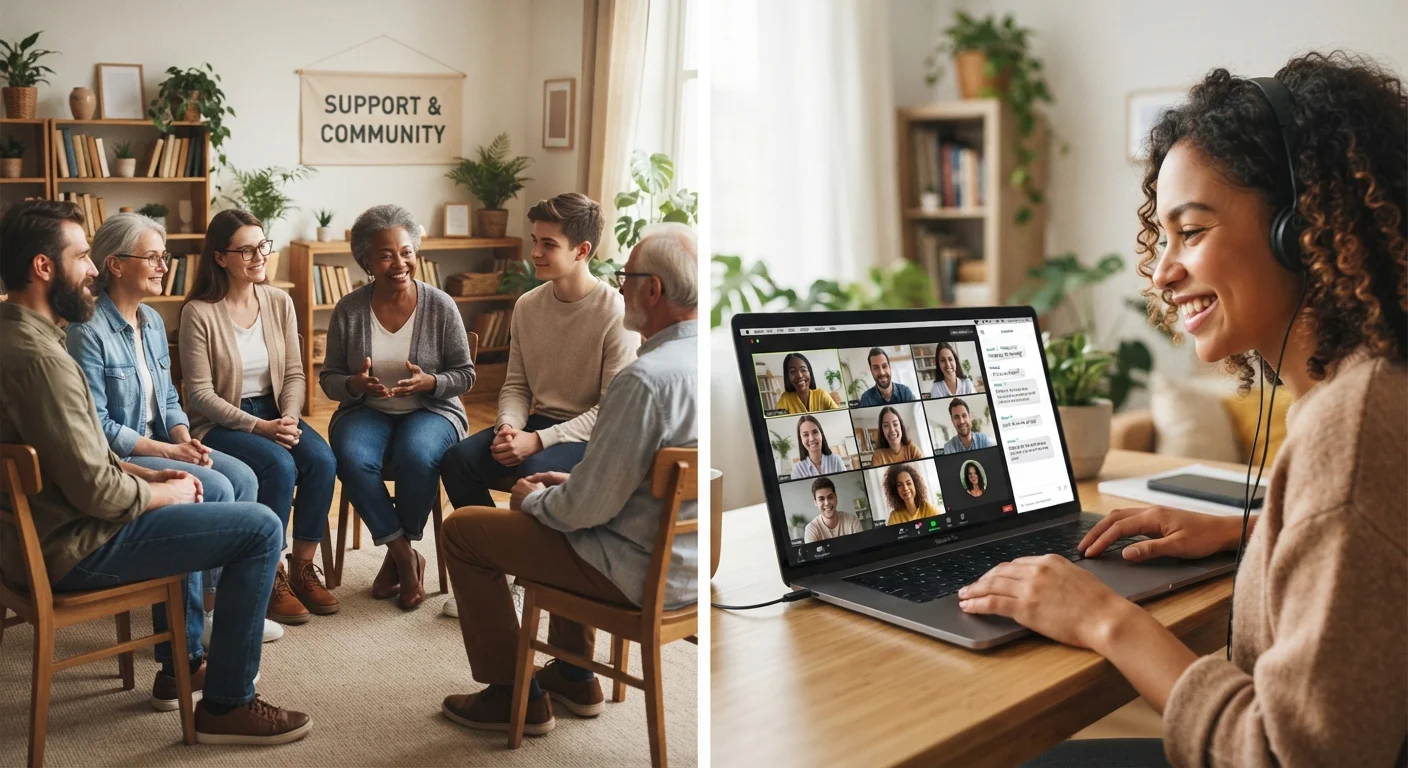
Why the Format of Your Community Matters
When people seek connection or peer support, they rarely stop to ask whether the format of that community will shape what they actually receive. But it does. Research in social psychology consistently shows that the medium through which we connect influences the quality, depth, and type of support we experience.
This isn't about ranking one format above the other. It's about understanding the trade-offs clearly so you can make an intentional choice — or deliberately combine both. Whether you're exploring a peer support group for the first time or re-evaluating where you spend your social energy, the distinctions below are worth knowing.
The Case for Online Communities
Online communities have expanded access to peer support in ways that were simply not possible a generation ago. For people in rural areas, those managing chronic illness, or anyone whose schedule or mobility makes regular in-person attendance difficult, digital spaces can be transformative.
Available any time, from any location
Online communities remove geographic and scheduling barriers entirely. Someone in a rural county or on a night-shift schedule can participate in real-time conversations that would otherwise be inaccessible.
Anonymity encourages honest self-disclosure
Many people find it easier to share sensitive experiences when they are not identifiable. This can lower the threshold for seeking support, particularly around stigmatized topics.
Access to niche or specialized communities
The internet aggregates people across vast distances, making it possible to find communities organized around very specific experiences — rare diagnoses, uncommon life circumstances, or particular identities.
Lower commitment threshold to get started
Joining an online forum or group chat requires less initial vulnerability than walking into a room of strangers, which makes it a useful entry point for people new to seeking peer support.
Anonymity is another underappreciated asset. Being able to share vulnerably without fear of running into someone at the grocery store lowers the stakes in ways that genuinely help some people open up. Research on computer-mediated communication suggests that reduced social cues can, in some contexts, encourage more honest self-disclosure.
That said, online communities are not a uniform experience. A well-moderated forum anchored in shared purpose differs enormously from an unmoderated comment section. For a closer look at what digital connection can and cannot deliver, see our article on online social connection.
The Case for In-Person Groups
Face-to-face connection engages the full range of human communication — tone of voice, eye contact, a reassuring hand on the shoulder. These nonverbal signals carry emotional information that text and even video cannot fully replicate. Studies on social support consistently find that physical co-presence is associated with greater feelings of being understood and less experienced loneliness over time.
Physical presence and nonverbal cues are absent
Text-based communication strips away tone, facial expression, and touch — elements that carry significant emotional weight. Even video calls only partially restore these dimensions.
Logistical and geographic barriers can exclude people
Transportation, work hours, childcare responsibilities, and local availability can make consistent attendance genuinely difficult, limiting who in-person groups realistically serve.
Slower to form for people new to an area
Building an in-person community takes sustained time and repeated exposure. People who have recently relocated or experienced social disruption may find it harder to establish these ties quickly.
Group culture varies widely and is hard to preview
The quality of an in-person group depends heavily on facilitation, membership dynamics, and shared norms — factors that can be difficult to assess before committing to attend.
In-person groups also build accountability in organic ways. Showing up to a regular meeting, seeing familiar faces, and being recognized creates a low-pressure structure that many people find motivating. Over months, these repeated encounters often deepen into genuine friendships in a way that online relationships can struggle to sustain.
For those weighing how this applies specifically to therapeutic contexts, our comparison of online therapy and in-person therapy explores similar trade-offs in a clinical setting.
When Neither Format Is Enough
Peer communities — online or in-person — are not a replacement for professional mental health care. If you are experiencing persistent depression, anxiety, trauma responses, or thoughts of self-harm, please speak with a licensed mental health provider. Support groups work best as a complement to professional help, not a substitute for it. If you're unsure where to start, our overview of support groups can help orient you.
Practical Ways to Decide — or Combine Both
Rather than framing this as an either/or decision, consider what each format does best for your current situation.
- If access is a barrier (distance, disability, childcare, work hours), online communities may be the most realistic starting point.
- If you want deeper accountability and are able to commit to a regular schedule, an in-person group is worth prioritizing.
- If you're dealing with stigma or shame around your topic, the relative anonymity of online spaces may help you engage more honestly at first.
- If you already have an online community you value, look for local events or meetups that could add a physical dimension to those relationships.
Many people find the most sustainable arrangement is a hybrid — an online community for day-to-day connection and an occasional or regular in-person group for depth. The community connection hub offers further perspective on how belonging, in any form, supports emotional resilience.
36%
US adults reporting serious loneliness
A large-scale Harvard survey on loneliness found that roughly 36% of Americans — including 61% of young adults — reported feeling serious loneliness, underscoring the scale of unmet connection needs.
2x
Mortality risk linked to social isolation
Research published in peer-reviewed public health journals has found that prolonged social isolation carries a health risk comparable to smoking up to 15 cigarettes a day, roughly doubling certain mortality risks.
This article is for general informational purposes only and is not a substitute for professional mental health advice, diagnosis, or treatment. If you are in distress, please reach out to a qualified mental health professional or a crisis helpline.