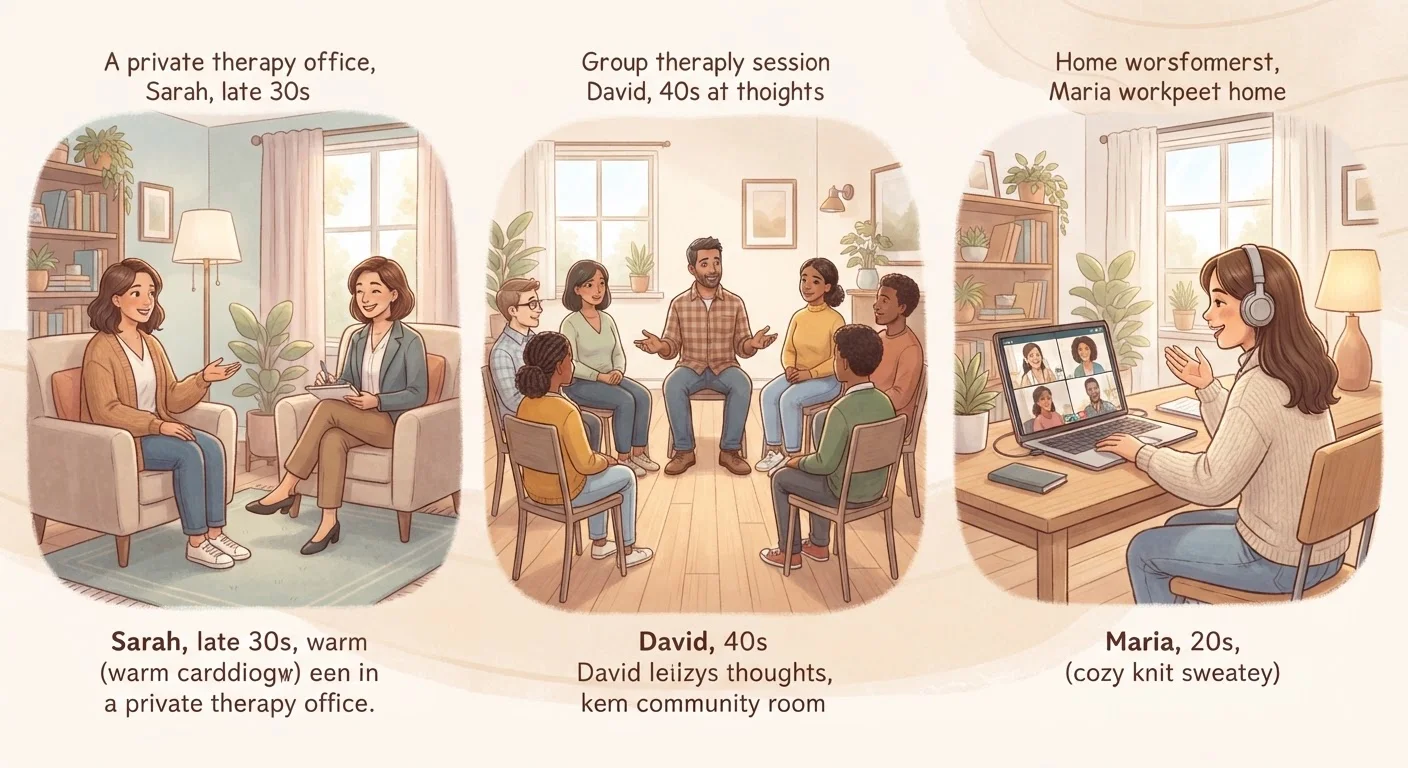

Two Different Approaches to Mental Health Support
When you're looking for support with your mental health, two paths come up often: joining a peer support group or starting individual therapy. On the surface they might seem similar — both involve talking about difficult experiences. But they operate on different principles, offer different kinds of help, and suit different needs.
Understanding what sets them apart isn't about deciding which one is "better." It's about knowing which one fits where you are right now — and recognising that the two can work together powerfully. For a deeper look at what peer groups actually involve, see what peer support groups actually are. If you want to understand the therapy side more broadly, therapy basics is a good starting point.
| Criterion | Peer Support Groups | One-on-One Therapy |
|---|---|---|
| Who leads it | Peer with lived experience | Licensed mental health clinician |
| Primary purpose | Connection, shared understanding | Clinical treatment and personal growth |
| Confidentiality | Informal group agreement | Legally protected professional relationship |
| Typical cost | Free or low-cost | Varies; may be covered by insurance |
| Personalization | Shared experience focus | Fully individualized to you |
| Clinical assessment | Not available | Core part of the process |
| Relationship dynamic | Reciprocal peer support | Professional caring for a client |
What Each Approach Actually Offers
Peer support groups are spaces where people with shared experiences gather — often weekly — to listen, share, and encourage one another. They are typically facilitated by a peer with lived experience rather than a licensed clinician. The goal isn't treatment; it's connection, mutual understanding, and hope drawn from seeing others navigate similar challenges. Research consistently links social support to better mental health outcomes, and structured peer groups are one formal way to access that kind of connection.
One-on-one therapy, by contrast, is a professional service delivered by a licensed mental health clinician — such as a psychologist, licensed clinical social worker, or licensed professional counselor. Sessions are private, structured, and focused on the individual's specific history, symptoms, and goals. A therapist can draw on evidence-based methods — such as cognitive behavioral therapy (CBT) or dialectical behavior therapy (DBT) — to address conditions like depression, anxiety, or trauma in ways a peer group is not equipped to do.
It's also worth noting that group therapy — a clinician-led treatment format — is distinct from both peer support groups and individual therapy. For a closer look at how those formats compare, individual, group, and online therapy options breaks this down clearly.
70%+
Adults reporting benefit from peer support programs
Multiple reviews of peer support research suggest a majority of participants report improvements in wellbeing, hope, and sense of belonging.
~50%
People with mental illness who receive any treatment
According to SAMHSA's National Survey on Drug Use and Health, roughly half of adults with mental illness receive some form of mental health treatment in a given year.
Key Differences Worth Knowing
The distinctions between peer support and individual therapy matter most when you're trying to decide what kind of help you need. A few areas stand out:
- Confidentiality: Therapy carries legal protections around privacy. Support groups ask members to maintain confidentiality, but this is an informal agreement — not a legal one.
- Clinical guidance: Therapists are trained to assess mental health concerns, recognize warning signs, and refer to other professionals when needed. Peer facilitators are not in a clinical role.
- Cost and access: Many peer support groups are free or low-cost. Individual therapy can be expensive, though insurance coverage, sliding-scale fees, and community mental health centers can reduce the barrier. Types of peer support groups outlines some of the formats available.
- The relationship dynamic: Therapy involves a one-directional relationship — a professional caring for a client. Peer support is reciprocal; members both give and receive support. That mutuality is part of what makes it meaningful.
Support Groups Are Not a Substitute for Clinical Care
Peer support groups can be a valuable part of a mental health journey, but they are not designed to diagnose conditions, provide therapy, or manage psychiatric emergencies. If you are experiencing severe symptoms, suicidal thoughts, or a mental health crisis, please contact a licensed professional or a crisis service immediately. The 988 Suicide and Crisis Lifeline is available by call or text in the US.
If you've tried a support group and it didn't feel right, that doesn't mean all groups are wrong for you. why a group might not feel like the right fit explores what to consider when a particular group isn't working.
When Both Together Makes Sense
For many people, the most supportive path involves both. A therapist can provide individualized clinical care while a peer group offers the ongoing sense of community and shared humanity that's harder to find in a one-on-one professional relationship. The two rarely conflict — they tend to complement each other in ways that reinforce progress.
Someone managing recovery from addiction, for example, might attend a structured peer group for community accountability while also working with a therapist on underlying anxiety or trauma. Someone grieving a significant loss might find validation in a grief support group while processing deeper layers in individual therapy sessions.
If you're exploring how your broader network of support fits together, building support networks offers practical ways to think about this. And if you're new to therapy and wondering what to expect, why talking to a therapist feels different from talking to a friend can help set realistic expectations.
This article is for general informational purposes only and is not a substitute for professional mental health advice, diagnosis, or treatment. If you are experiencing a mental health crisis or have concerns about your wellbeing, please reach out to a qualified mental health professional or contact a crisis line in your area.