
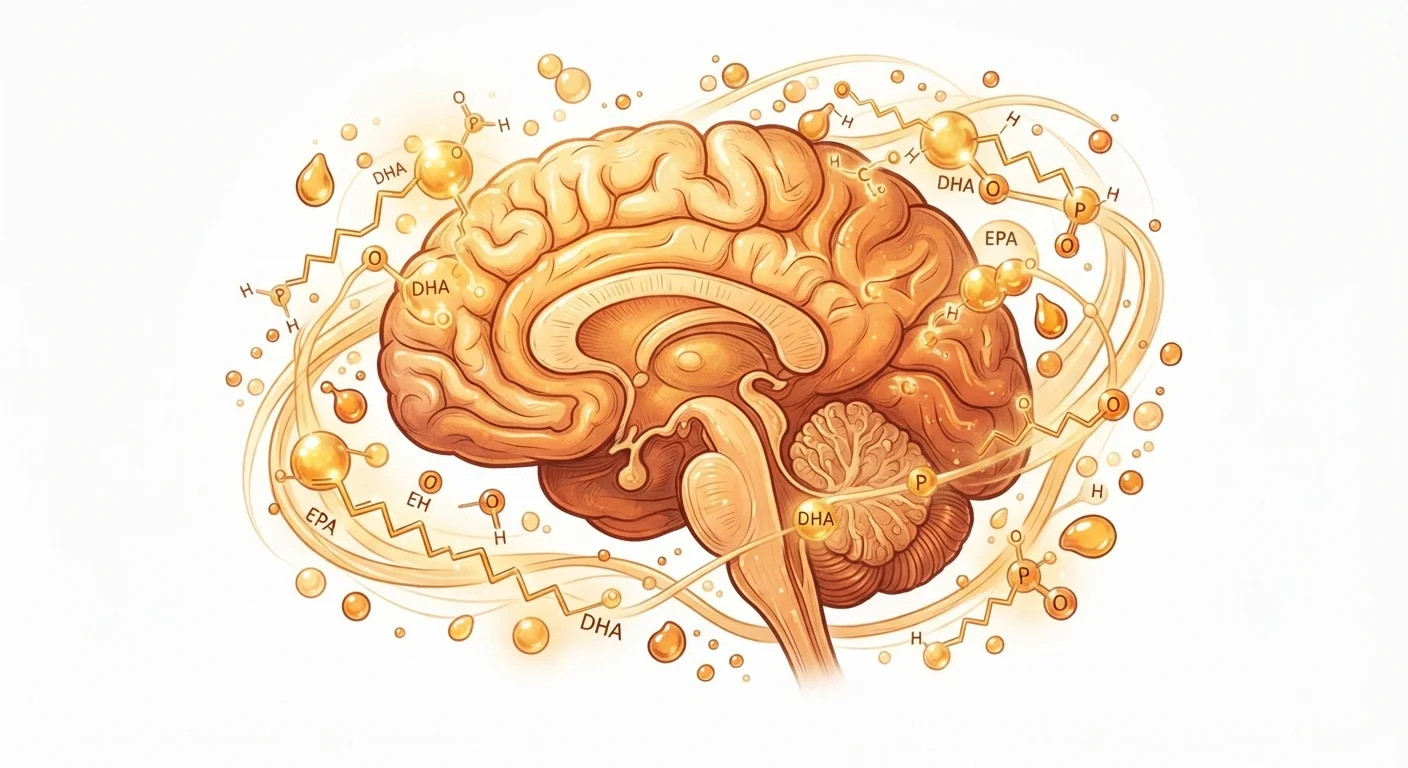
A Fat Brain Is a Healthy Brain
It may seem counterintuitive in an era that has long treated dietary fat with suspicion, but the human brain depends on fat for its very architecture. Strip away the brain's water content, and roughly 60% of what remains is fat. This isn't stored energy - it's functional tissue. The type of fat present in brain cell membranes directly shapes how neurons communicate, how efficiently signals travel, and how resilient the brain is to stress and inflammation.
Among all dietary fats, omega-3 polyunsaturated fatty acids occupy a uniquely important position. Unlike saturated fats, which tend to stiffen cell membranes, omega-3s contribute a structural flexibility that is fundamental to how neurons fire and receive signals. Understanding this biology helps explain why these fatty acids are considered foundational to mental wellness - not as a supplement trend, but as a basic nutritional principle.
~60%
Fat content of the brain by dry weight
A widely cited figure in neuroscience literature reflecting the brain's composition after water is excluded.
<10%
ALA converted to DHA in most adults
Research estimates suggest conversion of plant-based ALA to brain-active DHA is highly limited in most healthy adults.
10-12 billion
Neurons in the cerebral cortex
Each neuron is surrounded by a membrane where DHA plays a direct structural and functional role.
DHA: The Brain's Primary Structural Fat
Of the three main omega-3s - ALA, EPA, and DHA - it is docosahexaenoic acid (DHA) that dominates brain tissue. DHA is highly concentrated in the cerebral cortex (the region associated with thinking and decision-making), the retina, and most critically, at the synapse - the junction between neurons where chemical signals are passed.
DHA's molecular shape, with its long carbon chain and multiple double bonds, creates a naturally fluid quality in the membrane. This fluidity allows proteins embedded in the membrane - including neurotransmitter receptors and ion channels - to move and function optimally. When DHA levels are low, these membranes can become less adaptable, potentially affecting signal transmission speed and receptor sensitivity.
To understand the differences between DHA and its fellow omega-3 EPA, and how each contributes to mental wellbeing, see our comparison of DHA and EPA for mental wellbeing.
DHA Accumulates Early - and Keeps Mattering
DHA builds up rapidly in the brain during fetal development and the first two years of life, but neural membranes continue to incorporate and renew DHA throughout adulthood. This means that maintaining adequate long-term intake - not just during early life - supports ongoing brain structure and function. Pregnant and breastfeeding individuals should speak with a healthcare provider about their specific DHA needs.
Why the Body Can't Simply Make Its Own
DHA is classified as a conditionally essential nutrient. The body can theoretically synthesize it from alpha-linolenic acid (ALA), a plant-derived omega-3 found in flaxseed, walnuts, and chia seeds. In practice, however, this conversion is inefficient - research estimates that less than 10% of consumed ALA is converted to DHA in most adults, and real-world conversion rates are often far lower.
This means that for most people, dietary sources of preformed DHA - primarily fatty fish, seafood, and algae - are the most reliable way to maintain adequate brain levels. For those following plant-based diets, this conversion limitation is particularly relevant. Our guide to ALA, DHA, and EPA explores why this distinction matters for brain health in more depth.
Algae-Based DHA: A Plant-Derived Option
For people who do not consume fish, algae-based DHA supplements offer a direct source of preformed DHA - the same form found in fish oil, since fish themselves obtain DHA by eating algae. While the evidence on algae-derived DHA supplements is still developing, they are considered a viable option for those with low fish intake. Discuss this with a healthcare provider to determine whether it's appropriate for your situation.
What Happens When Omega-3 Levels Are Low
When the diet consistently lacks sufficient DHA, the brain does not simply go without - it substitutes. Research has shown that in DHA-deficient states, the brain may incorporate other fatty acids (including omega-6 fatty acids like docosapentaenoic acid, or DPAn-6) into cell membranes in place of DHA. These substitutes do not replicate DHA's structural or functional properties, and this substitution has been associated in animal and observational human studies with changes in neurotransmitter signaling, increased neuroinflammation, and alterations in cognitive and mood-related outcomes.
It's important to note that much of this evidence comes from observational research and animal models. Causal relationships in humans are still being established, and omega-3s are not a treatment for any clinical condition. For a broader review of the evidence base, see what the science actually says about omega-3s and the brain.
“The brain is the most fat-rich organ in the body, and the quality of dietary fat has a direct bearing on the structural integrity of neural membranes. DHA is not optional - it is foundational.”
— Nutrition & Mind Editorial Team, Collective of nutrition scientists and mental health researchers
Practical Implications for Mental Wellness
Understanding the structural role of omega-3s reframes them from a supplement category into a dietary foundation. Rather than asking whether omega-3s "treat" any particular condition, a more useful question is whether your current dietary pattern supports adequate DHA availability for your brain's structural needs.
For most adults, a diet that regularly includes fatty fish (such as salmon, sardines, or mackerel), alongside plant-based ALA sources, provides a reasonable baseline. Those with limited fish consumption, specific health conditions, or particular life stages - including pregnancy - should discuss their omega-3 status with a qualified healthcare professional before making significant dietary changes or considering supplements. For guidance on how to build this kind of eating pattern, see our article on building an omega-3-rich eating pattern for mental wellness.
Omega-3s are also just one piece of the nutritional picture for brain health. Other nutrients - including B vitamins, folate, and fat-soluble vitamins - interact with the same systems. Explore how vitamin solubility affects brain nutrient availability for a broader context.
This article is for general informational and educational purposes only and does not constitute medical or nutritional advice. Always consult a qualified healthcare professional before making changes to your diet or supplement routine.