What Sets These Two Paths Apart
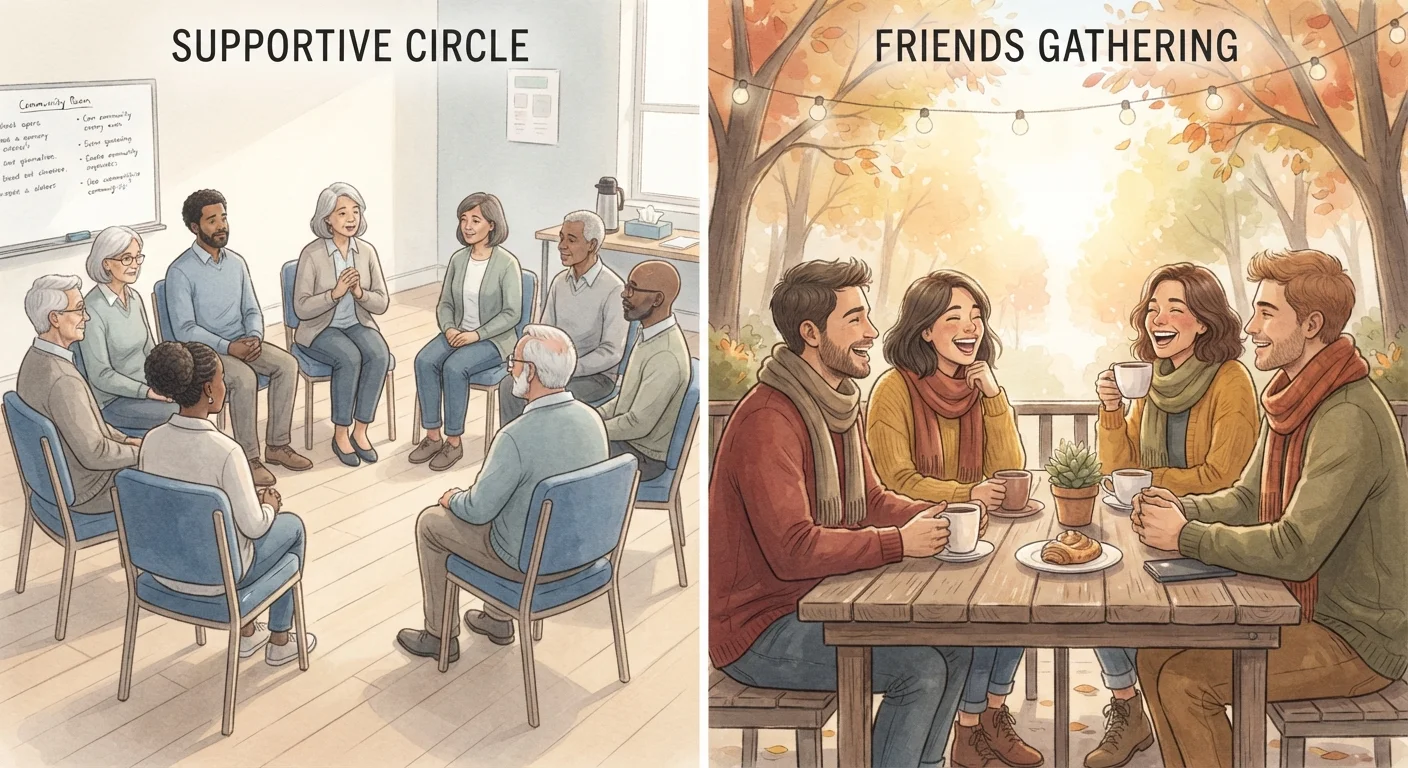
When we talk about community as a mental health resource, we're really talking about two quite different experiences that often get grouped together. Formal support groups — whether facilitated by a trained leader or run as peer-led meetings — are designed around a shared purpose. Participants typically join because they have something in common: a diagnosis, a loss, a recovery journey. There's usually a structure: a time, a place, agreed-upon norms, and a focus that keeps conversations meaningful.
Informal social circles are something different altogether. These are your friendships, your neighbors, your running group, your book club. They grow organically over time and don't require anyone to disclose a struggle or identify as someone in need. The connection is real, but it's woven into the ordinary fabric of life rather than carved out for a specific purpose.
Understanding this distinction matters because the type of support each provides — and the needs each meets — differs in important ways. Explore the Building Support Networks hub for practical guidance on identifying which forms of connection you may already have and where there might be gaps.
| Criterion | Formal Support Groups | Informal Social Circles |
|---|---|---|
| Structure | Scheduled meetings, set format | Flexible, self-organizing |
| Entry point | Shared challenge or experience | Shared interests or proximity |
| Type of support | Emotional, informational, coping-focused | Companionship, identity, belonging |
| Facilitator | Often trained or experienced leader | None — naturally emergent |
| Confidentiality norms | Typically explicit and agreed upon | Implicit, varies by relationship |
| Depth of disclosure | Often high — vulnerability encouraged | Variable — not required |
| Accessibility | May require searching or referral | Often already present in daily life |
The Strengths of Formal Support Groups
Formal support groups offer something that's hard to replicate elsewhere: the immediate, unspoken understanding of people who share your specific experience. Research in social psychology consistently highlights the value of perceived similarity — the sense that others truly get what you're going through — as a driver of emotional relief and reduced isolation.
These groups also tend to provide a degree of safety and accountability. Confidentiality norms, a facilitator's guidance, and the shared commitment of participants create a container where vulnerability feels less risky. For people navigating grief, addiction recovery, chronic illness, or mental health conditions, that structure isn't a limitation — it's what makes honest conversation possible.
Types of peer support groups vary widely, from condition-specific meetings to general wellbeing circles, so finding a format that fits is more achievable than many people expect. It's also worth knowing that support groups complement rather than replace individual therapy — a point explored in depth in Support Groups vs. One-on-One Therapy.
45%
Adults reporting loneliness regularly
A 2023 advisory from the U.S. Surgeon General identified loneliness as a public health epidemic, with nearly half of American adults reporting measurable loneliness.
50%
Reduced mortality risk with strong social ties
A widely cited meta-analysis published in PLOS Medicine found that robust social relationships were associated with a roughly 50% greater likelihood of survival across study populations.
The Quiet Power of Informal Social Circles
Informal social circles carry a different kind of weight. Decades of public health research — including landmark work on social determinants of health — point to everyday social integration as one of the most protective factors for long-term mental and physical wellbeing. This isn't about deep emotional disclosure; it's about the cumulative effect of being known, included, and valued in ordinary life.
Friendships and casual communities provide what researchers sometimes call companionship support: the joy of shared activities, the comfort of routine check-ins, and the identity affirmation that comes from being seen outside any single role or diagnosis. A friend who knows you beyond your hardest chapter offers something a support group is not designed to provide.
The many forms community takes — from religious congregations to hobby clubs — each contribute distinct threads to collective mental health. And within any social circle, different people play different roles, from trusted confidants to activity partners, all of which matter.
Finding Your Balance
Most people don't have to choose one path over the other — and ideally, they won't. A support network that includes both structured peer connection and organic social relationships tends to be more resilient than one that relies on either alone. If you're curious about how digital settings fit into this picture, Online Support Groups and In-Person Meetings can help you weigh the options.
Both Can Coexist — and Often Should
Choosing a formal support group doesn't mean pulling back from friendships, and investing in social circles doesn't make structured peer support unnecessary. Research on support networks consistently finds that variety — different people serving different functions — predicts better outcomes than relying heavily on a single source. Think of these two paths as complementary rather than competing.
The right starting point depends on what you're navigating right now. If a specific challenge is at the center of your life, a formal group may offer the most targeted relief. If general loneliness or a thin social life is the concern, investing in informal community — however modest — can shift things meaningfully. And if you're unsure, speaking with a mental health professional about what kind of social support might help most is always a reasonable next step.
This article is for general informational purposes only and is not a substitute for professional mental health advice, diagnosis, or treatment. If you are in crisis or need immediate support, please contact a qualified healthcare professional or a crisis helpline in your area.