
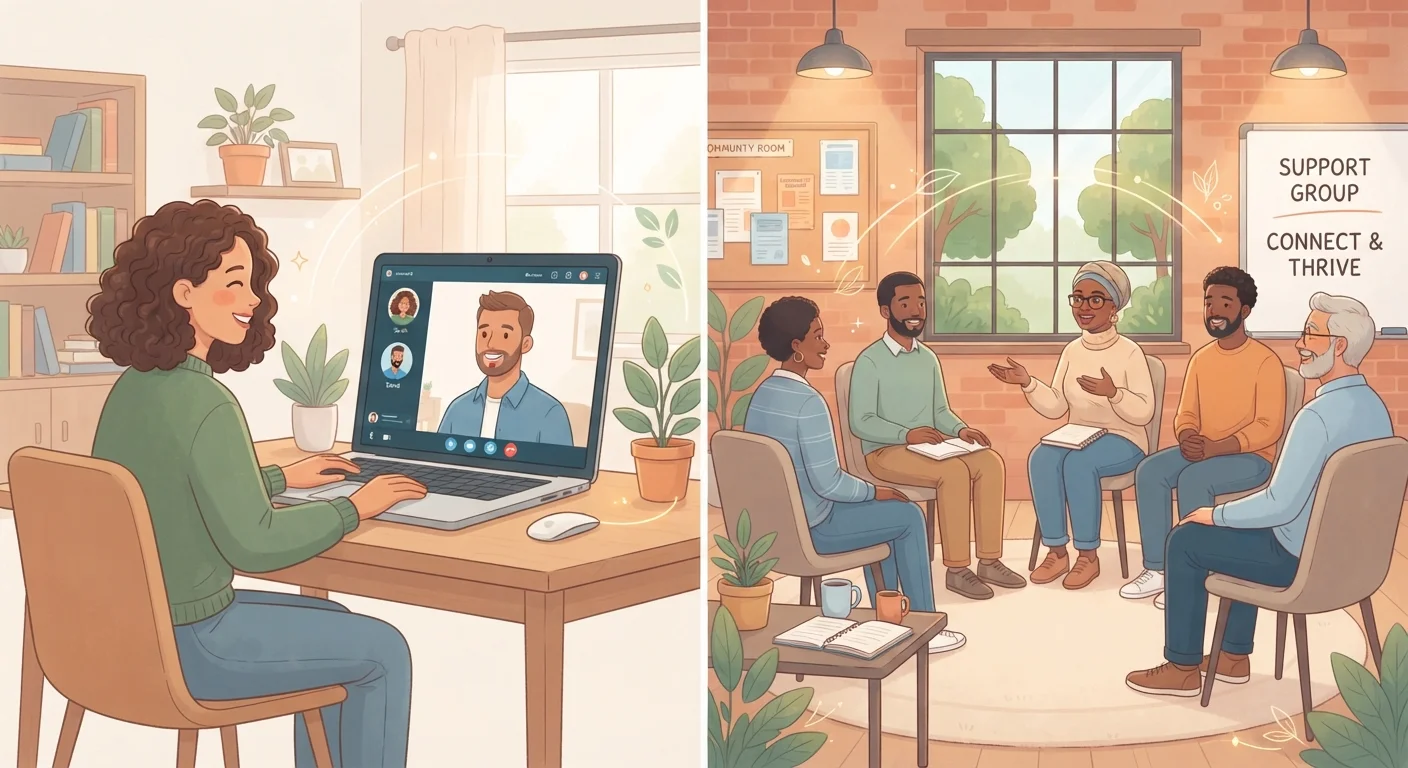
Why Format Matters in Peer Support
Peer support groups — whether focused on grief, addiction recovery, anxiety, chronic illness, or general mental wellness — share a core purpose: bringing people together around a common experience. Research consistently supports their value. A substantial body of evidence suggests that structured peer connection can reduce feelings of isolation, improve coping skills, and strengthen a sense of hope. But where and how a group meets shapes what it can realistically offer you.
Choosing between online and in-person formats isn't just a logistical question. It touches on what kind of connection you're looking for, what barriers you're navigating, and what environment helps you feel safe enough to open up. For broader context on how peer groups differ from individual therapy, see our guide to support groups vs. one-on-one therapy.
| Online Support Groups | In-Person Meetings | |
|---|---|---|
| Accessibility | High — no travel required | Limited by geography and transport |
| Anonymity | Greater — camera optional in many groups | Lower — physically visible to others |
| Depth of connection | Can feel more surface-level over time | Often deeper through physical presence |
| Scheduling flexibility | Often asynchronous or varied time zones | Fixed meeting times and locations |
| Accountability | Easier to disengage without notice | Social presence encourages attendance |
| Variety of groups available | Very broad — not location-dependent | Limited to what exists locally |
| Stigma barrier | Lower — no public visibility required | Higher — attendance is a visible act |
The Case for Online Support Groups
Online groups — offered through video platforms, moderated forums, or dedicated apps — have expanded access to peer support dramatically. Their most significant advantage is removing logistical barriers. If you live in a rural area, have a physical disability, work irregular hours, or care for dependents, an online group may be the only format that fits your life consistently.
Anonymity is another meaningful benefit. Many people find it easier to share something vulnerable — a relapse, a difficult diagnosis, a shameful feeling — when they aren't physically visible to others. That layer of distance can lower the threshold for speaking up, especially early in the recovery process.
Try a Group Before Committing
Most online and in-person groups welcome first-time visitors without any obligation to return. Attending once to observe — without pressure to share — can give you a realistic sense of the group's culture and tone. Give yourself permission to try two or three groups before deciding which format or community feels right.
Online groups also tend to offer greater variety. You're not limited to groups meeting within driving distance, which means you may find communities organised around very specific experiences that wouldn't draw enough local members to meet in person.
The limitations are real, though. Technical difficulties can interrupt the flow of a meeting. It's easier to disengage — muting yourself, multitasking, or simply not showing up — without the social accountability of a physical room. And for many people, the absence of eye contact, touch, and shared physical space creates a ceiling on how deep a sense of belonging can grow. Our article on what online connection can and cannot offer explores this tension in more depth.
The Case for In-Person Meetings
There is something that happens in a physical room that video cannot fully replicate. Shared silence, a reassuring glance, the simple act of handing someone a tissue — these nonverbal elements carry emotional weight that research on social bonding suggests is significant. In-person groups tend to foster stronger interpersonal bonds over time, and members often report a deeper sense of belonging and accountability.
For people working on social anxiety or interpersonal skills, the in-person setting itself becomes part of the therapeutic value. Practicing vulnerability in front of people you can see — and who can see you — builds a different kind of confidence than online interaction.
In-Person Attendance Isn't Always Feasible
Chronic illness, disability, caregiving responsibilities, or living in a rural area can make regular in-person attendance genuinely difficult — not a matter of effort or motivation. If these barriers apply to you, prioritizing an online group isn't a compromise; it's a practical decision that supports consistency. Forcing an inaccessible format often leads to dropping out entirely, which serves no one.
The practical constraints of in-person groups are equally real. Transportation, childcare, work schedules, geographic location, and physical health can all make consistent attendance difficult or impossible. There's also the stigma factor: walking into a building for a support group meeting is a visible act, and for some people that visibility is a barrier they aren't ready to cross.
If a group isn't feeling right — regardless of format — our piece on when a support group isn't the right fit can help you assess your options.
Making Your Decision — and Getting the Most From It
The most important variable in peer support is consistency. A group you attend reliably — even imperfectly — will serve you better than the theoretically ideal format you rarely manage to reach. Start with whichever option removes the most barriers to showing up.
Many people find value in combining both: an online group for weekly check-ins and an in-person meeting when schedules allow. As your circumstances change — a new job, improved mobility, growing comfort with vulnerability — your preferred format may shift too. That flexibility is a feature, not a sign of indecision.
For practical guidance on participating sustainably without oversharing or burning out, see getting the most out of a support group. And if you're still building the broader network of support around you, our Building Support Networks hub offers a range of starting points.
This article is for general informational and educational purposes only and is not a substitute for professional mental health advice, diagnosis, or treatment. If you are in crisis or need immediate support, please contact a qualified healthcare provider or a crisis helpline.