
The Problem Is Bigger Than Willpower
Most people who set out to eat fewer ultra-processed foods (UPFs) - products manufactured with industrial ingredients, additives, and flavoring agents that go far beyond basic cooking - know what they're supposed to do. What they underestimate is the scale of the obstacles standing between intention and habit. Framing the challenge as a simple matter of discipline misses the biology, the psychology, and the social structures working against change.
Research consistently shows that dietary patterns high in UPFs are associated with increased markers of systemic inflammation and disrupted gut microbiome composition - both of which are implicated in mood regulation and mental health outcomes. Understanding the gut-brain connection and how food patterns shape it is a useful starting point. But knowledge alone rarely closes the behavior gap. That's where avoiding common mistakes becomes essential.
Common Mistakes That Derail the Shift
Whether you're reducing UPF intake for mental wellness, inflammation management, or general health, the following errors consistently appear - and consistently set people back.
Attempting a complete overnight dietary overhaul rather than incremental substitutions.
Why it happens: Motivation spikes - after reading an article or receiving health news - can create an all-or-nothing mindset that feels urgent.
Underestimating how strongly ultra-processed foods are engineered to drive continued consumption.
Why it happens: Many people attribute persistent cravings solely to weak willpower, overlooking that UPFs are specifically formulated to maximize palatability and override satiety signals.
Ignoring the social and environmental context that makes UPFs the default choice.
Why it happens: Food environments - workplaces, social gatherings, and household norms - are often built around convenience products, making whole foods the exception rather than the rule.
Treating individual 'superfood' additions as a substitute for changing the overall dietary pattern.
Why it happens: Food marketing promotes single ingredients as solutions, which is a simpler and more appealing narrative than the less marketable concept of sustained pattern change.
Discounting the emotional and psychological roles that UPFs play in daily life.
Why it happens: Comfort foods often serve genuine stress-regulation and reward functions, and these needs don't disappear when the food is removed.
If you're looking to move beyond awareness and into action, practical approaches to building an anti-inflammatory meal pattern can help bridge the gap between intention and habit.
Why the Stakes Are Worth Understanding
~57%
Of US adult calories from ultra-processed foods
A study published in BMJ Open estimated that ultra-processed foods account for approximately 57% of daily caloric intake among US adults.
~20-25%
Higher depression risk associated with high UPF intake
Several observational studies have found associations between high ultra-processed food consumption and elevated risk of depressive symptoms, though causality is not fully established.
~1,000+
Gut microbial species potentially affected by diet
Research suggests that dietary shifts can meaningfully alter the composition of the gut microbiome, which contains over a thousand bacterial species involved in immune and neurochemical signaling.
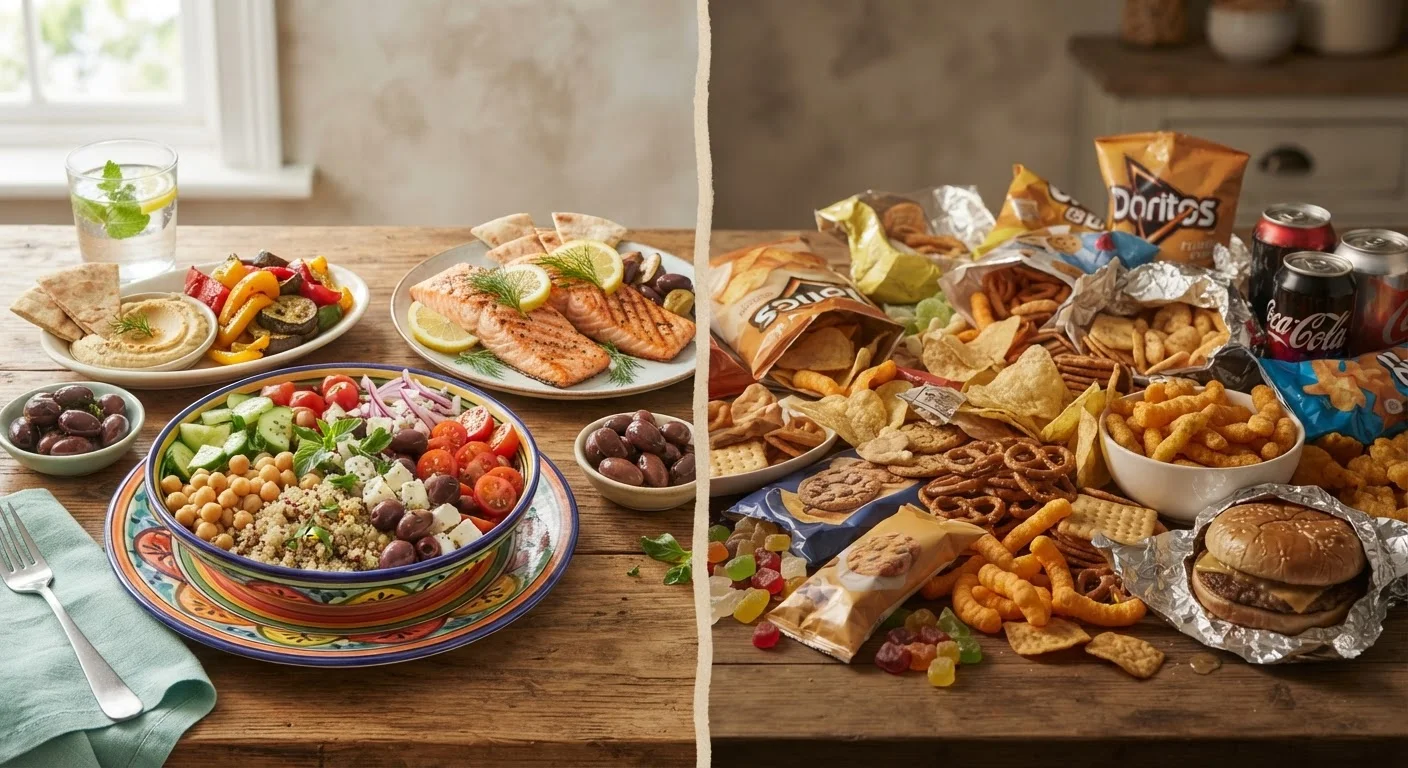
The mental health dimension of diet is increasingly well-supported in research, though it's important to recognize that findings are still developing and dietary change is one part of a broader picture. A comparison of Mediterranean and ultra-processed dietary patterns and their relationship to mood illustrates what a sustained dietary shift may - and may not - do for emotional wellbeing.
Dietary Change Is Not a Mental Health Treatment
While research supports a relationship between dietary patterns and mental wellbeing, improving your diet is not a substitute for professional mental health care. If you are experiencing symptoms of depression, anxiety, or another mental health condition, speak with a qualified healthcare provider. Dietary adjustments can complement - but should not replace - evidence-based treatment.
For a fuller view of how nutrition intersects with emotional health at every level, the complete picture from biology to daily habits offers a grounded end-to-end perspective. And if the behavioral side of eating is where you get stuck, it may also be worth examining the common myths about mindful eating that stop people before they start.
This article is for informational purposes only and does not constitute medical or dietary advice. Consult a qualified healthcare professional before making significant changes to your diet, especially if you have an existing health condition.