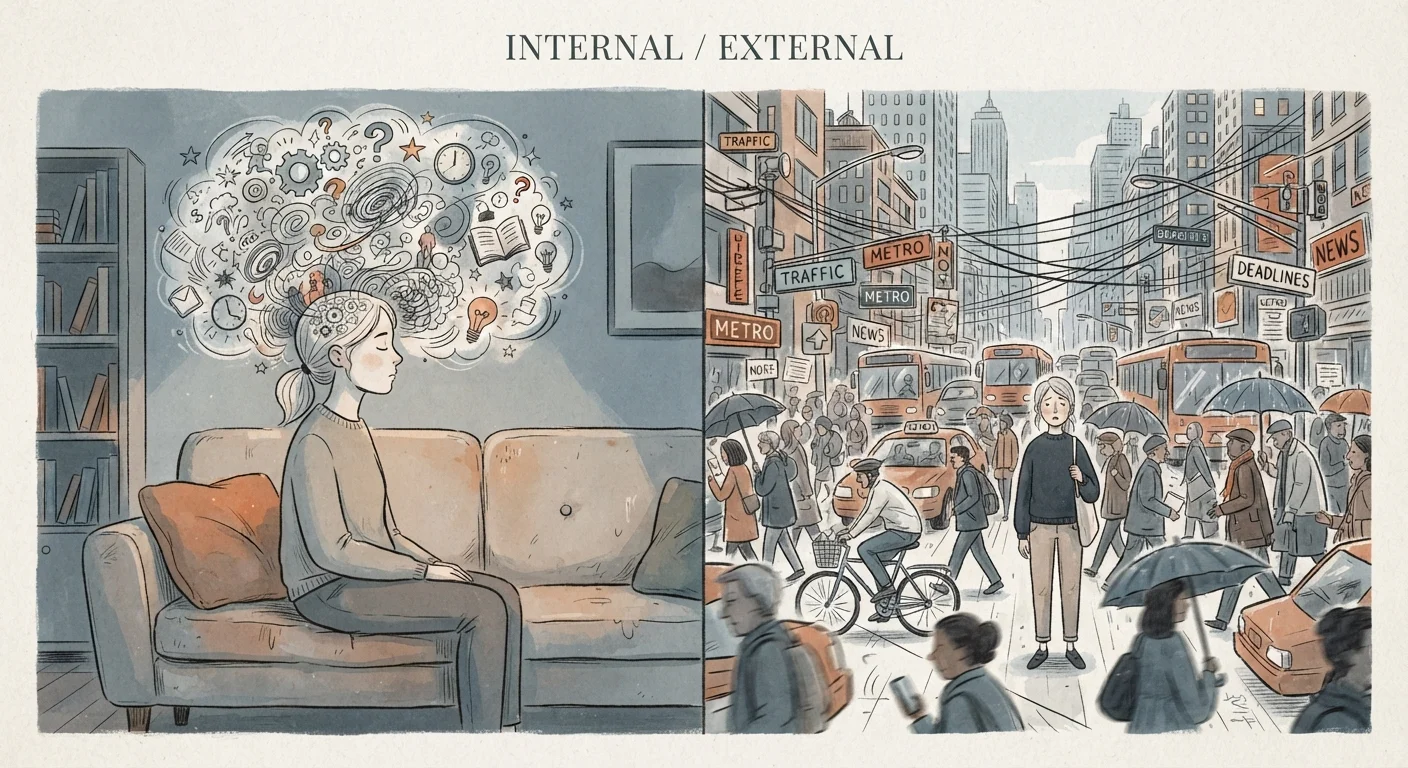

The Same Stressor, Radically Different Reactions
Picture two colleagues receiving the same critical feedback from their manager. One walks away energized, determined to improve. The other lies awake that night replaying every word. Neither is overreacting — they are simply wired differently.
Stress is not a uniform experience. It is the product of a complex interaction between your nervous system, your personal history, your current physical state, and the specific nature of the pressure you face. Understanding why your stress response looks the way it does can make it feel far less mysterious — and far more manageable.
~33%
Adults reporting extreme stress regularly
Surveys conducted by the American Psychological Association have repeatedly found that roughly a third of U.S. adults report living with extreme stress levels.
2x
Higher cortisol reactivity in highly sensitive individuals
Research on sensory processing sensitivity suggests that individuals with higher nervous system reactivity show measurably greater cortisol responses to comparable stressors than less reactive peers.
Up to 50%
Variance in stress response explained by genetics
Twin studies in behavioral genetics suggest that genetic factors may account for up to half of the individual differences observed in stress reactivity and emotional regulation.
Biological Factors That Shape Your Stress Response
Your nervous system has a natural set point — a baseline level of reactivity that is partly inherited. Research in behavioral genetics consistently finds that sensitivity to stress has a heritable component, meaning some people are simply born with a more reactive HPA axis (the brain-body circuit that releases stress hormones like cortisol).
This is not a flaw. Higher nervous system reactivity can also mean heightened awareness, creativity, and empathy. It is a trait, not a defect. But it does help explain why the same traffic jam that rolls off one person's shoulders can leave another feeling jangled for hours.
Hormonal differences also matter. Fluctuations in estrogen and progesterone, for example, are linked to changes in how the nervous system processes threat signals, which is one reason stress can feel noticeably different at different points in the menstrual cycle or across life stages.
Track Your Physical Stress Signals
Keep a simple log for one week: whenever you notice physical tension, fatigue, or restlessness, note the time, what you were doing, and how intense it felt on a scale of 1–10. Over time, patterns emerge that are far easier to act on than vague feelings of being 'stressed out.' This kind of self-monitoring is a foundational tool in many evidence-based stress-management programs.
How Your History Gets Written Into Your Body
Your nervous system is not static. It is shaped by everything you have lived through. Early-life experiences — particularly prolonged adversity or unpredictability — can alter the sensitivity of the stress response system in lasting ways. Researchers refer to this as allostatic load: the cumulative wear on the body from repeated or chronic stress exposure.
This means someone who grew up in an unpredictable environment may have a nervous system primed to detect threat quickly and respond strongly — a survival adaptation that can feel like being "too sensitive" in adulthood. Conversely, people with a history of secure attachment and consistent support often have a stress response that activates more proportionately and recovers more quickly.
This is not destiny. The brain retains a degree of plasticity throughout life, and targeted support — including therapy, mindfulness practice, and stable relationships — can meaningfully shift these patterns over time.
The Role of Context, Coping, and Daily Habits
Even with the same biology and history, stress intensity varies day to day based on what else is happening in your life. Sleep deprivation, poor nutrition, social isolation, and unresolved conflict all lower your threshold for feeling overwhelmed. When multiple stressors stack up simultaneously, the cumulative effect is often greater than each one alone.
It is also worth distinguishing between the stressor itself and your interpretation of it. Psychological research consistently shows that perceived control — whether you believe you have any influence over the situation — powerfully moderates the stress response. A demanding workload can feel exhilarating when you feel competent and supported, and crushing when you feel trapped. You can explore how internal and external stress triggers differ and how both shape your experience.
Coping style is another major variable. Active problem-solving, social support-seeking, and expressive writing are associated with more adaptive stress responses. Avoidance or rumination tend to amplify and prolong stress. Importantly, coping habits are learned behaviors — which means they can be unlearned and replaced.
“It is not stress that kills us, it is our reaction to it. Understanding your own reaction is therefore one of the most powerful tools available.”
— Hans Selye, Endocrinologist and pioneer of modern stress research
Recognizing Your Personal Stress Signature
Stress doesn't always announce itself clearly. For some people it shows up as physical tension — tight shoulders, a clenched jaw, persistent headaches. For others it looks more behavioral: procrastination, irritability, withdrawing from people they love. Some experience it primarily emotionally — a low-grade dread or a sudden loss of motivation. Our guide on when stress shows up as anger, numbness, or withdrawal explores these less obvious patterns in depth.
Noticing your own pattern — your personal "stress signature" — is genuinely useful. When you know that your first sign of overwhelm is sleep disruption rather than anxiety, you can intervene earlier. When you recognize that your irritability often precedes conscious awareness of pressure, you can name what's happening rather than acting on it.
If you want to understand how the duration of stress also changes the experience, the difference between acute and chronic stress is a helpful next step.
This article is for general informational and educational purposes only. It is not medical advice or a substitute for professional evaluation. If stress is significantly affecting your daily life, please speak with a qualified healthcare professional.