
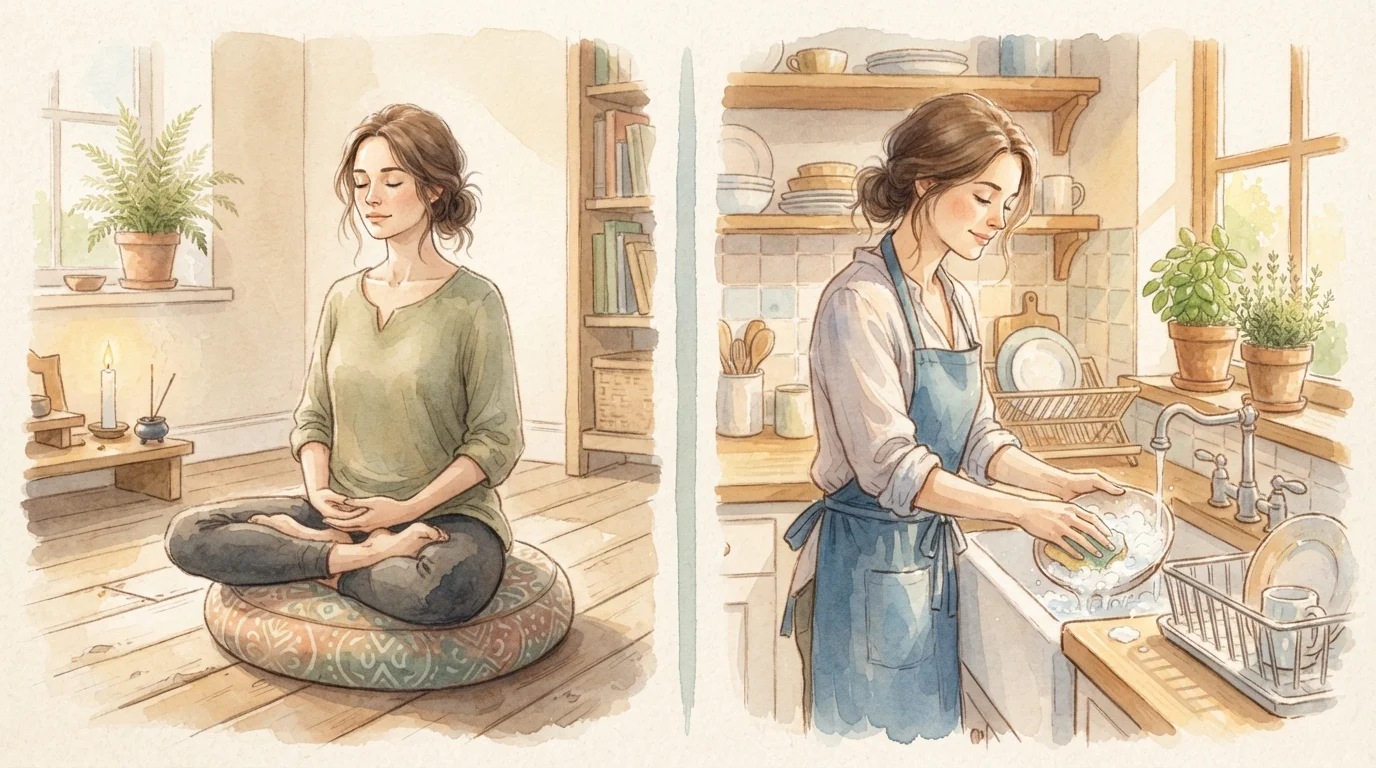
What Sets These Two Approaches Apart
When most people picture mindfulness, they imagine someone sitting cross-legged with eyes closed. That image captures formal practice — intentional, scheduled time devoted entirely to cultivating present-moment awareness. But mindfulness extends far beyond the meditation cushion.
Informal practice means bringing that same quality of attention — curious, non-judgmental, present — to activities you are already doing. Washing dishes, walking to the mailbox, eating lunch: any routine moment can become a mindfulness opportunity.
If you are new to the topic, it helps to start with a grounding definition. What mindfulness actually means goes deeper into what the practice really involves, including why the goal is not to empty your mind.
| Formal Practice | Informal Practice | |
|---|---|---|
| Time required | Dedicated block (5–30 min) | No extra time needed |
| Setting | Quiet, designated space | Anywhere, during daily tasks |
| Structure | Guided or timed session | Self-directed, moment-to-moment |
| Primary benefit | Builds focused attention skill | Extends awareness into daily life |
| Best for beginners? | Yes, with short sessions | Yes, especially for busy people |
| Equipment needed | None required (cushion optional) | None at all |
Formal Practice: Building the Skill
Formal mindfulness practice works like a workout for your attention. You set aside a block of time — typically five to thirty minutes — and focus on a chosen anchor, most commonly the breath. When the mind wanders (and it will), you simply notice and return. Repeating that cycle is the exercise itself.
Common formal formats include:
- Seated breath meditation — focusing on the physical sensation of each inhale and exhale
- Body scan — slowly moving attention through different parts of the body
- Loving-kindness meditation — silently extending goodwill toward yourself and others
Research published in peer-reviewed journals, including studies associated with Mindfulness-Based Stress Reduction (MBSR), consistently links regular formal practice with reductions in perceived stress and anxiety. Even brief daily sessions have shown measurable effects on self-reported well-being.
Start Shorter Than You Think You Need
Many beginners set an ambitious 20-minute target and then abandon practice entirely after a few frustrating sessions. Starting with just five minutes daily is genuinely effective and far easier to sustain. Consistency over weeks matters more than session length. You can always extend the time once the habit feels natural.
One honest caveat: formal practice can feel particularly difficult precisely when stress peaks. Why mindfulness feels harder when you're most stressed explains why this happens and how to work with it rather than against it.
Informal Practice: Mindfulness in Motion
Informal practice requires no schedule and no quiet room. It asks only that you bring deliberate attention to what is already happening. The objective is the same as formal practice — noticing present-moment experience without immediately reacting — just applied to the texture of ordinary life.
Examples include:
- Tasting each bite during a meal rather than eating on autopilot
- Feeling the temperature of water while showering
- Noticing the sounds around you during a short walk
- Pausing for three conscious breaths before answering a stressful email
Because it slots into existing routines, informal practice is often the more sustainable starting point for busy people. It also reinforces formal skills: the attention you train on the cushion becomes easier to access when making coffee or sitting in traffic.
Mindful eating is one well-studied form of informal practice. The mindful eating hub explores how bringing awareness to meals can ease stress-driven eating patterns and improve your relationship with food.
Choosing the Right Balance for You
There is no single correct ratio of formal to informal practice. Research suggests both contribute independently to stress resilience, and most mindfulness teachers recommend treating them as partners rather than alternatives.
A practical starting framework:
- Begin with one short formal session per day — even five minutes counts — to build the core skill.
- Choose two or three daily activities to practice informally (morning coffee, lunch, the commute home).
- Gradually extend formal sessions as comfort grows, while keeping informal anchors in place.
If you are weighing mindfulness against other self-help tools, journalling, mindfulness, and structured reflection compares these approaches side by side. And for a broader look at how mindfulness fits alongside relaxation techniques, see mindfulness vs. relaxation techniques.
8 weeks
Typical MBSR program length
Mindfulness-Based Stress Reduction programs — which blend formal and informal practice — typically run eight weeks and have been studied in numerous clinical trials for stress and anxiety.
5 min
Minimum effective formal session
Several studies suggest that even brief daily formal meditation sessions of around five minutes can produce measurable improvements in self-reported stress and attention over time.
This article is for general informational and educational purposes only and does not constitute medical advice. If you are experiencing significant stress, anxiety, or mental health concerns, please consult a qualified healthcare professional.