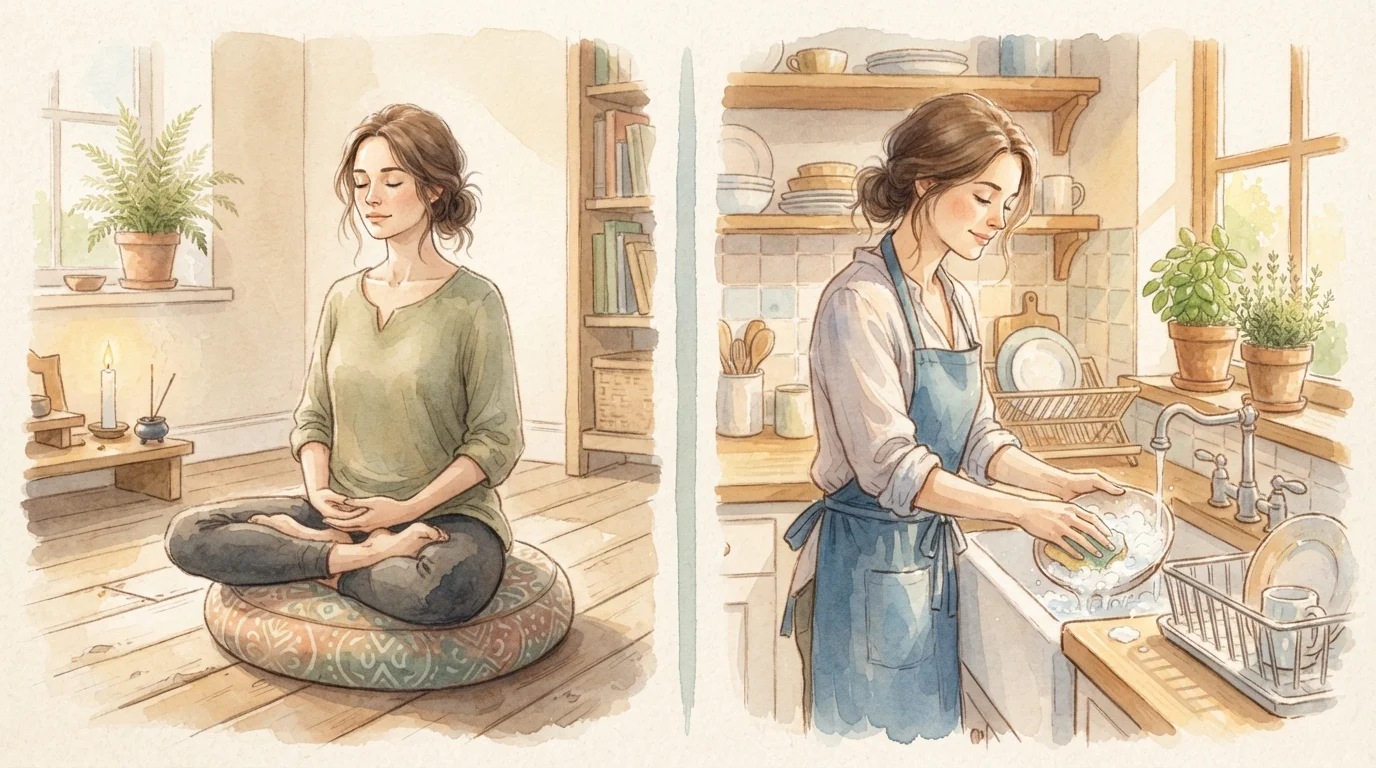

What Each Practice Actually Involves
Before comparing these approaches, it helps to be clear about what each one actually is - because they're often conflated or described vaguely.
Mindfulness is the practice of deliberately bringing attention to the present moment without judgment. It can take a formal shape (seated meditation, body scans, breathing exercises) or be woven into everyday activities like eating or walking. Research across clinical psychology consistently links regular mindfulness practice to reduced stress reactivity and improved emotional regulation. To understand how formal and informal versions differ, see formal vs. informal mindfulness practice.
Journalling means writing about your thoughts, feelings, and experiences with the intention of increasing self-awareness. This isn't the same as keeping a diary - intentional journalling is more deliberate. Journaling for emotional clarity explores this distinction in detail, including how structured writing differs from informal note-keeping.
Structured reflection sits somewhere between the two. It typically involves applying a consistent framework - a set of questions, a model like GROW or after-action review, or a weekly check-in ritual - to deliberately examine experiences, decisions, and patterns. Unlike open-ended journalling, it produces concrete observations; unlike mindfulness, it is retrospective rather than present-focused.
| Journalling | Mindfulness | Structured Reflection | |
|---|---|---|---|
| Primary mechanism | Writing to process emotions and thoughts | Present-moment awareness without judgment | Framework-guided analysis of experience |
| Time orientation | Past and present | Present moment only | Retrospective (past events) |
| Skill required to start | Low - just write freely | Low - but consistency takes practice | Low to moderate - requires a framework |
| Best for | Emotional processing, self-awareness | Stress reduction, anxiety, focus | Identifying patterns, goal-setting |
| Time commitment | 10-20 minutes per session | 5-20 minutes per session | 15-30 minutes per week minimum |
| Evidence base | Moderate, format-dependent | Strong for formal programmes | Moderate, draws on CBT principles |
| Works well with | Mindfulness before writing | Journalling after meditating | Journalling to capture insights |
How the Evidence Compares
Each practice has a different evidence base, and being honest about that matters.
Mindfulness has one of the strongest research profiles in the self-help space. Mindfulness-Based Stress Reduction (MBSR) and Mindfulness-Based Cognitive Therapy (MBCT) are established, clinician-delivered programmes with well-replicated findings. At-home mindfulness practice has a more mixed evidence base, though it still shows meaningful benefit for many people. The mindfulness for stress hub provides a broader overview of how these practices apply to everyday stress.
Journalling's research story is similarly nuanced. James Pennebaker's foundational work on expressive writing showed benefits for emotional processing and immune function, but more recent meta-analyses suggest effects vary considerably by format, population, and follow-through. For a grounded look at what the science actually supports, what the research actually says about journaling and mental health separates evidence from popular claims.
Structured reflection has a smaller dedicated research base, though it draws on well-evidenced CBT (Cognitive Behavioral Therapy) principles - particularly the idea that examining automatic thoughts and behavioural patterns supports mood regulation. It is widely used in coaching, leadership development, and educational psychology.
Start With What Feels Least Intimidating
If you're new to all three practices, resist the urge to optimize. Pick the one that feels most natural - even if it's imperfect - and give it two weeks before evaluating. Consistency at any level matters far more than choosing the "right" approach on day one. A brief, imperfect practice done regularly will outperform a sophisticated one that never happens.
Matching a Practice to Your Life
The most important filter is not which practice is most scientifically supported - it's which one you'll actually do.
Choose mindfulness if: you tend to ruminate, feel anxious, or find it hard to "switch off." Mindfulness is particularly effective at interrupting worry loops in the moment. It requires no writing and can be practiced in as little as five minutes. The barrier to entry is low, though consistency can be challenging without external prompts or apps.
Choose journalling if: you process emotions better when you can articulate them. Writing creates distance from overwhelming feelings, making them easier to examine. Different styles - gratitude, reflective, cognitive - target different goals. The journaling methods compared article can help you identify which format aligns with your current needs. If you're not sure where to start, starting a journaling practice when you have no idea what to write offers practical, low-pressure entry points.
Choose structured reflection if: you're analytically minded and want your self-examination to produce clear patterns or action steps. This approach works well for people who feel that open-ended journalling becomes circular, or that mindfulness feels too abstract. Daily practices that reinforce a growth-oriented perspective includes structured reflection within a broader set of evidence-informed habits.
8 weeks
Time for mindfulness to show structural brain changes
Research published in Psychiatry Research found measurable changes in brain grey matter density after an 8-week MBSR programme.
~15-20 min
Effective journalling session length
Pennebaker's original expressive writing research used 15-20 minute sessions across 3-4 consecutive days to produce emotional processing benefits.
Many practitioners find value in combining approaches - for example, using mindfulness to settle the mind before journalling, or ending a reflection session with a few minutes of present-moment breathing. There's no rule that says you must choose only one.
This article is for informational purposes only and is not a substitute for professional mental health advice, diagnosis, or treatment. If you're experiencing significant distress, please consult a qualified healthcare professional.