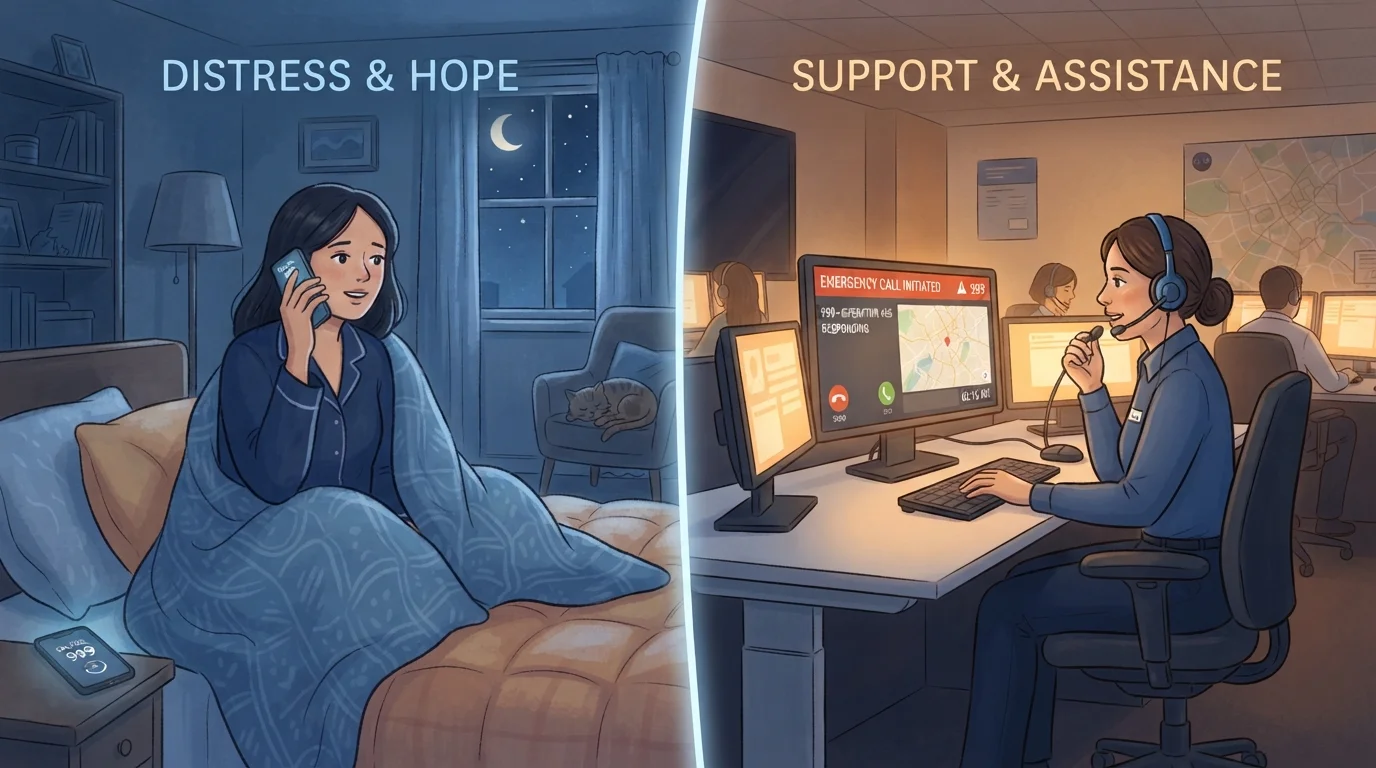

What Is a Mental Health Crisis?
A mental health crisis is a period of intense emotional or psychological distress that feels unmanageable on your own. It isn't a single, fixed event - it can look like overwhelming anxiety that won't ease, thoughts of self-harm, a complete inability to function day-to-day, or a sense that reality has become unreliable. What matters is not whether your distress 'qualifies' by some external standard, but whether it feels beyond your current capacity to cope.
Many people experiencing a crisis for the first time feel certain that something has gone permanently wrong with them. That fear is understandable, but it is rarely accurate. A crisis is a moment - one that can be responded to - not a life sentence.
Mental health crisis
A period of intense emotional or psychological distress that feels impossible to manage alone, often requiring immediate external support.
Crisis line
A free telephone or text service staffed by trained volunteers or professionals, available to provide immediate emotional support to people in distress.
Crisis team
An NHS community-based team that provides urgent mental health assessment and support, often as an alternative to hospital admission.
Psychiatric emergency
A situation involving immediate, serious risk to a person's life or safety due to a mental health condition - distinct from a crisis, which may not involve immediate danger.
Dissociation
A feeling of being detached from your own thoughts, body, or surroundings - often described as feeling unreal or like you're watching yourself from outside.
Before reading further, it may help to review our plain-language introduction to mental health, which covers foundational concepts without assuming prior knowledge.
What You Might Be Feeling Right Now
If this is your first time in crisis, the experience itself can be frightening to describe. Common feelings include a sense of unreality, physical symptoms like a racing heart or difficulty breathing, an inability to think clearly, and an overwhelming urge to escape - the situation, the feeling, or sometimes yourself. You may also feel ashamed or embarrassed, worried about burdening others, or convinced that no one could understand.
All of these reactions are normal responses to abnormal levels of distress. They are not signs of weakness or failure.
Shame Can Be a Barrier to Help
Many people in crisis delay reaching out because they worry about being judged, being seen as dramatic, or causing inconvenience. Crisis services exist precisely for moments like this - you are not wasting anyone's time by asking for help. Waiting until things feel 'bad enough' can make a crisis harder to navigate.
If someone you care about is in crisis and you're trying to help them while managing your own distress, our guide on supporting someone through a mental health crisis without burning out addresses your situation directly.
Your Immediate Options for Support
In the UK, several pathways are available to you right now, depending on the level of support you need.
- Samaritans (116 123): A free, confidential helpline available 24 hours a day, every day of the year. You don't need to be suicidal to call - any level of distress is welcome.
- NHS 111: If you're unsure whether you need urgent mental health support, NHS 111 can assess your situation and connect you with local crisis services.
- Your GP: For same-day or urgent appointments, most GP practices have a system for mental health emergencies. Be direct about how you're feeling.
- A&E: If you or someone else is in immediate danger, going to your nearest accident and emergency department is appropriate.
- Crisis text lines: SHOUT (text 85258) offers text-based crisis support for those who find it hard to speak on the phone.
You Don't Have to Explain Everything
When you contact a helpline or crisis service, you don't need a clear, ordered account of what's happened. Simply saying 'I'm not coping and I don't know what to do' is enough to begin. Crisis workers are trained to help you find words when yours have run out.
For a fuller comparison of when each type of response is most appropriate, see our guide on crisis vs. emergency: knowing when to call a helpline. A comprehensive directory of UK-specific services is also available in our mental health crisis resources reference guide.
What Happens After the Crisis
Getting through a crisis is significant - but the period that follows matters too. Once the immediate intensity has passed, many people feel a mix of relief, exhaustion, and uncertainty about what comes next. This is a natural response, and it's also an important window for connecting with more sustained support.
Your GP can refer you to a community mental health team, talking therapies, or other services depending on your needs. If you're not sure how to start that conversation, our guide to finding mental health support when you don't know where to begin walks you through the process step by step. For an introduction to therapy and what it involves, the therapy basics hub is a good starting point.
A crisis often signals that something needs ongoing attention - not as a cause for alarm, but as useful information. Seeking follow-up care is one of the most practical things you can do for your long-term wellbeing.
Crisis Support Is a Starting Point
Helplines and crisis teams are designed to stabilize the immediate situation - they are not a substitute for ongoing mental health care. Once the acute phase has passed, connecting with your GP or a mental health professional is an important next step toward longer-term support.
This article is for general informational purposes only and does not constitute medical or clinical advice. If you are in immediate danger, please contact emergency services or go to your nearest A&E. Always consult a qualified healthcare professional for guidance specific to your situation.