Why These Three So Often Get Confused
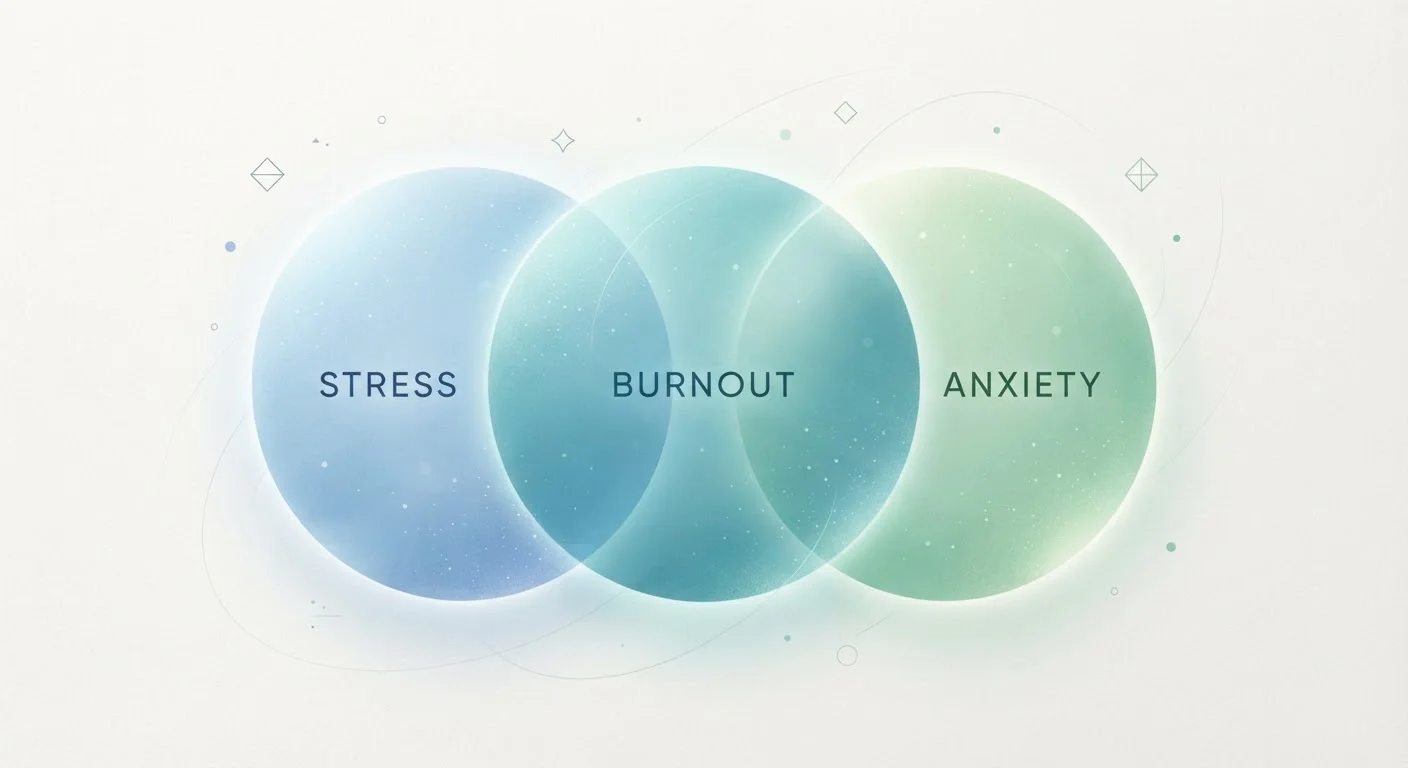
If you've ever Googled "why am I so exhausted and on edge," you've likely run into all three terms - stress, burnout, and anxiety - used almost interchangeably. That's understandable. They share real common ground: difficulty sleeping, trouble concentrating, irritability, and a nagging sense that something is wrong. But they aren't the same experience, and treating them as identical can mean reaching for the wrong kind of support.
Think of it this way: all three are signals your mind and body send when something is off. The difference lies in what's triggering the signal, how long it lasts, and what helps it ease. Understanding those distinctions - even roughly - can help you feel less confused and more capable of taking a useful next step.
For a deeper look at how anxiety and stress are clinically distinguished, see when stress crosses into anxiety disorder.
Stress: A Response With a Source
Stress is the body and mind's natural reaction to demand or pressure. It has a cause you can usually point to: a looming deadline, a difficult conversation, financial worry, a health scare. The stress response - elevated heart rate, heightened alertness, a sense of urgency - evolved to help us meet challenges. In short bursts, it can even improve performance.
The defining feature of stress is that it tends to be situational and proportional. When the stressor eases, so does the stress - at least to some degree. A difficult week at work feels heavy, but the weekend brings some relief. A hard conversation eventually ends.
That said, stress that continues without adequate recovery time is where things begin to shift. Ongoing, unrelieved stress is the soil in which burnout grows. Understanding your personal stress triggers is often a useful starting point.
Check In With Your Recovery
One useful question to ask yourself: does a good night's sleep or a relaxing weekend make a noticeable difference to how you feel? If rest genuinely helps, stress is likely a significant factor. If rest barely touches the exhaustion, burnout may be more relevant. This isn't a diagnosis - just a useful starting observation to bring to a professional.
Burnout: What Happens When Stress Goes Unaddressed
Burnout isn't just severe stress. It's a distinct state that develops over time when demands consistently outpace recovery. The World Health Organization classifies burnout as an occupational phenomenon characterized by three core features: exhaustion, cynicism or mental distance from one's work, and reduced sense of effectiveness.
Where stress tends to make people feel urgently wound up, burnout often produces the opposite: a hollow flatness, a loss of motivation, and emotional numbness. People experiencing burnout frequently describe feeling like they have nothing left to give - not just tired, but emptied out. Tasks that once felt meaningful may feel pointless.
Burnout also develops gradually, which is partly what makes it hard to recognise. Most people don't wake up burned out; they drift there over months. Our burnout overview covers its warning signs and how it tends to develop. If you want to reflect more carefully on where you currently sit, the symptom mapping guide offers a structured way to do that.
| Stress | Burnout | Anxiety | |
|---|---|---|---|
| Typical cause | Identifiable external pressure | Prolonged, unrelieved demands | Can persist without clear external cause |
| Emotional quality | Urgency, tension, overwhelm | Emptiness, numbness, cynicism | Persistent worry, sense of threat |
| Energy level | Still engaged, though strained | Depleted, nothing left to give | Varies; often tense and hypervigilant |
| Eases when stressor resolves? | Usually yes | Not quickly; recovery takes time | Not necessarily |
| Common support approach | Rest, problem-solving, boundaries | Structural change, professional support | CBT, therapy, sometimes medication |
Anxiety: When the Alarm Keeps Sounding
Anxiety shares territory with stress but differs in an important way: it doesn't necessarily require an external stressor to persist. While stress is a response to something identifiable, anxiety can continue - or intensify - even when life circumstances are relatively calm. It often involves persistent worry, physical tension, and a sense of threat that feels difficult to switch off, even when you know, rationally, that things are okay.
Anxiety exists on a spectrum. Feeling anxious before a big presentation is normal and expected. But when worry is frequent, hard to control, and begins to interfere with daily functioning, it may reflect an anxiety disorder - a clinically recognised condition that responds well to professional support.
It's also worth noting that burnout can make anxiety worse, and anxiety can make someone more vulnerable to burnout. They often co-occur. For a closer look at how clinicians approach these overlapping presentations, how clinicians distinguish burnout, depression, and anxiety is a helpful companion read.
When to Seek Professional Support
If worry, exhaustion, or emotional numbness has been present for several weeks or more, is interfering with work, relationships, or daily life, or is accompanied by feelings of hopelessness, please reach out to a qualified mental health professional. In the US, you can contact the SAMHSA National Helpline at 1-800-662-4357 for free, confidential referrals. You don't need to have everything figured out before asking for help.
Why the Distinction Matters - and What to Do With It
Naming what you're experiencing isn't about labelling yourself. It's about finding a map. Stress often responds to practical changes: reducing workload, improving sleep, setting clearer limits around work. Burnout typically requires something more structural - real rest, meaningful change in how demands are distributed, and often professional guidance. Anxiety, particularly when it persists across situations, tends to benefit most from evidence-based approaches like cognitive behavioral therapy (CBT) or, in some cases, medication - decisions best made with a qualified mental health professional.
None of these experiences mean something is fundamentally wrong with you. They're signals worth listening to. If you're unsure which resonates most, the core distinctions between stress and burnout and recognising when stress overlaps with anxiety or depression are both worth exploring.
This article is for general informational and educational purposes only. It is not a substitute for professional medical or mental health advice, diagnosis, or treatment. If you are concerned about your mental health, please consult a qualified healthcare professional.