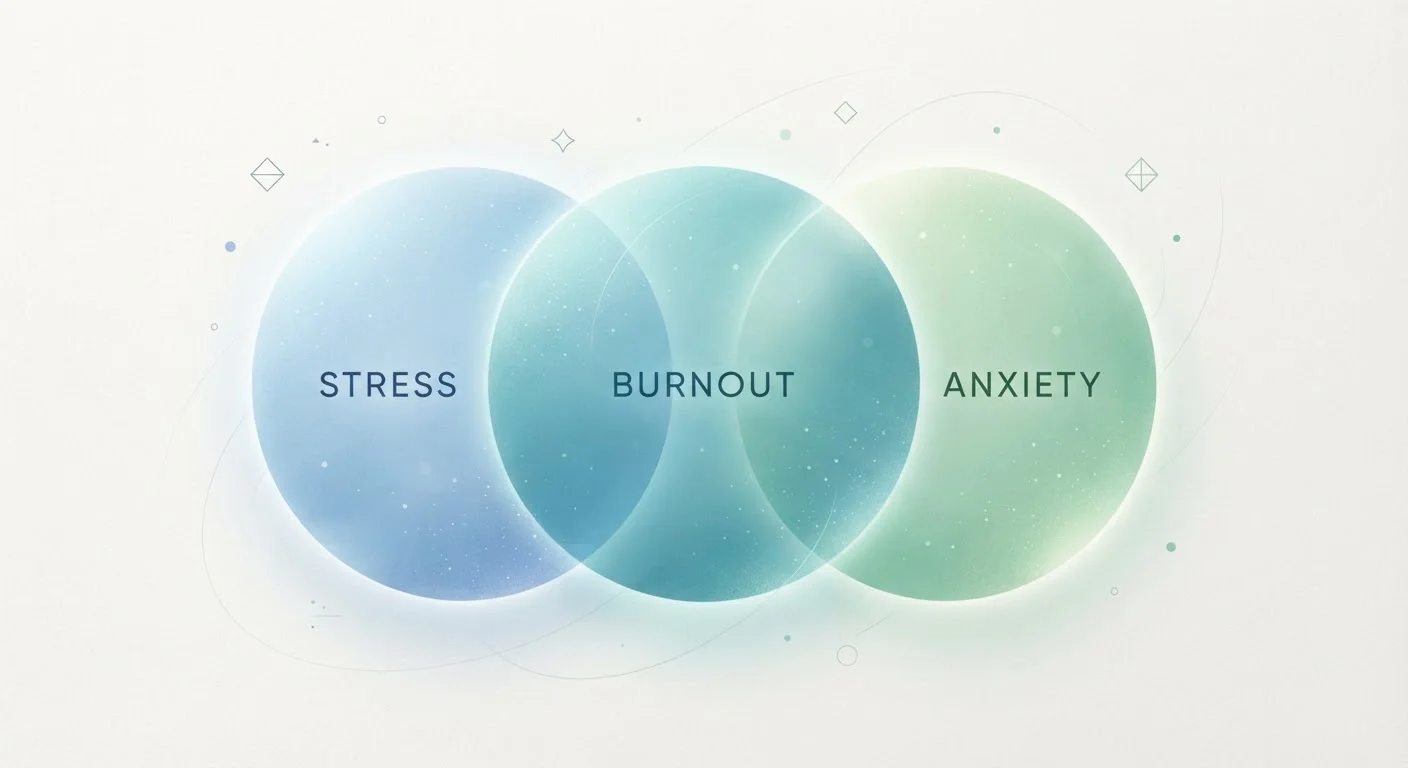

Why These Three Conditions Are So Easy to Confuse
Exhaustion, difficulty concentrating, irritability, and pulling back from others - these symptoms appear in burnout, depression, and anxiety alike. That overlap is precisely why people often spend months unsure what they are dealing with, or assume one condition when another is actually present.
Clinicians approach these distinctions carefully because the path forward differs significantly. Understanding what separates them - and where they converge - is a useful first step before seeking support. For a broader look at how burnout is formally defined, see Burnout at a Glance.
Defining Each Condition on Its Own Terms
Burnout is classified by the World Health Organization as an occupational phenomenon - not a medical disorder - resulting from chronic workplace stress that has not been adequately managed. It presents through three core dimensions: emotional exhaustion, a sense of detachment or cynicism toward one's work (called depersonalization), and reduced feelings of professional accomplishment. A defining feature is context-specificity: burnout is tethered to a role or environment, and symptoms often ease - at least partially - during vacations, weekends, or after a job change.
Depression (formally, major depressive disorder) is a clinical diagnosis defined in the DSM-5 by at least two weeks of persistent low mood or loss of interest, accompanied by a cluster of symptoms such as changes in sleep and appetite, fatigue, feelings of worthlessness, difficulty thinking, and - in severe cases - thoughts of death or suicide. Crucially, depression does not require a triggering stressor and does not lift reliably with rest or a change of environment.
Anxiety disorders encompass several diagnoses - generalized anxiety disorder, panic disorder, social anxiety disorder, and others - but share a common thread: excessive, difficult-to-control worry or fear that persists and causes real functional impairment. Where burnout exhausts, anxiety tends to agitate. The nervous system stays in a heightened state even when no immediate threat is present.
| Burnout | Depression | Anxiety Disorder | |
|---|---|---|---|
| Classification | Occupational phenomenon (WHO) | Clinical diagnosis (DSM-5) | Clinical diagnosis (DSM-5) |
| Primary emotion | Exhaustion and detachment | Persistent sadness or emptiness | Excessive fear or worry |
| Context-dependence | Tied to specific role or setting | Pervades all areas of life | Often not tied to a specific context |
| Response to rest | Partial improvement common | Unlikely to resolve with rest alone | Unlikely to resolve with rest alone |
| Physical symptoms | Fatigue, reduced motivation | Sleep/appetite changes, fatigue | Muscle tension, rapid heartbeat |
| Typical treatment pathway | Recovery, boundary-setting, systemic change | Therapy, medication, or both | Therapy (especially CBT), medication |
Where the Lines Blur - and Why That Matters
Burnout that goes unaddressed can develop into clinical depression. Chronic anxiety can contribute to burnout. And someone can meet diagnostic criteria for depression and an anxiety disorder at the same time - a common pattern known as comorbidity. This is why self-diagnosis based on symptom checklists carries real limits.
A few practical distinctions that clinicians often use:
- Does relief come with rest? A long weekend or holiday that meaningfully reduces symptoms points more toward burnout. Depression and anxiety disorders are unlikely to respond so quickly or reliably.
- Is the distress tied to a specific domain? Burnout stays anchored to a context. Depression tends to color all areas of life - relationships, hobbies, sense of self - regardless of setting.
- Is the predominant feeling exhaustion or fear? Profound flatness and emptiness lean toward depression; pervasive dread and hypervigilance lean toward anxiety.
For a deeper look at how these experiences interact, Stress, Burnout, and Anxiety: Untangling Three Overlapping Experiences offers additional context.
Tracking Symptoms Over Time Helps
Keeping a simple daily log of mood, energy, sleep, and triggers for two to three weeks can give a clinician much more useful information than memory alone. Note whether bad days cluster around work or occur regardless of what is happening. Patterns that emerge over time - rather than a single snapshot - are what professionals use to guide a thorough assessment.
When to Seek Professional Input
If symptoms are persistent - lasting more than a few weeks - or are significantly affecting your ability to work, maintain relationships, or care for yourself, professional evaluation is appropriate. A primary care physician, psychologist, or psychiatrist can conduct a thorough assessment that accounts for medical causes, life context, and symptom patterns that a self-assessment cannot reliably capture.
If you are trying to decide how to raise these concerns with a doctor, manager, or loved one, Conversations Worth Having When You Suspect Burnout offers practical guidance on framing those discussions.
Avoid Using Labels as a Reason to Wait
People sometimes delay seeking help because they are uncertain whether what they feel is "serious enough" to count as depression or anxiety, versus "just burnout." This uncertainty is understandable, but it should not become a barrier. Any persistent condition that is affecting your quality of life warrants professional attention. A clinician can assess the full picture - you do not need to arrive with a self-diagnosis in hand.
This article is for general informational purposes only and is not a substitute for professional medical advice, diagnosis, or treatment. If you are experiencing distress or mental health symptoms, please consult a qualified healthcare provider.