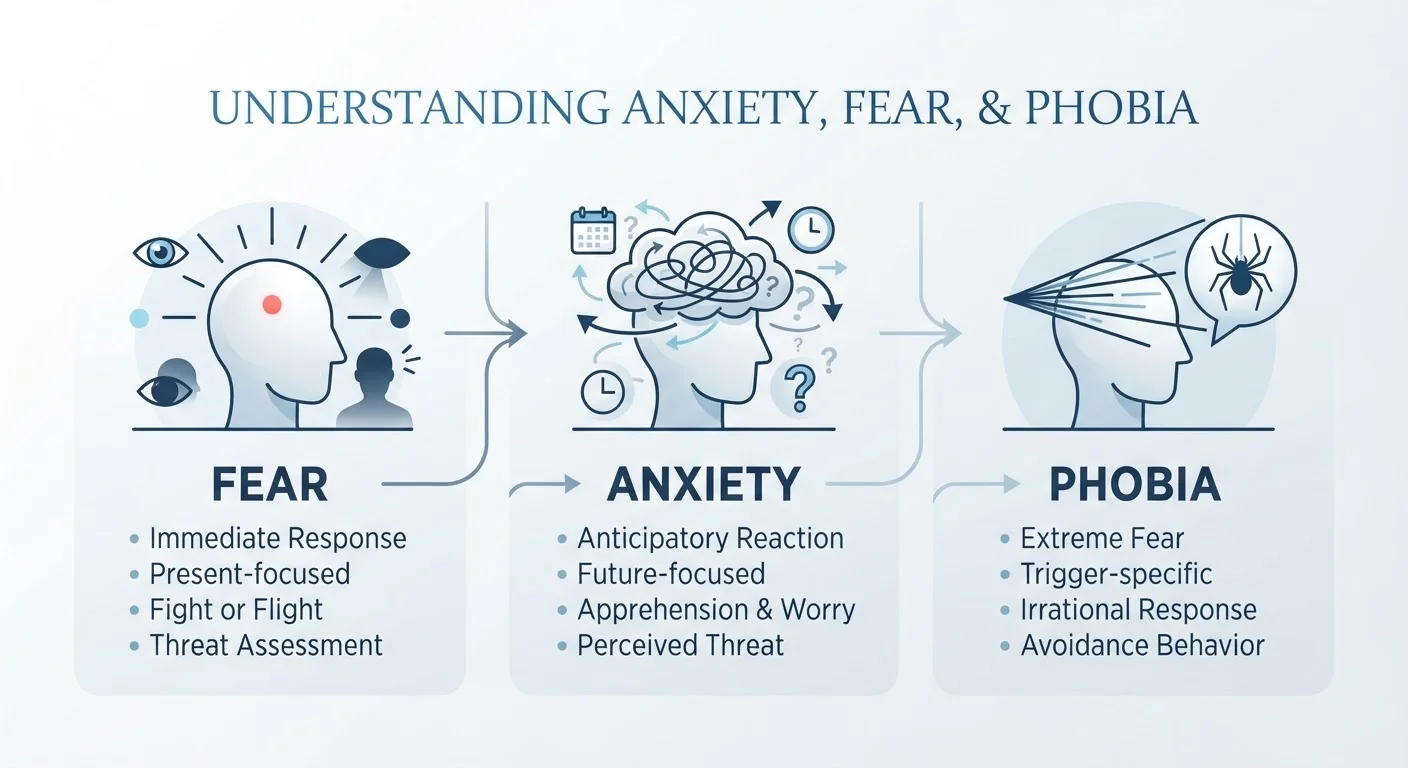

What Are Intense Fear Responses?
Fear is a normal, protective emotion - the brain's alarm system for real danger. But when that alarm fires without an actual threat, or fires in proportion far exceeding any real risk, the experience crosses into clinical territory. Two of the most well-documented examples of disordered fear responses are panic disorder and specific phobias.
It helps to separate a few terms that are frequently blurred. Fear is a response to a known, present threat. Anxiety is a forward-looking unease about something that might happen. A phobia is an intense, irrational fear tied to a specific object or situation. For a more detailed breakdown of these distinctions, see Fear, Anxiety, and Phobia: Sorting Out the Terminology.
Understanding where your experience fits within these categories is the first step toward making sense of it - and toward knowing what kind of support might help.
~11%
U.S. adults affected by panic disorder in their lifetime
Lifetime prevalence estimates from national epidemiological surveys consistently place panic disorder among the most common anxiety disorders.
~12%
U.S. adults who experience a specific phobia
The National Institute of Mental Health estimates that specific phobias affect roughly 12% of U.S. adults at some point in their lives.
10 min
Typical time for a panic attack to reach peak intensity
Clinical descriptions consistently note that panic attack symptoms usually peak within approximately 10 minutes of onset.
Understanding Panic Disorder
A panic attack is a sudden surge of overwhelming fear accompanied by intense physical symptoms. These can include a racing or pounding heart, shortness of breath, chest tightness, dizziness, trembling, sweating, and a sense of unreality or detachment. Most attacks peak within 10 minutes and resolve within 30.
What makes panic disorder distinct - rather than isolated panic attacks - is the pattern that follows. According to criteria in the DSM-5, panic disorder is characterized by recurrent, unexpected panic attacks plus at least one month of either persistent worry about future attacks or significant changes in behavior aimed at avoiding them.
Rule Out Medical Causes First
Panic attack symptoms - chest pain, racing heart, shortness of breath - overlap significantly with symptoms of cardiac and respiratory conditions. Anyone experiencing these symptoms for the first time should seek a medical evaluation to rule out physical causes before attributing them to panic disorder. Do not self-diagnose.
Panic disorder often leads people to misinterpret physical symptoms as signs of a heart attack or other medical emergency. While physical causes should always be ruled out by a doctor, repeated negative medical workups alongside the symptom pattern described above are a common presentation. For a closer look at what precedes episodes, identifying your personal panic triggers can be a useful next step.
Panic disorder can also give rise to agoraphobia - a fear of situations where escape might be difficult or help unavailable during a panic attack. This relationship is explored in detail in Agoraphobia and Panic Disorder: How the Two Are Connected.
When a panic attack strikes, labeling what is happening - literally saying or thinking 'this is a panic attack' - can interrupt the cycle of catastrophic interpretation that intensifies symptoms.
Research on cognitive interventions shows that accurate appraisal of bodily symptoms reduces their perceived threat, which in turn reduces peak symptom intensity.
Avoidance feels like relief in the short term, but every time you avoid a feared situation, you send the brain a signal that the threat was real - making the fear stronger, not weaker.
Behavioral models of anxiety are well-supported in showing that avoidance maintains and escalates phobic and panic responses over time.
Understanding Specific Phobias
A specific phobia is a marked, persistent fear of a particular object or situation that is out of proportion to any actual danger it poses. The DSM-5 organizes specific phobias into five broad categories: animal type (spiders, dogs), natural environment type (heights, storms), blood-injection-injury type, situational type (flying, enclosed spaces), and other type.
The defining feature is that exposure to the feared stimulus - or even anticipating exposure - reliably triggers immediate anxiety. People with specific phobias typically recognize that their fear is excessive, but that awareness does not reduce it. Avoidance of the trigger becomes the primary coping mechanism, which often narrows a person's life significantly.
Specific phobias are among the most common anxiety disorders, affecting an estimated 12% of adults in the U.S. at some point in their lives. For a detailed look at the range of phobia types and what research reveals about each, see Common Types of Specific Phobias and the Fears Behind Them.
How Phobias and Panic Disorder Differ
Both conditions involve intense fear and overlap in important ways, but they are clinically distinct. The key differences lie in what triggers the fear and how predictable it is.
- Trigger specificity: Specific phobias have a clearly identifiable trigger. Panic disorder, by definition, includes at least some attacks that are unexpected - they arise without an obvious cue.
- Anticipatory anxiety: People with specific phobias mainly fear encountering the trigger. People with panic disorder fear having another attack itself, regardless of setting.
- Avoidance pattern: Phobia avoidance is targeted (avoiding elevators, for example). Panic disorder avoidance can become broad and diffuse, as nearly any situation may feel potentially unsafe.
It is also worth noting how these conditions differ from related anxiety disorders. Social anxiety disorder centers on fear of social evaluation, while generalized anxiety disorder involves chronic, wide-ranging worry rather than discrete fear responses to specific triggers.
Comorbidity Is Common
Panic disorder and specific phobias frequently occur alongside other anxiety disorders, depression, or substance use. A thorough professional evaluation will consider the full picture rather than focusing on a single diagnosis. Treating one condition often requires addressing others that coexist.
Evidence-Based Approaches to Treatment
Both panic disorder and specific phobias have well-established treatment frameworks. The goal of treatment is not to eliminate fear entirely - fear is healthy - but to reduce its intensity, improve functioning, and break the cycle of avoidance.
Cognitive Behavioral Therapy (CBT) is the most extensively studied psychological treatment for both conditions. For panic disorder, CBT typically includes psychoeducation about the body's fear response, restructuring catastrophic thoughts about symptoms, and controlled exposure to feared physical sensations. For phobias, the primary active ingredient is exposure therapy - gradual, structured contact with the feared object or situation, beginning with less threatening scenarios and working toward the most feared.
Medication may also be considered, particularly for panic disorder. Selective serotonin reuptake inhibitors (SSRIs) and serotonin-norepinephrine reuptake inhibitors (SNRIs) are commonly used; short-term benzodiazepines are sometimes prescribed with caution. Any medication decisions should be made with and monitored by a qualified prescriber.
Start with Psychoeducation
Before diving into any formal treatment, learning how your nervous system produces fear responses can itself be therapeutic. Understanding that panic symptoms are the result of a normal physiological process - not evidence of a serious medical event - reduces their power. Many therapists begin treatment here for exactly this reason.
When to Seek Professional Support
Many people experience isolated moments of intense fear without meeting the threshold for a diagnosable condition. What typically signals the need for professional evaluation is impairment - when fear begins to interfere with work, relationships, physical health, or quality of life.
Consider reaching out to a mental health professional if you notice any of the following:
- Repeated unexpected panic attacks, especially with persistent worry about recurrence
- Avoidance of situations, places, or activities that used to be routine
- Physical symptoms of fear that are ruling out by a doctor but remain unexplained
- Significant distress about your fear responses that is hard to manage alone
A licensed therapist, psychologist, or psychiatrist can conduct a thorough assessment, rule out other conditions, and recommend a personalized treatment plan. This article is general educational information - it is not a substitute for professional evaluation or care. If you are in distress or feel unsafe, please contact a crisis line or emergency service.
This article is for informational purposes only and is not a substitute for professional medical or mental health advice, diagnosis, or treatment. Always consult a qualified healthcare provider with questions about your health.