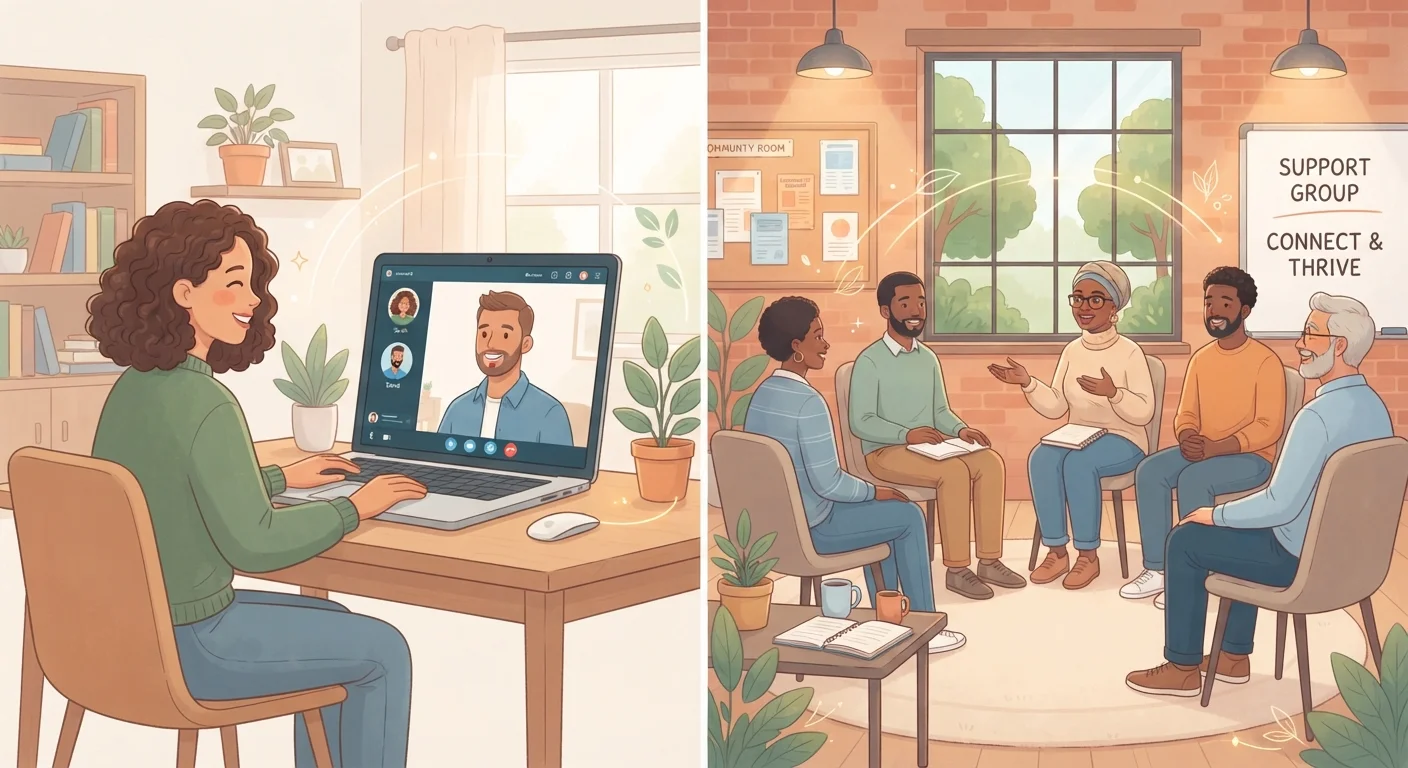
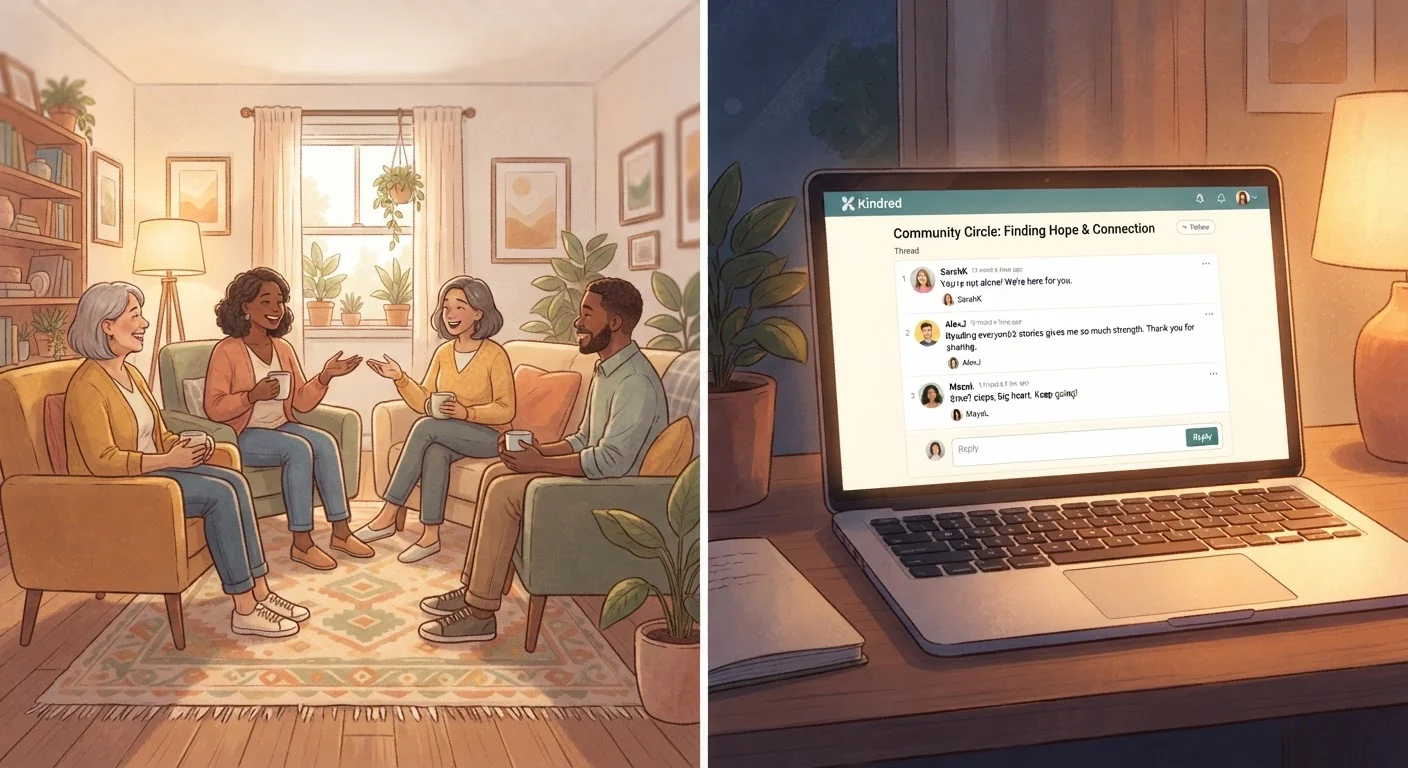
Why the Medium of Connection Matters
Human connection is one of the most consistently supported protective factors in mental health research. Strong social bonds are associated with lower rates of depression and anxiety, better stress recovery, and greater overall resilience. But the channels through which we build those bonds have multiplied — and they differ in meaningful ways.
Online communities and in-person networks both foster genuine belonging, yet they do so through distinct mechanisms. Understanding those differences can help you make intentional choices about where to invest your energy — and when to draw on each. For a complementary look at how digital spaces specifically affect wellbeing, see what online social connection can and cannot offer.
| Criterion | Online Communities | In-Person Networks |
|---|---|---|
| Accessibility | 24/7, location-independent | Requires proximity and scheduling |
| Anonymity | Often available; reduces disclosure risk | Typically none; known identity |
| Nonverbal richness | Limited; text or video only | Full — tone, touch, expression |
| Relationship depth over time | Variable; often shallower | Higher with regular contact |
| Niche community fit | Strong; global reach | Limited by local population |
| Moderation & safety | Highly variable by platform | More predictable social norms |
| Reciprocal support | Possible but less consistent | More reliable with established ties |
What Online Communities Do Well
Digital support spaces — whether forums, moderated chat groups, or social media communities centered on a shared experience — excel in accessibility. They are available around the clock and require no commute, childcare arrangement, or geographical proximity. For someone in a rural area, or going through a difficult night when local support is unavailable, this matters enormously.
Online communities also lower the barrier to disclosure. Anonymity or pseudonymity can make it easier to share difficult feelings without fear of social consequences. Research on peer support communities suggests that this reduced social risk encourages people to open up who might otherwise stay silent. Niche communities — for specific health conditions, grief experiences, or identity groups — can also provide a sense of being deeply understood by people who share your exact situation.
~75%
Adults who report social media use for emotional support
Pew Research Center surveys have consistently found a large majority of US adults use online platforms partly for social connection and support, though findings vary by age group and platform.
50%
Reduced mortality risk linked to strong social ties
A meta-analysis published in PLOS Medicine found that people with adequate social relationships had approximately 50% greater odds of survival compared to those with poor or insufficient social ties.
The limitations are real, too. Online interactions lack the nonverbal richness of in-person contact: no tone of voice, no facial microexpressions, no comforting physical presence. Misunderstandings are more common, and the quality of moderation varies widely. Some communities can inadvertently reinforce unhelpful thought patterns if they lean toward venting rather than growth. See our guide to building support networks for strategies on evaluating community quality.
What In-Person Networks Offer
Face-to-face connection engages the body as well as the mind. Physical co-presence — sharing a meal, sitting in the same room, or even a brief embrace — activates neural and hormonal pathways associated with safety and trust. Research on social bonding suggests that physical proximity and synchronised nonverbal behavior (mirroring expressions, matching breathing) deepen the felt sense of being understood in ways that text-based interaction cannot fully replicate.
In-person networks also tend to be more reciprocal over time. When you see the same people regularly — at a community group, a place of worship, a fitness class, or simply as neighbors — the relationship accumulates history and mutual investment. This depth of tie is associated with stronger resilience outcomes compared with broader but shallower networks.
The trade-offs include logistical demands: travel, scheduling, the social energy required to show up when you're already depleted. Stigma around mental health struggles can also make in-person disclosure feel riskier. For those navigating structured peer support specifically, how online support groups and in-person meetings compare explores these trade-offs in detail.
Choosing, Combining, and Knowing Your Limits
For most people, the most resilient approach is not either/or. Online communities can supplement in-person relationships — filling gaps during difficult moments, connecting you with peers who share niche experiences, or serving as a low-pressure space to process feelings before raising them with people in your life. In-person networks anchor you in place and relationship in ways that sustain long-term wellbeing.
A few questions worth reflecting on: Do you need access now, at any hour? Online may suit you better in the short term. Do you feel isolated in your immediate community? An online space might bridge the gap while you build local ties. Are you looking for accountability and depth? In-person relationships tend to provide more of both.
Quality Matters More Than Format
Research consistently suggests that the quality of connections — characterized by trust, reciprocity, and genuine understanding — predicts wellbeing outcomes more reliably than simply the number of connections or whether they occur online or offline. A single supportive, trusted relationship can be more protective than a large network of superficial ones. As you evaluate your own support landscape, focus on depth and consistency alongside accessibility.
Whatever format you choose, neither replaces professional mental health care when that level of support is needed. For guidance on getting started with professional help, compare online and in-person therapy options to find the setting that suits your situation. You can also explore how community belonging broadly supports resilience through our community connection hub.
This article is for general informational and educational purposes only and is not a substitute for professional mental health advice, diagnosis, or treatment. If you are concerned about your mental health, please consult a qualified healthcare professional.