
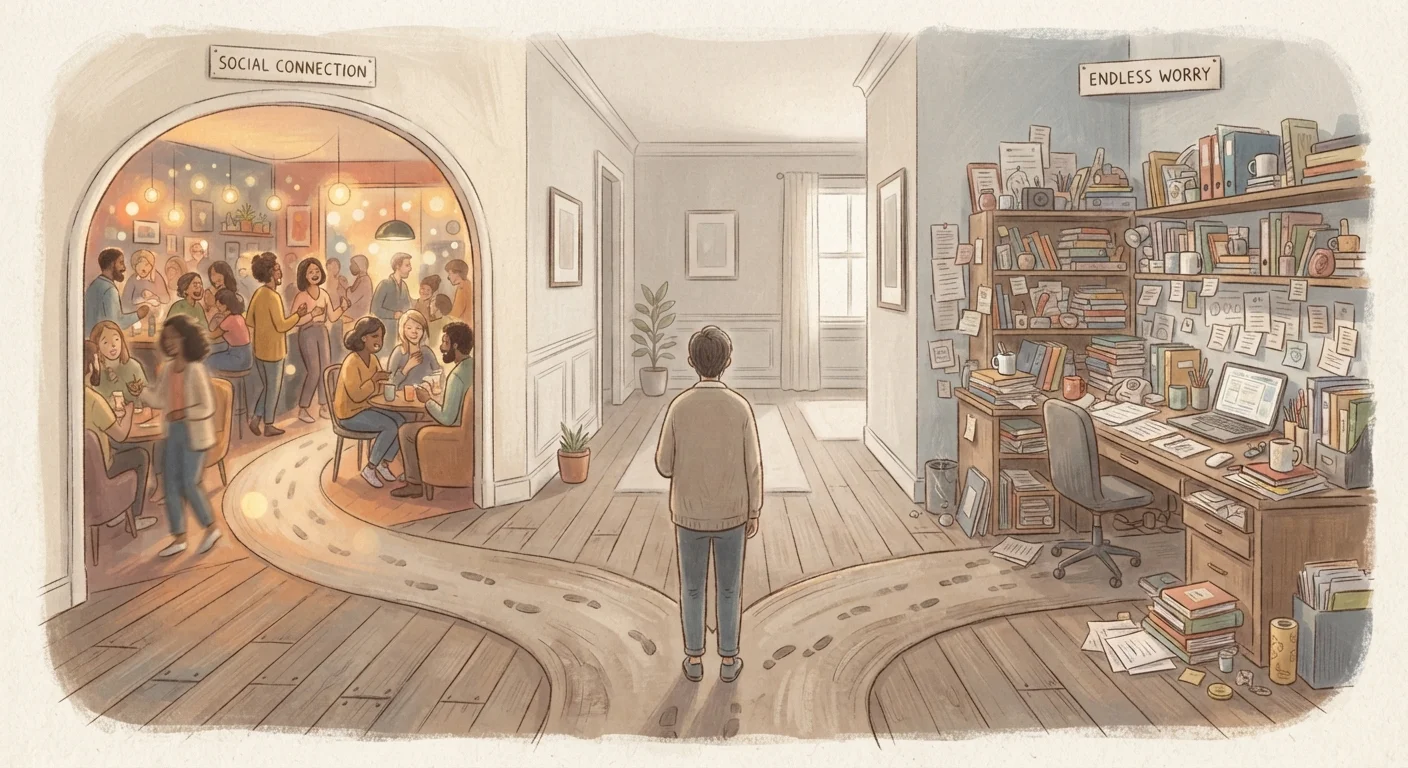
What Each Condition Actually Is
Both generalized anxiety disorder (GAD) and social anxiety disorder (SAD) are recognized anxiety disorders listed in the DSM-5, the standard clinical reference used by mental health professionals in the US. While they share the word "anxiety," they describe meaningfully different experiences.
GAD is defined by excessive, difficult-to-control worry about a wide range of everyday topics - things like health, finances, family, work, or minor matters - persisting for at least six months. The worry is disproportionate to the actual situation and happens more days than not. For a plain-language breakdown of how clinicians identify this condition, see the GAD diagnostic criteria explained.
Social anxiety disorder, by contrast, is a marked and persistent fear of social or performance situations in which the person expects to be observed and potentially judged, embarrassed, or humiliated. The fear is specific to that social evaluation context. Social anxiety disorder goes well beyond ordinary shyness - it causes real impairment in relationships, school, or work.
How the Two Conditions Compare
Laying the differences side by side makes the distinctions clearer. Both disorders share physical symptoms and overlap in avoidance behaviors, but their core features diverge in important ways.
| Criterion | Generalized Anxiety Disorder (GAD) | Social Anxiety Disorder (SAD) |
|---|---|---|
| Core fear | Uncontrollable worry across many topics | Fear of negative evaluation by others |
| Trigger | Wide-ranging; almost anything can prompt worry | Specific social or performance situations |
| Duration requirement (DSM-5) | Symptoms present most days for 6+ months | Fear is persistent, typically 6+ months |
| Characteristic physical symptoms | Muscle tension, fatigue, headaches | Blushing, trembling, sweating in social contexts |
| Avoidance pattern | Avoids tasks or decisions linked to worry topics | Avoids social gatherings, speaking, or performance |
| Worry content | Health, finances, work, family, minor events | Being embarrassed, judged, or humiliated publicly |
| Anxiety between triggers | Persistent - rarely fully absent | Can be low when no social situation is anticipated |
One practical way to think about it: a person with GAD might lie awake worrying about a medical bill, a leaking roof, and whether they said something wrong to a friend - all in the same hour. A person with social anxiety disorder might worry intensely about an upcoming presentation but feel little general anxiety once that situation passes.
Where the Symptoms Overlap - and Where They Don't
Both conditions can cause restlessness, difficulty concentrating, and sleep problems. Both can lead to avoidance - steering clear of anything that triggers the anxiety. That overlap is part of why clinicians take a careful history rather than relying on a single symptom.
Where they diverge is telling. GAD's signature physical symptoms include chronic muscle tension, fatigue, and headaches that aren't tied to specific events. The physical side of GAD surprises many people - it isn't purely mental. Social anxiety disorder, on the other hand, tends to produce situation-specific physical responses: blushing, trembling, sweating, or a racing heart that appears when facing social scrutiny and subsides afterward.
The object of fear is the clearest separator. In GAD, the worry is wide and object-less - almost anything can become a source of concern. In social anxiety, the fear has a specific shape: being watched, judged negatively, or doing something humiliating in front of others. For more on how these conditions differ at the root level, see overlapping symptoms, different roots.
When Anxiety Looks Like Something Else
Some symptoms of GAD and social anxiety overlap with other conditions, including panic disorder and depression. Blushing or a racing heart in social settings might also be part of a panic response rather than social anxiety specifically. A mental health professional can distinguish between these patterns through a structured clinical interview. If you're curious about the difference between panic and anxiety experiences, panic attacks and anxiety attacks are not the same thing.
Co-Occurrence and Why It Matters
These two conditions are not mutually exclusive. Research consistently shows that anxiety disorders frequently co-occur, meaning a person diagnosed with GAD has a meaningfully elevated likelihood of also meeting criteria for social anxiety disorder - and vice versa. When both are present, social situations become a trigger for both general worry and specific fear of judgment, compounding distress and avoidance.
This is why self-identification, while a useful starting point, has limits. A clinician will ask not just what you worry about, but when the worry appears, how long it lasts, how much control you feel you have over it, and how much it disrupts your daily life. Understanding where normal anxiety ends and GAD begins is a useful step before seeking a formal assessment.
If you recognize elements of both conditions in yourself or someone you care about, that's a reason to speak with a qualified mental health professional - not a reason to self-diagnose. Treatment approaches for GAD and social anxiety do overlap (cognitive behavioral therapy, or CBT, is evidence-based for both), but the specific focus of therapy differs depending on which pattern is driving the most distress. For a broader overview of anxiety types, the Anxiety Explained hub is a helpful starting point.
This article is for general informational purposes only and is not a substitute for professional medical or mental health advice. If you are concerned about anxiety symptoms, please consult a qualified healthcare provider.