
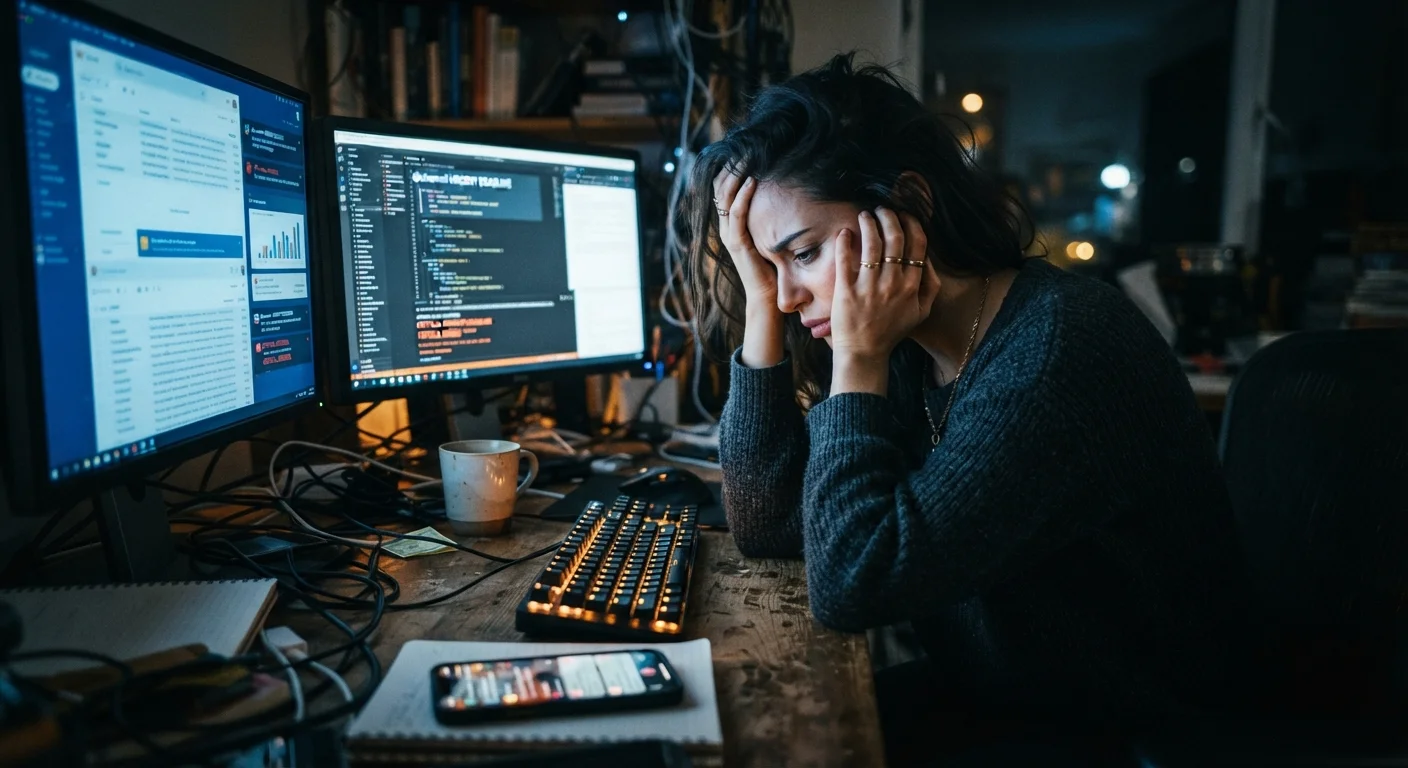
Why Your Brain Treats Notifications Like Threats
Every ping, banner, and badge on your phone sends a small signal to your brain: something needs your attention right now. The nervous system, built for survival rather than productivity, doesn't automatically distinguish between a work email and a genuine emergency. It responds to novelty and urgency cues by preparing the body to act — elevating heart rate slightly, sharpening focus, and releasing a modest pulse of cortisol.
Individually, each of these micro-responses is trivial. Cumulatively, across dozens of interruptions per day, they create a baseline state of physiological readiness that never fully winds down. Researchers sometimes describe this as allostatic load — the accumulated "wear" from repeated stress activation. When the nervous system rarely gets the signal that it's safe to rest, anxiety becomes the default setting rather than the exception.
This is the core of the anxiety loop: digital habits generate arousal, arousal primes you to scan for more threats, and scanning surfaces more content that triggers more arousal. It's a cycle with no natural stopping point — unless you build one deliberately. Explore what current research says about digital boundaries and mental well-being for a closer look at the evidence behind this pattern.
The Hidden Costs of Always-On Availability
Being perpetually reachable carries psychological costs that are easy to overlook because they accumulate gradually. One of the most significant is attention fragmentation — the difficulty of sustaining deep focus when the brain has been conditioned to expect interruption every few minutes. Studies on attention suggest that after an interruption, it can take considerably longer to return to the same level of concentration, meaning frequent pings don't just steal the moment — they borrow from what follows.
There's also the dimension of social comparison and threat monitoring that social platforms specifically amplify. Scrolling through curated updates can subtly reinforce a sense that others are managing life more effectively, which feeds what psychologists sometimes call reassurance-seeking behavior — checking for likes, replies, or news updates to reduce uncertainty. Paradoxically, this behavior tends to sustain anxiety rather than resolve it. Learn why reassurance-seeking can quietly reinforce anxiety explains this dynamic in more depth.
96+
Average daily phone checks by US adults
Research by Asurion (a phone insurance company) found American adults check their phones more than 96 times per day on average — roughly once every 10 minutes during waking hours.
~23 min
Time to regain focus after an interruption
Research from the University of California, Irvine, found it takes an average of about 23 minutes to return to the original task after a workplace interruption.
It's also worth recognizing that digital connectivity intersects with other lifestyle factors. For instance, late-night screen use can delay sleep onset, and caffeine timing can further disrupt sleep architecture, creating overlapping pressures on the nervous system that compound anxiety. Daily habits that quietly raise stress levels offers a broader look at how routine choices interact.
Building Intentional Tech Boundaries That Actually Work
The goal isn't to abandon technology — it's to stop letting technology set the terms of your nervous system's schedule. Intentional boundaries are self-defined rules that create predictable low-stimulation windows, giving the parasympathetic nervous system (your body's rest-and-digest mode) time to do its job.
Start Small: One Boundary at a Time
Trying to overhaul your entire relationship with technology at once is likely to feel overwhelming and fail quickly. Choose a single boundary — such as no phone for the first 30 minutes after waking — and practice it consistently for one week before adding another change. Gradual, sustainable adjustments tend to produce more lasting shifts in nervous system baseline than dramatic all-or-nothing approaches.
A few approaches that behavioral health research and clinical practice commonly support:
- Batch your checking. Rather than responding to notifications as they arrive, designate two or three set times per day to review messages and email. This alone can significantly reduce the frequency of stress-arousal cycles.
- Use notification triage. Audit which apps are allowed to interrupt you and eliminate alerts for anything that doesn't require an immediate response. Most do not.
- Create phone-free transition periods. The first 30 minutes after waking and the hour before bed are particularly high-value windows. Morning phone use can prime the brain into reactive mode before the day has started; evening use can delay the physiological wind-down needed for restorative sleep.
- Build distance, literally. Keeping your phone in another room during meals, conversations, or focused work removes the temptation to check and reduces the ambient mental load of its presence.
None of these steps require willpower alone — environmental design does much of the work. Start with one change and observe how your baseline alertness shifts over a week before adding more. The anxiety loop is learned behavior; with consistent practice, it can be interrupted.
This article is for general informational and educational purposes only and is not a substitute for professional medical or mental health advice. If anxiety is interfering with your daily life, please consult a qualified healthcare professional.