
What the Evidence Actually Shows
The phrase "screen time is bad for you" has become so common it often bypasses scrutiny. The research picture is more nuanced — and more useful — than that summary suggests.
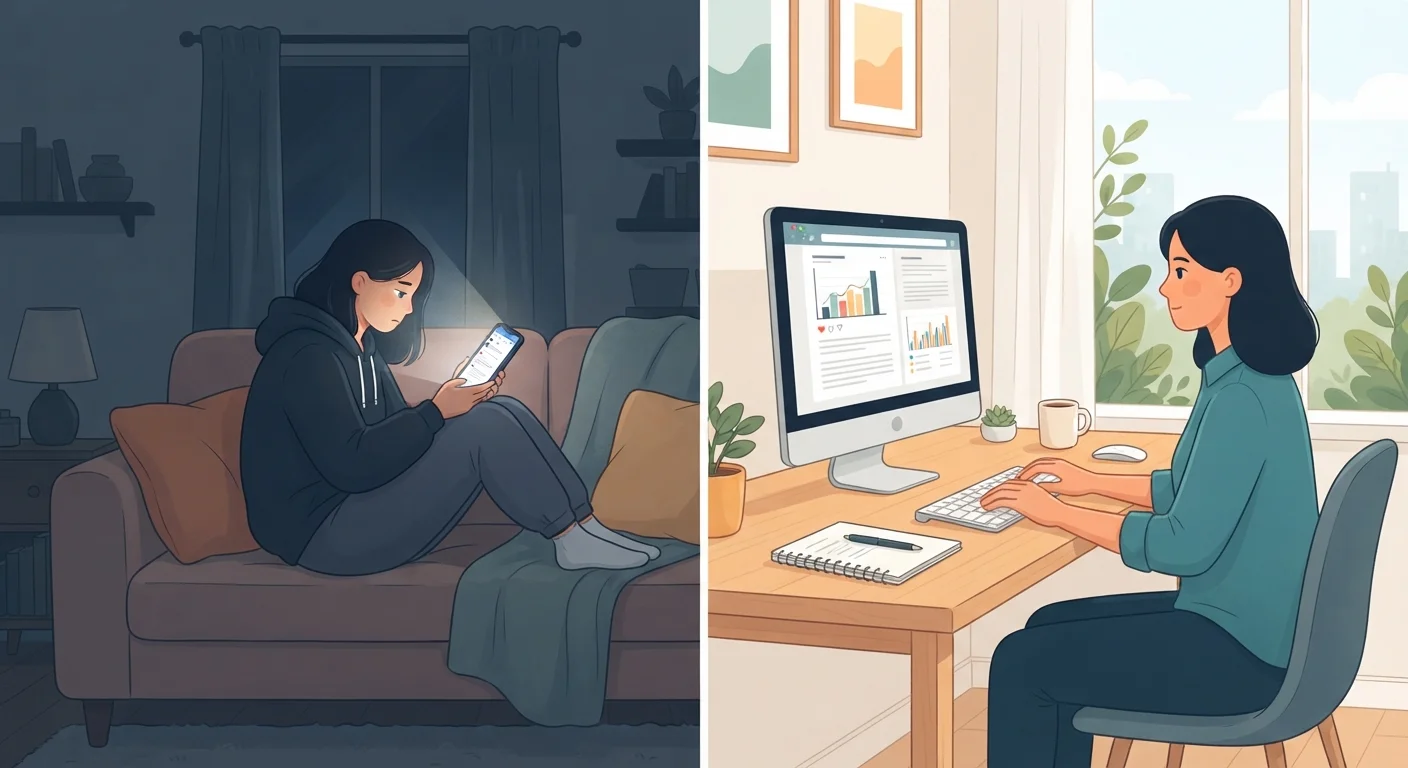
A substantial body of work does link heavy social media use to elevated symptoms of anxiety and depression, particularly among adolescents. But several large-scale reviews have found that the relationship is modest in size and heavily shaped by how platforms are used. Passive consumption — scrolling without interacting, comparing oneself to curated highlight reels — shows stronger negative associations than active, communicative use. For a deeper look at how that distinction plays out cognitively, see our piece on passive scrolling vs. active screen use.
What consistently emerges across studies is that context matters as much as quantity. Late-night use disrupting sleep, notifications fragmenting deep work, and social comparison on image-heavy platforms each carry distinct mechanisms of harm — separate from total hours logged.
23 min+
Average refocus time after a single digital interruption
Research in applied cognitive psychology has found that task-switching triggered by notifications can require more than 23 minutes to fully recover sustained focus.
~2x
Anxiety risk elevation with heavy passive social media use
Multiple review studies have found passive social media consumption to be associated with notably higher anxiety symptom scores compared to minimal or active use.
30–60 min
Earlier sleep onset linked to pre-bed screen limits
Sleep hygiene research consistently shows that reducing blue-light device exposure in the hour before bed is associated with falling asleep faster.
Why Notifications Are a Specific Problem
One of the clearest findings in attention research involves interruption costs. Cognitive scientists have repeatedly demonstrated that switching attention — even briefly — imposes a measurable recovery cost. After a notification breaks focus, it can take more than 20 minutes on average to return to a comparable depth of concentration on the original task.
Multiply that by the dozens of alerts most smartphones generate daily, and the cumulative drag on productive thinking becomes significant. For people managing anxiety, the constant ping of incoming information also sustains a low-grade physiological alertness — a stress-response posture that was not designed for a 24/7 information environment.
Start With a Notification Audit
Scroll through your phone's notification settings and ask one question for each app: does this alert ever require an immediate response? Most do not. Turning off non-essential notifications is a low-effort first step with a measurable impact on daily stress levels. You do not need to delete any apps or cut your screen time to start noticing a difference.
Reducing notification volume is one of the most evidence-consistent steps an individual can take without changing total screen time at all. It is also one of the most underused, because many people have never audited which notifications actually require real-time attention.
Setting Limits: What Research-Supported Practice Looks Like
Behavioral research on habit formation suggests that effective limits share several features: they are specific rather than vague, they modify the environment rather than relying purely on willpower, and they are sustainable in the long run rather than dramatic in the short term.
Applied to digital boundaries, this translates into practices such as designating phone-free zones (bedroom, dining table), setting scheduled check-in windows for email rather than monitoring continuously, and creating friction — intentional small obstacles — between yourself and apps associated with mindless use.
If you are new to this and unsure where to begin, our guide to building your first digital boundaries offers a plain-language starting point. And if you have tried limits before and found them hard to maintain, it is worth examining whether certain digital boundary myths are undermining your confidence before you try again.
This article is for general informational and educational purposes only. It is not a substitute for professional mental health advice, diagnosis, or treatment. If you are experiencing significant distress, please consult a qualified healthcare professional.