
Why Mental Health Is More Than One Thing
When most people think about mental health, they picture mood - whether someone feels happy or sad, anxious or calm. That's a reasonable starting point, but it only captures a fraction of the picture. Mental health, as defined by the World Health Organization, is a state of wellbeing in which an individual can realize their own potential, cope with normal stressors, work productively, and contribute to their community. That definition alone hints at how much territory is involved.
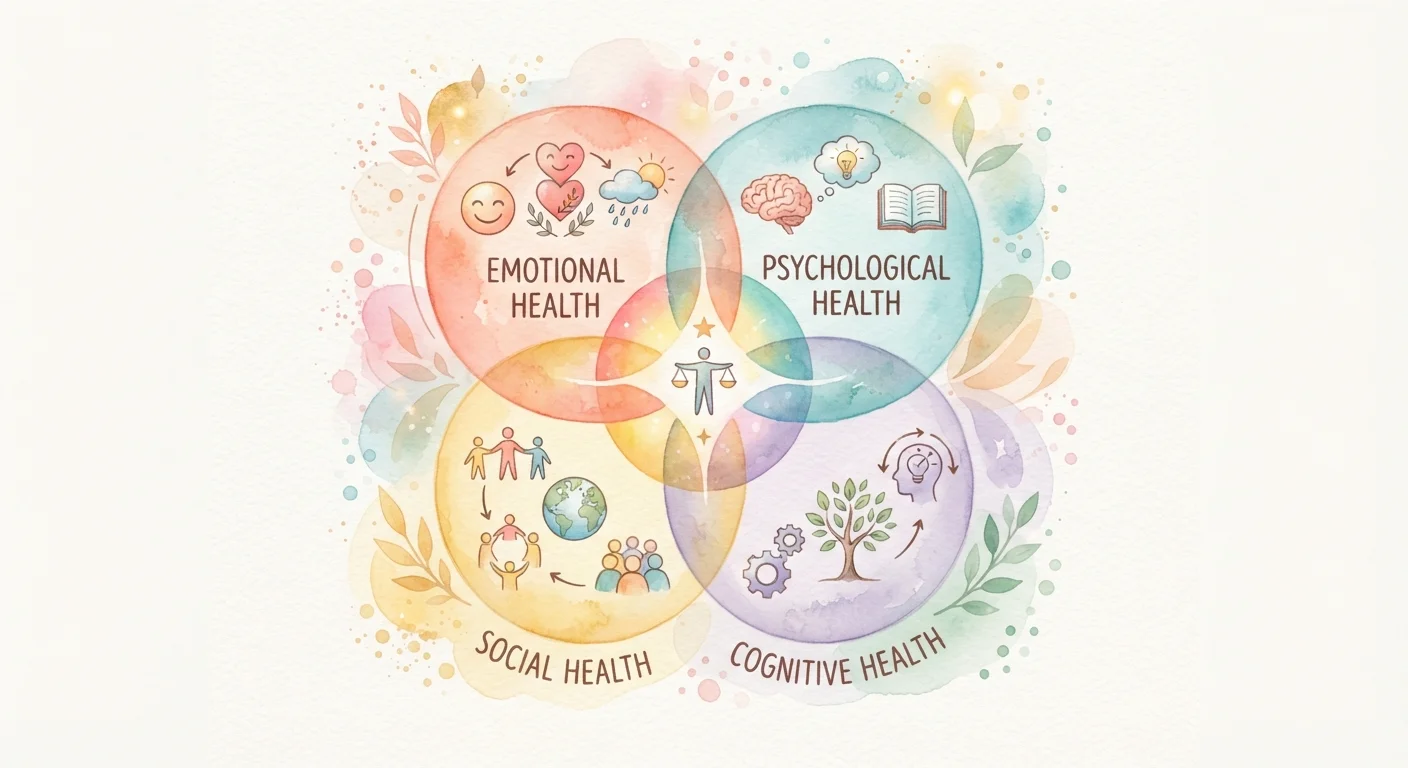
If you're just beginning to explore what mental health really means, it helps to think of it as having four distinct but interconnected dimensions. None of them exist in isolation. Understanding each one gives you a clearer, more honest map of your inner life - and a better sense of where to direct your attention. For a broader foundation, our overview of what mental health really means is a helpful place to start.
Emotional Wellbeing
Emotional wellbeing refers to your ability to recognize, understand, and manage your feelings - and to experience a reasonable range of positive emotions in daily life. It's not about feeling happy all the time. Rather, it's about having enough self-awareness to notice what you're feeling, and enough flexibility to respond rather than simply react.
People with strong emotional wellbeing can sit with uncomfortable feelings - grief, frustration, disappointment - without being overwhelmed by them. This capacity is sometimes called emotional regulation, and it's a skill that can be developed with practice. Journaling, mindfulness, and talking through feelings with a trusted person are all approaches that mental health professionals commonly discuss in this context. To explore what healthy emotional functioning can look like in practice, see our starter's overview of mental wellness.
Emotional wellbeing is about flexibility with feelings, not the absence of difficult ones.
Psychological Wellbeing
Psychological wellbeing is closely related to emotional health but focuses on your broader relationship with yourself and your life. Psychologist Carol Ryff's widely referenced model describes it as having purpose and meaning, a sense of personal growth, autonomy, and the ability to navigate your environment effectively.
In plain terms: Do you feel like your life has direction? Do you have a sense of who you are and what you value? Can you make decisions that feel genuinely yours? These questions sit at the heart of psychological wellbeing. When this dimension is under strain - often during major life transitions, loss, or prolonged stress - people may feel rudderless or disconnected from themselves, even if they can't quite name why. Understanding this dimension can help normalize those feelings and point toward meaningful areas of reflection.
Psychological wellbeing asks whether your life feels purposeful and authentically your own.
Social Wellbeing
Humans are wired for connection. Social wellbeing describes the quality of your relationships and your sense of belonging within a broader community. It includes how safe you feel being vulnerable with others, whether you have people to turn to in difficult times, and whether you feel like a contributing part of something larger than yourself.
Research consistently links strong social ties to better mental and physical health outcomes. Loneliness and social isolation, by contrast, are associated with elevated risks of depression and anxiety. Social wellbeing doesn't require a large social circle - depth often matters more than breadth. Even one or two reliable, reciprocal relationships can provide meaningful support. Family dynamics also play a significant role here, shaping patterns of connection and communication that often persist into adulthood.
Even one or two reliable relationships can significantly anchor your social wellbeing.
Cognitive Wellbeing
Cognitive wellbeing refers to how well your mind processes information, forms thoughts, and maintains clarity. It encompasses attention, memory, decision-making, and the quality of your inner dialogue - the ongoing mental commentary most of us carry throughout the day.
Cognitive health is often the first casualty of poor sleep, chronic stress, or overwhelming circumstances. You might notice it as difficulty concentrating, indecisiveness, or a tendency toward repetitive, unhelpful thought patterns (sometimes called rumination). Conversely, a well-supported cognitive dimension allows for clearer thinking, better problem-solving, and more constructive self-talk. Practices like adequate sleep, physical movement, and structured problem-solving are commonly discussed as ways to support cognitive functioning. For a clear glossary of related terms, our mental wellness indicators reference is a useful companion resource.
Cognitive wellbeing shapes the quality of your thinking, attention, and inner dialogue every day.
Putting It All Together
These four dimensions don't operate independently - they form a dynamic system. A difficult week at work might tax your cognitive functioning, which strains your emotional regulation, which then affects how you show up in relationships. That ripple effect is normal, and recognizing it is genuinely useful. It means that nurturing one dimension often benefits the others too.
Start With Awareness, Not Perfection
You don't need to optimize all four dimensions at once. A more manageable starting point is simply noticing which area feels most strained right now. From there, even one small, intentional action - reaching out to a friend, getting an extra hour of sleep, or pausing to name what you're feeling - can begin to shift things. Awareness itself is the first meaningful step.
You don't need to be struggling in all four areas to benefit from paying attention to your mental health. Even small, consistent efforts - like noticing your emotions without judgment, staying connected to someone you trust, or giving your mind space to rest - can support your overall wellbeing. Mental health isn't a fixed destination; it shifts with life's circumstances. Our article on how mental wellbeing evolves across a lifetime explores this further. If you'd like a plain-language guide to the terms used in this space, key mental health terms defined simply can help fill in any gaps.
This article is for general informational and educational purposes only and is not a substitute for professional medical or mental health advice. If you have concerns about your mental health, please consult a qualified healthcare professional.