
What Mental Wellness Actually Means
If you're new to thinking about mental health, one of the most helpful things to know is this: mental wellness isn't a fixed destination. It's a dynamic state - something you move in and out of as life changes around you.
The World Health Organization describes mental health as more than the absence of illness. It includes the ability to realize your own potential, cope with the normal stresses of life, work productively, and contribute to your community. Mental wellness sits within that broader picture - it's an active quality of functioning well, not simply not being unwell.
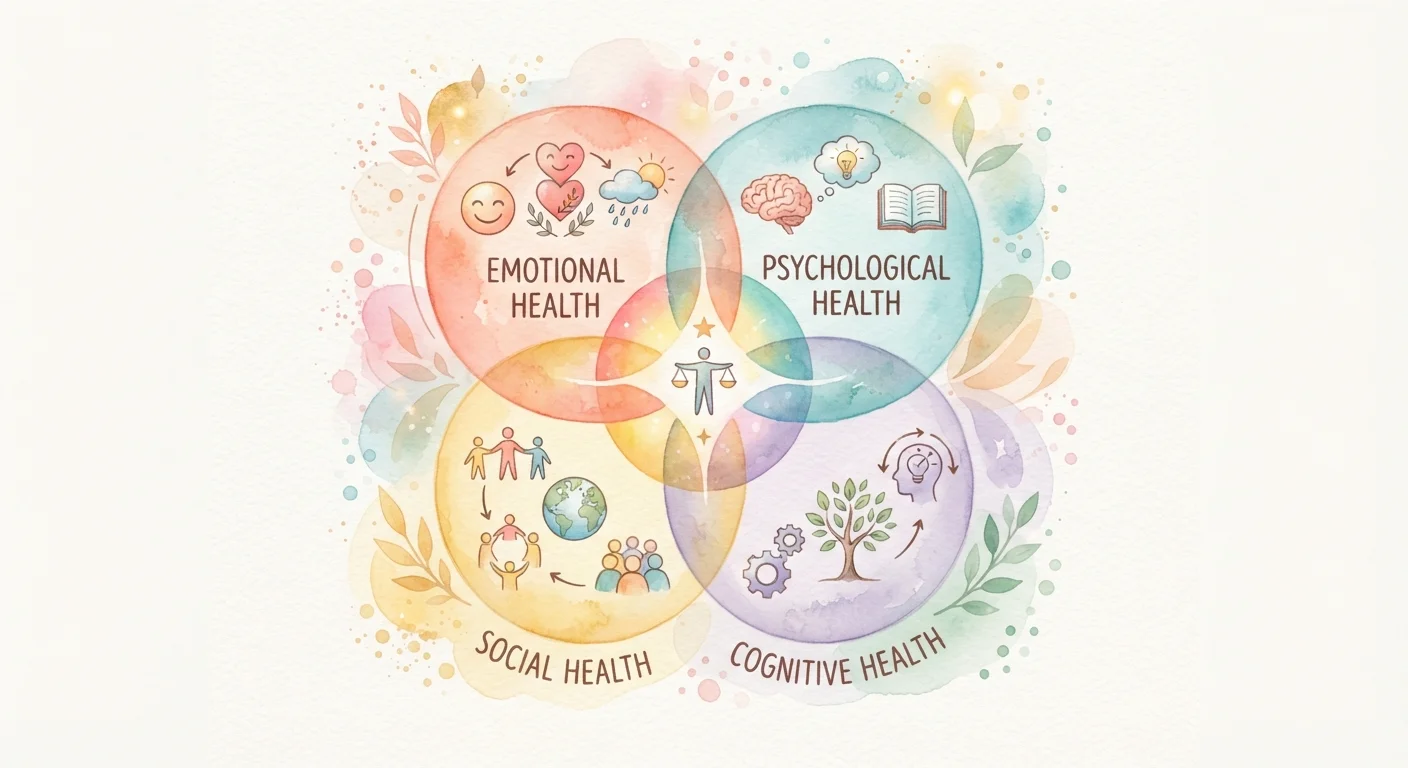
For a deeper look at the vocabulary behind these concepts, key mental health terms defined in plain English is a useful companion. And if you're curious about how mental wellness spans emotional, psychological, social, and cognitive dimensions, the four dimensions of mental health explores each one in accessible terms.
Mental wellness
An active, ongoing state of emotional and psychological well-being - not just the absence of illness, but the presence of the skills and conditions that help you function and feel connected.
Emotional regulation
The ability to notice and manage your feelings in a healthy way, so that strong emotions don't consistently overwhelm your thinking or behavior.
Resilience
The capacity to recover from setbacks, adapt to difficult circumstances, and keep functioning after stress or loss - not toughness, but flexibility.
Psychosocial well-being
A combined term for the emotional (psycho-) and social dimensions of health - how your inner life and your relationships with others both contribute to how you're doing overall.
Coping skills
Strategies and behaviors - conscious or learned - that help you manage stress, difficult emotions, or challenging situations without making things worse.
What Thriving Can Look Like Day-to-Day
Many people expect that good mental wellness would feel like a constant sense of calm or happiness. In reality, it tends to look much quieter and more ordinary than that.
Some everyday signs of healthy emotional functioning include:
- Emotional flexibility: You can feel frustration, sadness, or anxiety without those feelings taking over your whole day.
- Realistic self-perception: You have a reasonably accurate sense of your strengths and limits - not overly harsh, not disconnected from reality.
- Meaningful connection: You have at least one or two relationships where you feel genuinely seen and supported.
- Purposeful engagement: There are areas of your life - work, relationships, hobbies - that feel worth showing up for.
- Capacity to recover: After difficult events, you find your way back to a functional baseline, even if it takes time.
For a fuller, jargon-free reference on these indicators, mental wellness indicators in plain language walks through each sign in detail.
Wellness Looks Different for Everyone
There's no single image of what thriving should look like. Your baseline - shaped by personality, culture, life history, and circumstance - is uniquely yours. Instead of comparing yourself to an idealized standard, it can help to ask: 'Am I functioning a little better than I was last month?' Small, directional progress is meaningful.
Core Habits That Support Mental Wellness
Mental wellness doesn't happen automatically - it's shaped by daily choices and conditions. Research consistently points to a handful of behaviors that support emotional well-being over time. None of these are dramatic overhauls; they're small, sustainable practices.
- Prioritizing sleep: Sleep is deeply linked to mood regulation, stress tolerance, and cognitive functioning. Most adults function best with seven to nine hours per night.
- Moving your body: Regular physical activity - even walking - is associated with reduced symptoms of anxiety and low mood in a broad range of studies.
- Nurturing social connection: Feeling connected to others is one of the strongest predictors of well-being across cultures. Social support and mental health explores how to build and sustain those connections.
- Practicing self-awareness: Simply noticing how you feel - without immediately judging it - creates space to respond rather than react.
- Setting limits on stressors you can control: Not every demand on your time and energy deserves a yes. Boundaries are a form of self-care.
For a structured path to building these habits, self-help foundations offers grounded, beginner-friendly guidance. And building emotional resilience from the ground up is an excellent next read for anyone ready to go deeper.
Habits Are Helpful - Not a Cure
Lifestyle habits can genuinely support mental wellness, but they are not a substitute for professional care when it's needed. If you're experiencing persistent symptoms that interfere with daily life, please reach out to a qualified healthcare provider rather than relying solely on self-help strategies.
When to Reach Out for More Support
Self-help goes a long way - but it has limits, and recognizing those limits is itself a form of emotional intelligence. If you've been struggling for several weeks, finding it hard to manage daily responsibilities, or noticing that low mood or anxiety is a near-constant presence, those are meaningful signals to take seriously.
Reaching out doesn't have to mean formal therapy right away. It might start with a trusted friend, a primary care provider, or a community resource. If you're curious about what professional support looks like, talk therapy from the ground up is a reassuring introduction - no prior knowledge needed. therapy basics also covers what to expect as a beginner.
You don't need to be in crisis to deserve support. Seeking information - including reading this article - is already a step in the right direction.
This article is for general informational and educational purposes only. It is not a substitute for professional medical or mental health advice, diagnosis, or treatment. If you have concerns about your mental health, please speak with a qualified healthcare provider.