
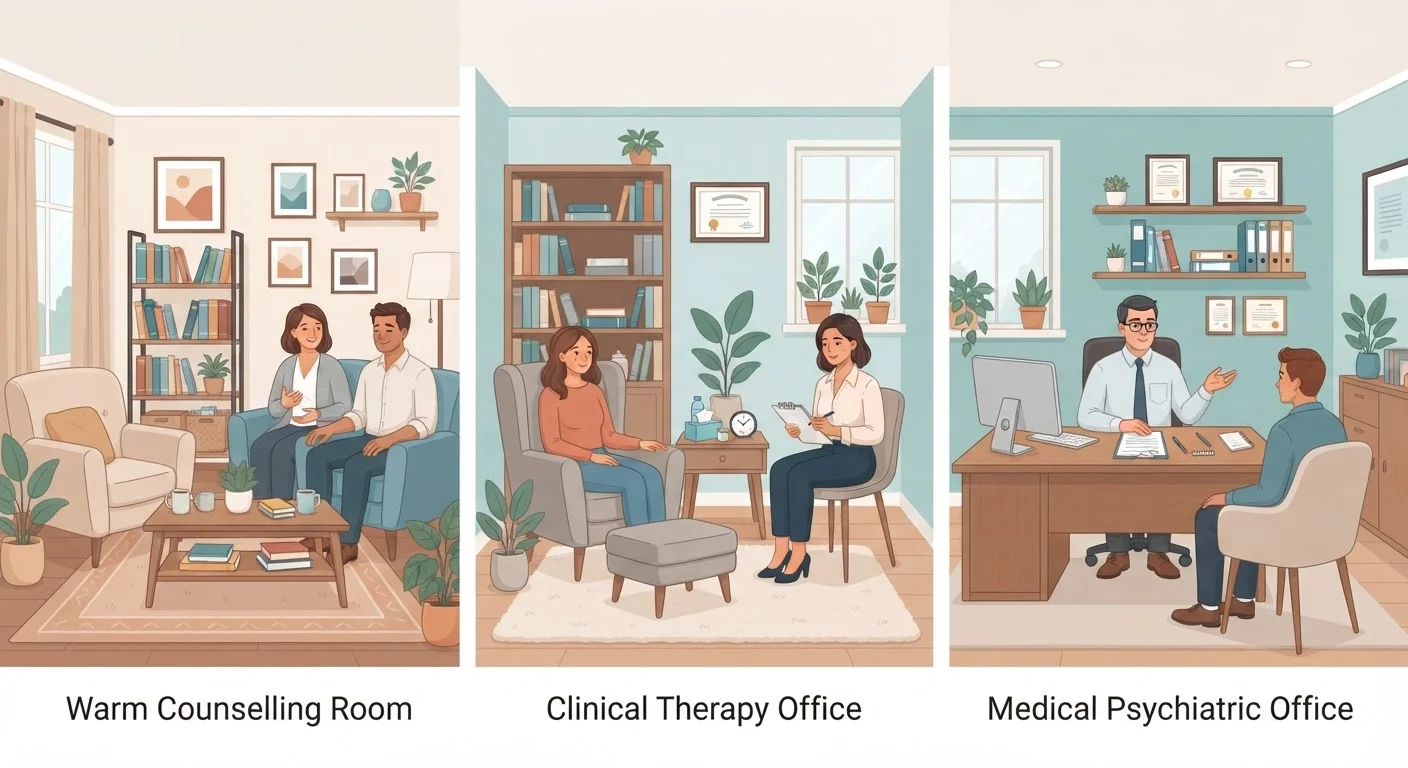
Why the Distinctions Matter
If you've ever Googled "who should I talk to about my mental health," you've likely encountered a wall of overlapping terms. Therapist. Counsellor. Psychotherapist. Psychiatrist. These words are often used interchangeably in everyday conversation, but they describe meaningfully different roles with different training, scope, and tools.
Understanding those differences isn't about finding the "right" label - it's about helping you feel less lost when you're ready to reach out. For a broader look at all the professionals in the mental health space, The Different Types of Mental Health Professionals Explained offers a helpful starting point.
Starting Somewhere Is Always Enough
If you're not sure which type of professional you need, that's completely okay. Many counsellors and therapists will let you know during an initial session if a different type of support might serve you better. You don't have to get it perfectly right on the first try - starting the conversation is the most important step.
What Is Counselling?
Counselling generally refers to a shorter-term, goal-focused type of support. A counsellor helps you work through a specific concern - grief, relationship difficulties, career stress, or a major life change - by offering a structured, empathetic space to talk and develop practical coping strategies.
Most counsellors hold a master's-level degree and are trained in active listening, problem-solving approaches, and supportive techniques. In the US, licensure titles vary by state and may include Licensed Professional Counselor (LPC) or Licensed Mental Health Counselor (LMHC).
Counselling tends to focus on the present. It's less likely to dig into early childhood experiences or long-standing behavioral patterns, and more likely to help you navigate what's happening in your life right now. For many people, this is exactly what they need.
What Is Therapy (Psychotherapy)?
The word "therapy" is broad - it encompasses many different approaches and practitioners. When people say "I'm in therapy," they usually mean they're engaging in psychotherapy: a structured, evidence-based process of exploring thoughts, emotions, and behaviors with a trained professional.
Psychotherapists may be psychologists (who typically hold a doctoral degree), licensed clinical social workers (LCSWs), or licensed professional counsellors with psychotherapy training. Therapy can be shorter-term or extend over months or years, depending on the individual's needs.
Common approaches include Cognitive Behavioral Therapy (CBT), which examines how thought patterns influence feelings and behavior, and psychodynamic therapy, which explores how past experiences shape present-day difficulties. Talk Therapy Is Not One Thing explains these approaches in plain language.
Therapy is generally appropriate when symptoms are persistent, when a diagnosis has been made, or when someone wants to understand themselves more deeply. Psychotherapy vs. Counselling explores how these two approaches compare in more depth.
| Counselling | Therapy (Psychotherapy) | Psychiatry | |
|---|---|---|---|
| Primary focus | Specific life stressors, coping skills | Emotional patterns, mental health conditions | Diagnosis and medication management |
| Typical duration | Short-term (weeks to months) | Short- to long-term (months to years) | Ongoing as needed for medication |
| Can prescribe medication? | No | No (in most US states) | Yes |
| Typical credentials (US) | LPC, LMHC, NCC | PhD, PsyD, LCSW, LMFT | MD or DO with psychiatry residency |
| Common approaches | Supportive talk, solution-focused | CBT, DBT, psychodynamic therapy | Medication evaluation, sometimes therapy |
| Best starting point when... | Managing a defined life challenge | Patterns persist or diagnosis exists | Symptoms are severe or medication is considered |
What Is Psychiatry?
A psychiatrist is a medical doctor (MD or DO) who has completed specialized training in mental health after medical school. This medical background is the key distinction: psychiatrists can diagnose mental health conditions, prescribe and manage medication, and coordinate care with other healthcare providers.
In practice, many psychiatrists today focus primarily on medication management - evaluating whether medication may be appropriate, prescribing it, and monitoring its effects over time. Some also provide psychotherapy, though this varies by practitioner and setting.
Psychiatry tends to be the right fit when symptoms are severe or significantly impairing daily life, when a biological component is suspected, or when other treatments haven't been sufficient on their own. For a side-by-side look at how psychiatrists differ from psychologists specifically, Psychologist vs Psychiatrist: Which One Do You Actually Need? walks through that comparison clearly.
Don't Self-Diagnose or Self-Prescribe
Learning about psychiatric conditions online can be useful for understanding your experience, but it's not a substitute for professional evaluation. Medication decisions involve careful assessment of your full health history and should always be made with a licensed prescriber. If you're in crisis or your symptoms feel unmanageable, reach out to a healthcare provider or call the 988 Suicide and Crisis Lifeline.
How to Use This Information
These three paths aren't mutually exclusive. Many people see a therapist for talk-based support while also working with a psychiatrist for medication. Others begin with counselling and later decide they want to explore deeper therapeutic work. The mental health system is more flexible than the labels suggest.
If you're genuinely unsure where to start, a primary care provider is a reasonable first stop - they can assess your concerns, rule out physical causes, and make a referral. You can also explore therapy basics for more context on what to expect when you begin.
What matters most is that reaching out - in whatever form that takes - is a meaningful act of self-care. You don't need to have it all figured out before you make that first call.
This article is for general informational and educational purposes only and does not constitute medical or mental health advice. Please consult a qualified healthcare or mental health professional for guidance specific to your situation.