What Meditation Actually Is
Meditation is a family of mental training practices that share one common aim: deliberately directing your attention and noticing where it goes. That's it. Despite centuries of tradition and a growing body of clinical research, the core activity is simple — you choose a focus, your mind wanders, and you return. Over time, that cycle of noticing and returning strengthens your ability to regulate attention and, by extension, your emotional responses.
It is worth separating meditation from relaxation. Relaxation can be a pleasant side effect, but it is not the goal. Some sessions feel calm; others feel frustrating and restless. Both are valid practice. Similarly, meditation is not the same as mindfulness — mindfulness refers to a quality of present-moment awareness, while meditation is a structured way of training that quality.
Mindfulness
Paying deliberate, non-judgmental attention to what is happening in the present moment — your thoughts, sensations, or surroundings — without trying to change them.
Breath anchor
A specific physical sensation of breathing — such as the rise of the chest or air passing through the nostrils — that you use as a steady point to return attention to when the mind wanders.
Mind wandering
The completely normal tendency of the mind to drift from the meditation focus toward thoughts, memories, plans, or feelings. Noticing this and returning attention is the core practice.
Body scan
A meditation technique where you slowly move attention through different parts of the body — from feet to head — noticing sensations without trying to relax or fix anything.
Loving-kindness (metta)
A practice of silently directing warm, friendly wishes toward yourself and others, used to cultivate a sense of compassion and reduce self-criticism.
Formal practice
A set-aside period specifically dedicated to meditation, as opposed to informal mindfulness woven into everyday tasks like eating or walking.
If you want to understand how mindfulness practice applies specifically to managing daily stress, this introductory mindfulness guide provides a useful companion overview.
How to Set Up Your First Session
Good setup reduces friction and makes it easier to start — and return. You do not need special equipment, a cushion, incense, or a particular posture. What you do need is a position that keeps you alert without creating pain, and an environment with minimal interruptions.
Make Your Environment Work For You
Before your first session, choose a spot you can return to regularly — familiarity helps cue the habit. Dim lighting, a comfortable seat, and reduced noise all lower friction. You don't need a dedicated meditation room; a corner of your bedroom with the door closed works fine.
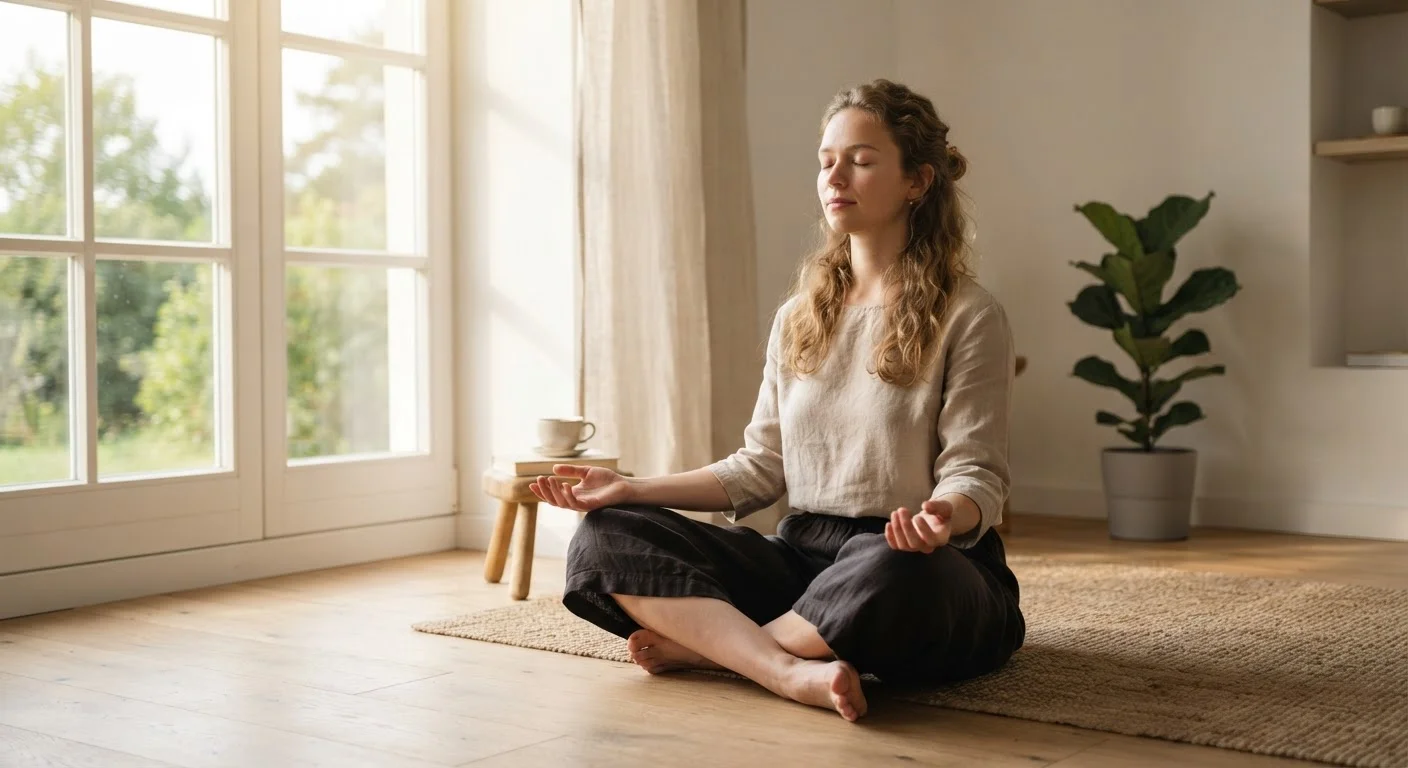
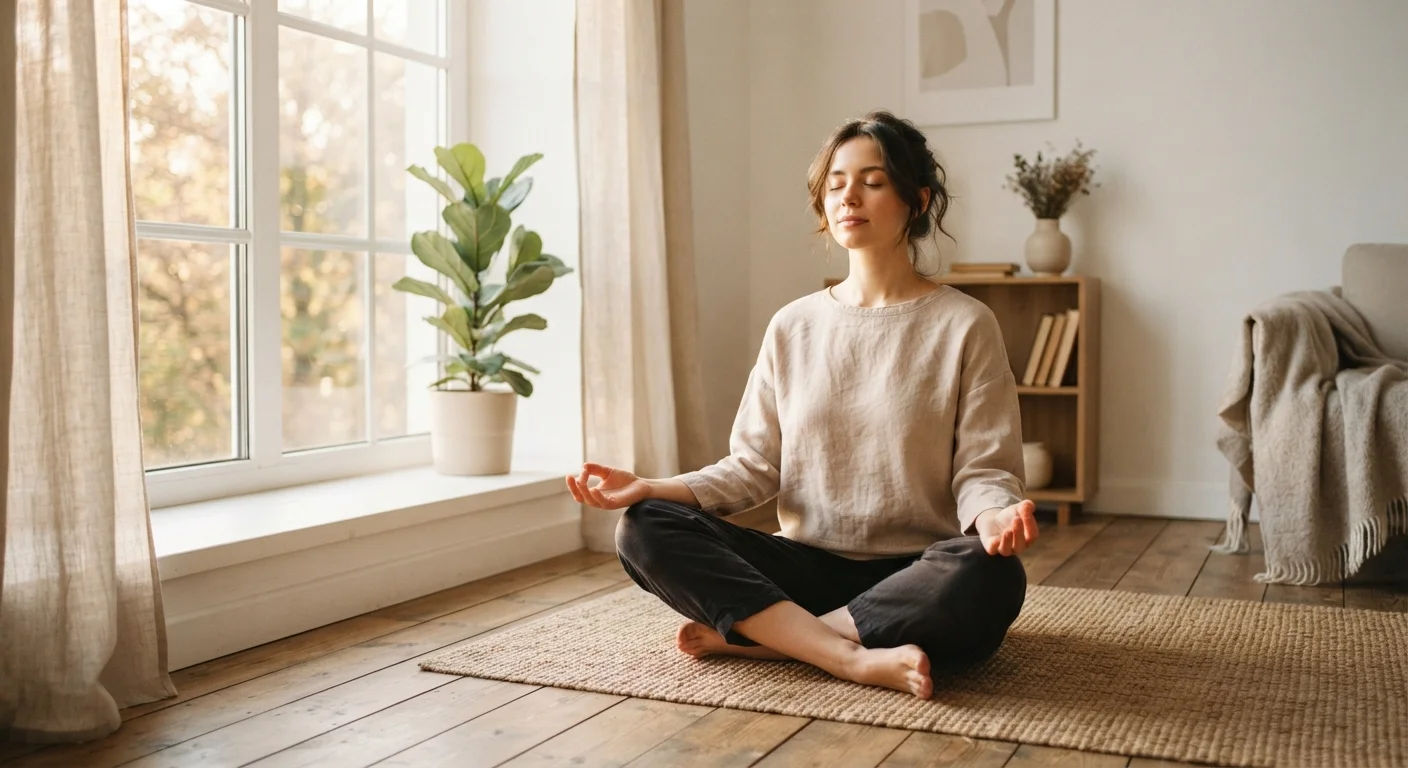
- Posture: Sit on a chair with your feet flat on the floor, or cross-legged on a cushion on the floor. Keep your spine reasonably upright — this helps maintain alertness. Lying down is fine but increases the chance of falling asleep.
- Duration: Set a timer for five minutes. Knowing the session will end at a fixed point helps resist the urge to check the clock.
- Eyes: Closed is the most common choice for beginners. A soft downward gaze with eyes slightly open also works if closed eyes feel uncomfortable.
- Phone: Put it face-down and silence notifications for the duration of your timer.
That is genuinely all you need to begin. For a guided walkthrough of your first session, try this five-minute breath-based practice designed specifically for first-timers.
What Happens in Your Mind (and Why It's Normal)
Most first-time meditators are surprised — and discouraged — by how quickly the mind wanders. Within seconds of focusing on the breath, you may find yourself planning dinner, replaying a conversation, or wondering whether you're doing this right. This is not a malfunction. Research in cognitive neuroscience has shown that the mind engages in spontaneous thought — often called mind-wandering — as a default mode of operation.
The moment of noticing that your mind has wandered is, counterintuitively, the most important moment in meditation. That noticing is the practice. Each time you catch a wandering thought and redirect attention back to your chosen focus, you are doing exactly what meditation training is designed to do. There is no benefit in judging the quality of distraction or trying to suppress thoughts — simply acknowledge the thought and return.
Meditation Is Not a Crisis Intervention
While meditation can support general mental wellness, it is not appropriate as a sole response to a mental health crisis, severe depression, trauma, or acute anxiety. If you are experiencing significant distress or symptoms that interfere with daily functioning, please reach out to a qualified mental health professional. Meditation is a complement to care, not a replacement.
Early sessions may also surface unexpected emotions. Sitting quietly without distraction can bring feelings closer to the surface. This is usually temporary and mild for most people. However, if meditation consistently triggers significant distress, it is worth discussing with a mental health professional before continuing.
Simple Techniques to Try Right Now
Three techniques are well-suited to absolute beginners. Start with just one — variety in the first week can delay building a stable habit.
1. Breath Awareness
Sit comfortably, set your timer, and place your attention on one specific sensation of breathing — the rise and fall of your chest, or the feeling of air entering your nostrils. When your mind wanders (it will), gently return attention to that sensation. No counting, no controlling the breath — just observing it.
2. Counted Breaths
A variation that gives the mind a simple anchor: count each exhale from one to ten, then start again. If you lose count, simply restart at one. This reduces the mental space available for distraction without being effortful.
3. Body Scan (Brief Version)
Move attention slowly from your feet to the top of your head, spending a few seconds on each area and noticing any sensations — warmth, pressure, tingling, or nothing at all. No attempt to relax or fix; just observe. This is particularly useful for people who find the breath too subtle as a focus.
On Terminology You May Encounter
Meditation draws from many traditions — Buddhist, Hindu, secular, and clinical — and the vocabulary can feel confusing at first. You'll encounter words like 'metta,' 'vipassana,' and 'samadhi' alongside clinical terms like 'open monitoring' and 'focused attention.' For a plain-English reference, see our meditation glossary for beginners.
Staying Consistent Through the Early Weeks
The most common reason people stop meditating in the first month is unrealistic expectations — they expect immediate calm and instead get a restless, busy mind. Reframing consistency as the only near-term goal removes that pressure. A five-minute session every day for three weeks is more valuable than ten sessions of varying length scattered over the same period.
Habit research suggests attaching new behaviors to existing ones — sometimes called habit stacking. Meditating immediately after brushing your teeth in the morning or directly before bed ties the new practice to something already automatic.
- Track simply: A paper calendar with a checkmark for each completed session is surprisingly effective. Missing one day is normal; missing two in a row is the pattern to interrupt.
- Adjust length before skipping: On difficult days, two minutes is always better than zero. Lowering the bar for hard days protects the habit.
- Expect plateaus: There will be stretches where practice feels flat or pointless. This is common and does not mean regression. Consistency through plateaus is what builds the skill.
If you find yourself curious about professional support alongside self-practice, understanding how therapy works can help you figure out when and how to take that step.
This article is for general informational and educational purposes only and is not a substitute for professional medical or mental health advice. If you are experiencing significant mental health symptoms, please consult a qualified healthcare professional.