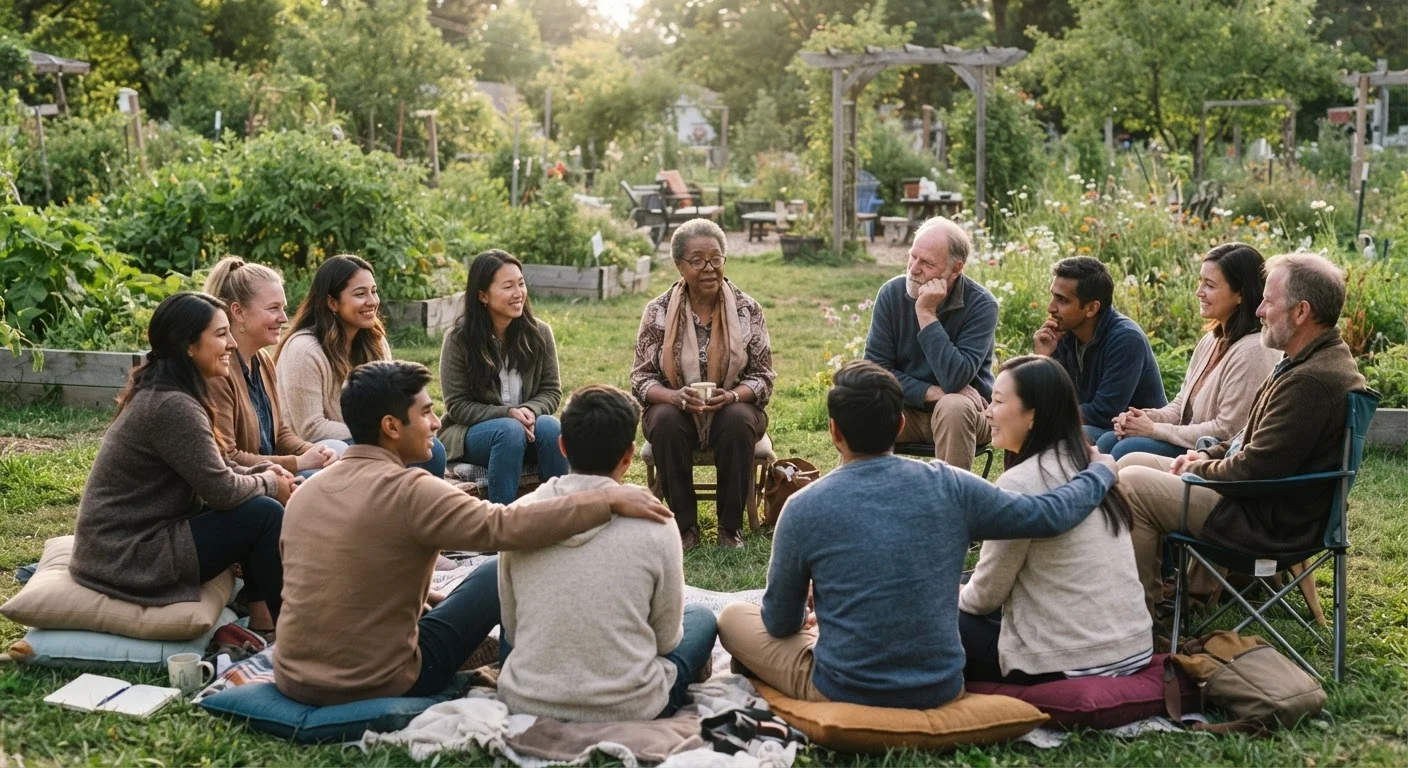

Why Community Matters for Mental Health
Humans are inherently social — not as a preference, but as a biological need. Research in social neuroscience consistently shows that a sense of belonging is linked to lower rates of anxiety and depression, better stress regulation, and stronger immune function. Isolation, by contrast, carries measurable health risks comparable to other well-recognised risk factors.
Yet many people today feel they don't quite belong anywhere — especially after major life transitions like moving to a new city, ending a long relationship, or leaving a job. If that resonates with you, you're in good company. And it doesn't mean there's no community for you. It may simply mean you haven't found it yet.
For a deeper look at how peer connection eases emotional burden, see our overview of support groups and what they can offer.
Sense of belonging
The feeling that you are accepted, valued, and included in a group or community. It's a core psychological need, not a luxury.
Weak ties
Casual acquaintances and friendly but not close connections. Research shows these relationships still contribute meaningfully to wellbeing and social resilience.
Peer support
Mutual emotional and practical support shared between people with similar lived experiences, rather than support delivered by a professional.
Anticipatory anxiety
Worry or dread that occurs before a social situation, often imagining a worse outcome than actually happens. It's very common and doesn't mean the situation will go badly.
Interest-based community
A group formed around a shared hobby, topic, or passion rather than geography or identity. These groups often lower the barrier to entry because the activity does the socialising work.
Knowing What Kind of Community You're Looking For
Before you start searching, it helps to get clear on what you're actually looking for. Community isn't one-size-fits-all. Some people thrive in large, activity-based groups with lots of new faces. Others need a small, tight-knit circle where depth of conversation is possible. Neither is better — they serve different needs.
Ask yourself a few honest questions:
- Do I want to connect around a shared interest, a shared identity, or a shared cause?
- Am I looking for emotional support, social activity, or a sense of purpose?
- Do I prefer in-person connection, online interaction, or a mix of both?
Your answers don't have to be permanent. You might join a hiking group for the activity and later find that it provides unexpected emotional support. The goal right now is simply to give your search some direction.
Our guide on building support networks can help you map what kinds of connections you already have and where the gaps are.
Where to Look: Real Starting Points
Once you have a rough sense of what you're looking for, finding actual groups becomes more manageable. Here are practical places to begin:
- Local libraries and community centers: Many host free recurring events — writing circles, language exchanges, craft groups — with no commitment required.
- Meetup platforms and apps: Interest-based gathering tools let you filter by location, topic, and group size, making it easier to find something that fits.
- Volunteer organisations: Contributing to a cause creates natural, low-pressure social contact alongside a sense of purpose.
- Faith communities: For those with spiritual inclinations, congregations often provide structured community with an existing culture of welcome.
- Peer support groups: If you're navigating a specific mental health challenge, structured peer groups offer shared understanding that general social settings can't replicate.
Meetup
A platform for finding and joining local interest-based groups, from hiking clubs to book circles. Useful for discovering recurring in-person gatherings in your area.
VolunteerMatch
Connects individuals with volunteer opportunities near them. Volunteering is a well-researched pathway to social connection and sense of purpose.
NAMI Connection Recovery Support Group
A free peer-led support group for adults living with mental health conditions, offered by the National Alliance on Mental Illness across the US and online.
If you're also navigating a deeper sense of disconnection, our article on rebuilding a sense of connection when you feel cut off offers graduated steps for those starting from a place of significant isolation.
Taking the First Step Without Overwhelm
The hardest part of finding community is usually the very first move. Anticipatory anxiety — the worry about how things might go — can make even low-stakes social situations feel daunting. The most effective antidote is to make the first step so small that it almost doesn't count.
Lower the Bar for Your First Step
If attending a group in person feels too daunting right now, try engaging with an online version of the same community first. Commenting on a forum post or joining a group chat costs very little emotionally and can help you gauge whether the community feels like a fit before committing to showing up in person.
Concrete examples of small first steps include:
- Reading about a group online without committing to attend
- Sending one message or RSVP without any pressure on the outcome
- Attending one meeting as an observer, with no expectation to participate actively
These micro-steps lower the emotional cost of entry and build momentum. You're not signing up for a community — you're simply showing up once. Everything else can be decided later.
For readers who feel overwhelmed about accessing support more broadly, our article on finding mental health support when you don't know where to begin breaks down those first steps in a similar way.
Sustaining Belonging Over Time
Showing up once is a beginning — belonging develops through repeated contact over time. Research on friendship formation suggests that familiarity built through consistent, low-stakes interaction is one of the strongest drivers of closeness. You don't need to be the most talkative person in the room; you need to keep returning.
A few habits that support sustained connection:
- Prioritise consistency over intensity. Attending a group monthly for a year builds more genuine connection than attending intensively for two weeks and then disappearing.
- Contribute modestly. Offering small help — a kind word, sharing a resource, remembering someone's name — signals investment and invites reciprocity.
- Stay curious about others. Asking follow-up questions in subsequent visits signals that you remember and care, which accelerates trust.
As your involvement grows, it's also worth reflecting on whether the community is actually good for your wellbeing. Our article signs that a community is genuinely supporting your mental health offers a practical checklist to assess this honestly.
Building meaningful community takes time, patience, and some tolerance for awkward early interactions. That discomfort is not a sign you're doing it wrong — it's a sign you're doing something real.
This article is for general informational purposes only and is not a substitute for professional mental health advice. If you are struggling significantly with isolation or your mental health, please reach out to a qualified healthcare professional.