
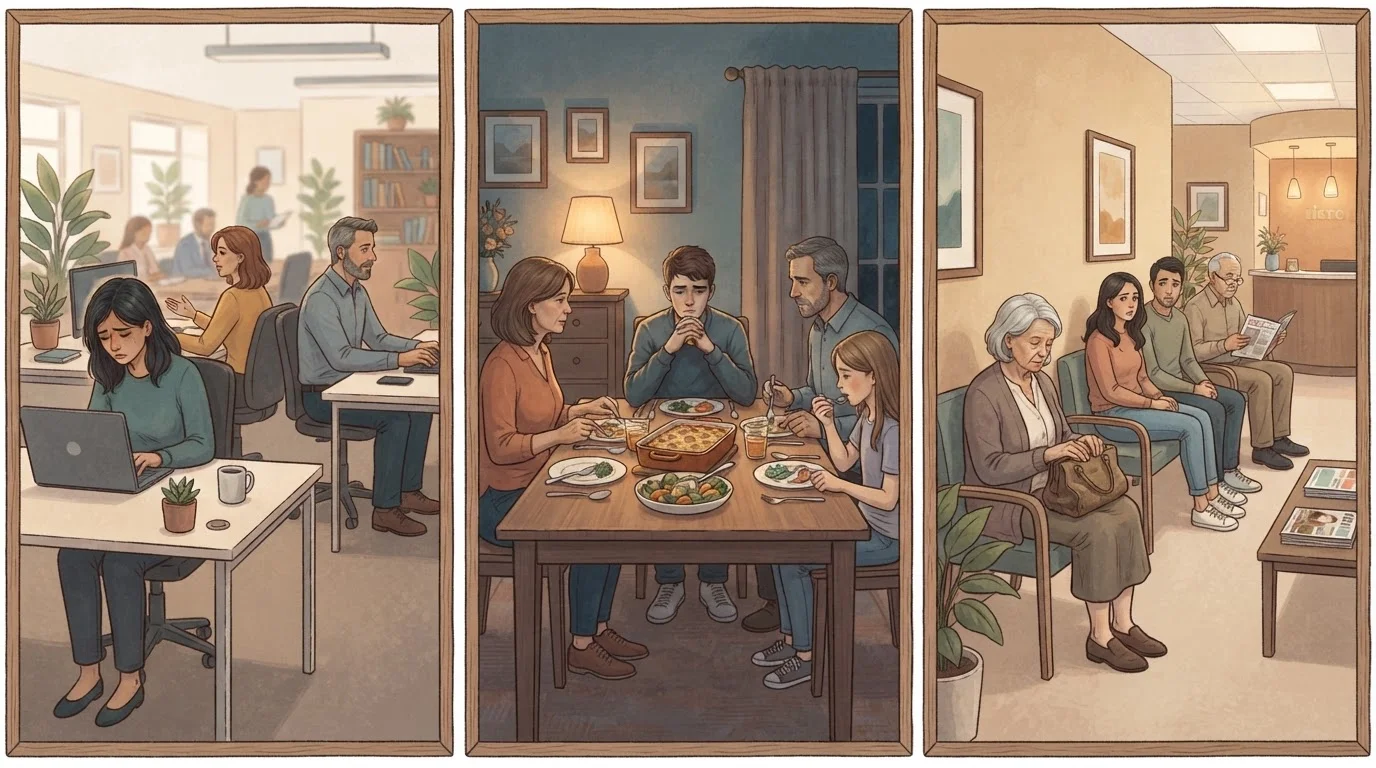
Why Setting Matters for Stigma
Mental health stigma is not a single, uniform experience. It shifts shape depending on the environment - and understanding where it shows up is just as important as understanding what it is. If you're new to this topic, our article on what mental health stigma is and why it persists provides a helpful foundation.
What makes setting-specific stigma particularly challenging is that the rules, power dynamics, and relationships in each environment are different. A coworker, a parent, and a physician all hold different kinds of influence - and that shapes how stigma is expressed, how much it stings, and what you can realistically do about it. The five patterns below cover the most common forms stigma takes in workplace, family, and healthcare settings.
Workplace stigma: fear of being seen as unreliable
In professional environments, one of the most persistent forms of stigma is the fear - often well-founded - that disclosing a mental health condition will lead others to question your competence or dependability. Employees may worry about being passed over for promotions, assigned less responsibility, or treated differently by managers after disclosure.
This creates a painful bind: staying silent can mean forgoing accommodations that might genuinely help, while speaking up carries real social risk. Research on mental health discrimination documents how help-seeking at work remains low partly because of these perceived consequences.
Practically speaking, employees in the US have some legal protections under the Americans with Disabilities Act (ADA) for certain mental health conditions. Understanding those rights - and consulting HR or an employment attorney when needed - is a reasonable starting point, though individual circumstances vary widely.
Fear of being seen as unreliable keeps many workers silent about mental health struggles.
Workplace stigma: informal culture and hallway comments
Formal policies can be supportive while the informal culture of a workplace remains quietly stigmatizing. Offhand comments - jokes about someone being "crazy," dismissive remarks about mental health days, or eye-rolls when stress is mentioned - normalize the idea that psychological struggles are weaknesses rather than health concerns.
These moments rarely rise to the level of a formal complaint, but they accumulate. They signal to colleagues who are already struggling that this is not a safe place to be honest. Everyday language that reinforces stigma operates precisely this way - it doesn't require bad intent to cause harm.
If you're in a position to do so, gently naming the impact of such comments - without shaming the speaker - can begin to shift the culture over time.
Informal jokes and dismissive comments can stigmatize just as powerfully as formal discrimination.
Family stigma: minimizing and reframing as weakness
Family environments carry unique weight because the relationships are often long-standing and deeply personal. A common form of family stigma is minimizing: responses like "everyone feels that way," "you just need to push through it," or "it's not that serious" are usually well-intentioned but communicate that the person's experience isn't valid.
These patterns are often intergenerational - family members may have grown up in households where mental health was never discussed, or where seeking help was equated with weakness or failure. Family dynamics and mental health explores how these inherited patterns shape individual wellbeing over time.
For people on the receiving end, it helps to name the experience clearly and to set realistic expectations - some family members may shift their perspective with time and information, while others may not. That reality is painful, and it's okay to acknowledge it.
Well-intentioned minimizing by family members is one of the most common - and quietly harmful - forms of stigma.
Family stigma: silence as a form of shame
In some families, mental health is simply never discussed. Diagnoses are kept secret. Hospitalizations are explained away. Therapy is treated as something that «happens to other people.» This silence is itself a form of stigma - it teaches younger family members that these experiences are shameful and that suffering should be hidden.
The long-term effects of family silence can include delayed help-seeking, difficulty identifying one's own emotional states, and internalised stigma - the process by which a person turns society's negative messages against themselves. Our article on social versus self-stigma explains this distinction in more depth.
Breaking generational silence starts small - with one honest conversation, one willingness to name what's happening. It may feel uncomfortable, and that discomfort is normal.
Family silence around mental health teaches younger generations that their struggles should stay hidden.
Healthcare stigma: being dismissed or undertreated
Perhaps the most consequential form of setting-specific stigma occurs in healthcare. People with known mental health diagnoses sometimes report that physical symptoms are attributed to their psychological history rather than investigated on their own terms - a pattern sometimes called diagnostic overshadowing. Conversely, mental health concerns raised with a primary care physician may be minimized or not followed up.
There is also stigma within mental healthcare itself: people with certain diagnoses - such as borderline personality disorder or schizophrenia - may find that some providers carry biases that affect the quality of care they receive. This is not universal, but it is documented.
If you feel dismissed in a healthcare setting, you are entitled to ask questions, request referrals, and seek a second opinion. Advocating for yourself in medical settings can feel difficult, especially when you're already struggling - but it is a legitimate and important option. Bringing a trusted support person to appointments can also help when self-advocacy feels overwhelming.
In healthcare, stigma can lead to dismissed symptoms and undertreated conditions - with serious real-world consequences.
Taking Steps Forward
Stigma in any setting rarely disappears on its own. But awareness genuinely does create openings for change - in how we speak, what we tolerate, and how we treat people around us. For guidance on navigating these conversations without accidentally making things harder, see talking about mental health without making things worse.
A small shift that makes a difference
One of the most effective things anyone can do - in any setting - is to use person-first or neutral language when mental health comes up. Saying "someone living with depression" rather than "a depressed person" is a small linguistic choice that reflects a bigger shift in perspective. It signals that the condition doesn't define the whole person. For more on how language shapes stigma, see how everyday words reinforce stigma.
It's also worth knowing that stigma reduction doesn't require dramatic gestures. Research points to consistent, small-scale contact and education as the most durable approaches. You can explore evidence-supported stigma reduction approaches for a broader look at what public health research finds most effective.
This article is for general informational and educational purposes only. It is not a substitute for professional mental health, medical, or legal advice. If you are experiencing a mental health crisis or discrimination in your workplace or healthcare setting, please consult a qualified professional.
When supportive intentions still cause harm
It's worth remembering that stigma in family and workplace settings often comes from people who genuinely care. Recognizing this doesn't excuse harmful behavior, but it does open space for more productive conversations. Understanding how good intentions can still reinforce stigma can help you navigate these dynamics with more clarity and less frustration.